


Listen to the article
Vaccine Skepticism Threatens Decades of Immunization Progress Worldwide
Growing distrust in vaccines is casting a shadow over one of global public health’s greatest success stories: the decades-long convergence toward higher immunization coverage across both wealthy and developing nations.
For generations, sustained international coordination and financing – with the United States among the largest contributors through the World Health Organization, Gavi (the Vaccine Alliance), and the U.S. Agency for International Development – helped build robust vaccination systems worldwide.
The results have been remarkable. Today, coverage for critical vaccines such as DTP3 – the third dose of diphtheria, tetanus, and pertussis vaccine that serves as a key indicator of immunization system performance – exceeds 80 percent across most regions globally. Some nations have made extraordinary transformations, with Ghana, India, and Nepal each increasing coverage from less than 10 percent of children in 1980 to more than 90 percent today.
Yet this hard-won progress stands on increasingly fragile ground. In conflict zones and humanitarian crisis areas like the Palestinian territories, Sudan, and Venezuela, vaccination rates have declined steadily, reflecting the collapse of basic health infrastructure. The COVID-19 pandemic created additional disruptions to immunization programs worldwide, with recovery proving slower than anticipated.
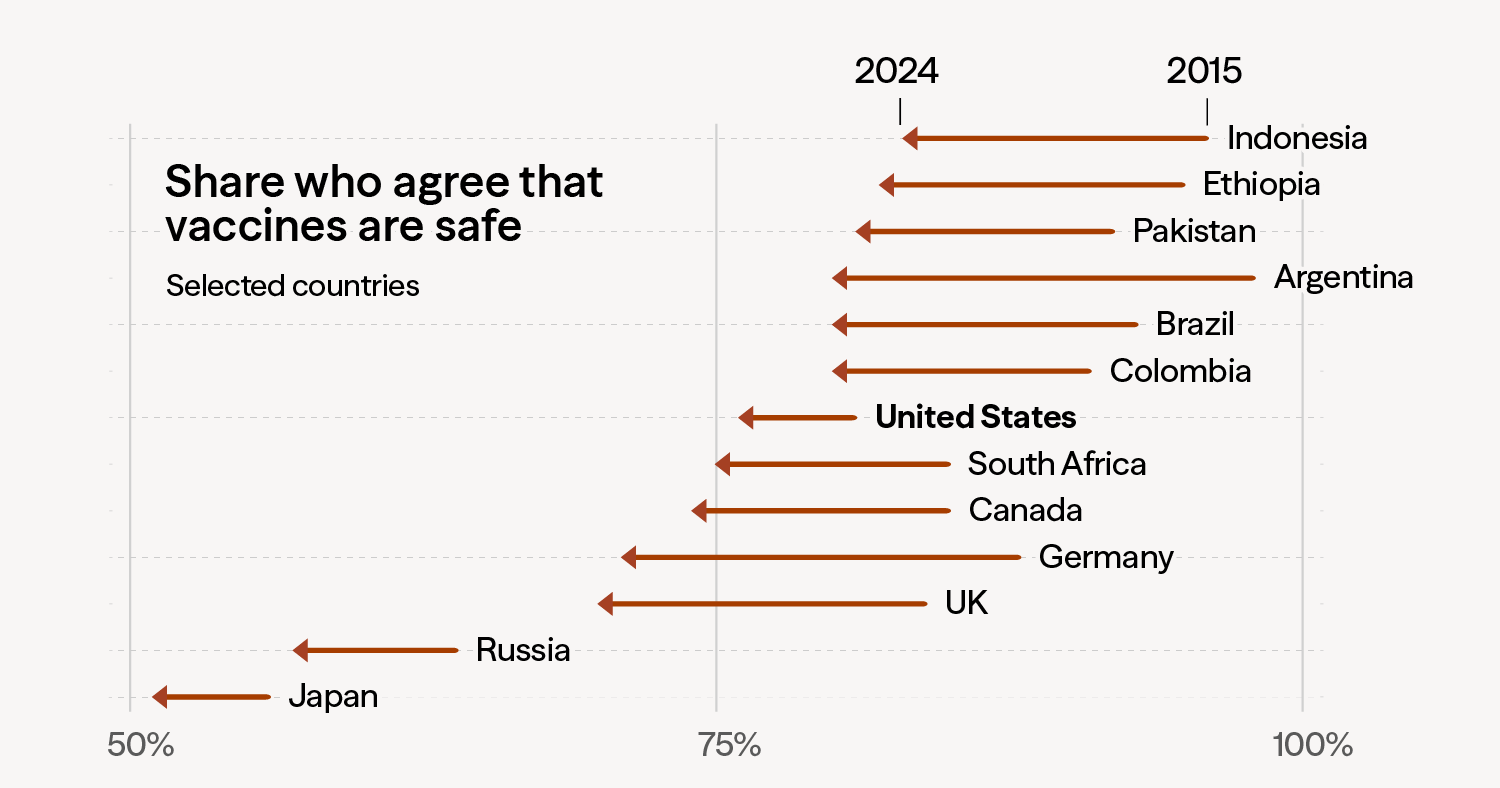
More concerning to public health officials are the coverage declines occurring in stable, developed nations without obvious structural shocks – declines increasingly linked to wavering public confidence in vaccines themselves.
“We’re seeing warning signs that decades of progress could unravel if we don’t address the growing skepticism about vaccines,” said Dr. Maria Gonzalez, a vaccine policy expert at the International Vaccine Institute. “This isn’t just about individual choices – it has population-level consequences.”
The relationship between vaccine confidence and actual coverage varies significantly between countries. High-income nations have historically maintained higher coverage rates, built on robust infrastructure and stable funding. However, this favorable context hasn’t shielded them from increasing public skepticism.
Some European nations, including Bulgaria, Hungary, and Latvia, maintain vaccination rates above 90 percent despite ranking among countries with the highest levels of vaccine skepticism globally – largely through strict mandate systems. Other European countries achieve high coverage without mandates through well-established public health infrastructures and social norms that support vaccination.
However, this resilience may be temporary. Several countries that maintained high coverage over the past decade are now experiencing meaningful drops as public confidence erodes. In Austria, a 15 percentage point decline in vaccine confidence between 2015 and 2023 coincided with coverage dropping from 93 percent to 85 percent. Romania saw a similar pattern, with coverage falling from 89 percent to 79 percent – well below the 90 percent threshold recommended for DTP3.
The consequences are becoming increasingly visible. In January 2026, the WHO announced that six European countries, including Austria, Spain, and the United Kingdom, had lost their measles-free status due to declining vaccination coverage. Canada lost its measles elimination status the previous year, while the United States is struggling to retain its status as cases surge nationwide.
“Measles serves as a canary in the coal mine for immunization systems because it’s so incredibly contagious,” explained Dr. Robert Chen, epidemiologist at the Centers for Disease Control and Prevention. “When we see measles returning, it tells us immediately that vaccination rates have fallen below protective thresholds.”
These measles outbreaks represent just the most visible manifestation of a broader trend. Multiple vaccine-preventable diseases are rising globally, threatening the potential reemergence of illnesses that had virtually disappeared in many regions.
Public health experts warn that the consequences of eroding vaccine confidence are no longer theoretical. The global health systems that eradicated smallpox and eliminated diseases like polio and diphtheria in many countries took generations to build. The social and political conditions that sustain them – grounded in trust and collective will – may prove more difficult to rebuild than the physical infrastructure itself.
“We face a critical juncture,” said WHO Director-General Tedros Adhanom Ghebreyesus at a recent immunization summit. “Either we recommit to the fundamental promise of vaccines as a shared public good, or we risk watching preventable suffering return to communities worldwide.”
Fact Checker
Verify the accuracy of this article using The Disinformation Commission analysis and real-time sources.

6 Comments
It’s discouraging to see hard-won gains in global vaccination coverage potentially unraveling. Addressing vaccine skepticism will require a multi-pronged approach – improving public education, strengthening healthcare systems, and building trust between communities and authorities. Hope to see concerted action on this critical public health issue.
Vaccine hesitancy is a complex issue with no easy solutions. While I respect people’s right to make their own medical choices, I worry the consequences of declining vaccination rates could be devastating, especially for vulnerable populations. Curious to hear more about the factors driving this trend.
The resurgence of vaccine skepticism is alarming, especially in light of the tremendous progress achieved through sustained global coordination and investment. Maintaining high coverage is essential to protect vulnerable populations. Curious to hear more about the root causes of this worrying trend.
Vaccines have saved countless lives and enabled tremendous progress in global health. While people should have freedom to make their own choices, the collective cost of declining vaccination rates could be very high. Curious to learn more about effective strategies to counter vaccine hesitancy.
Agree, the public health implications of falling vaccination rates are deeply concerning. Policymakers will need to tread carefully to address this issue without unduly infringing on individual liberties.
The erosion of vaccine confidence is concerning, especially in light of the tremendous progress made globally in boosting immunization rates. Maintaining high coverage is critical to prevent resurgence of deadly diseases. Hope policymakers can find ways to address this trend constructively.