


Listen to the article
Seattle’s New City Attorney Faces Scrutiny Over Crime Policies After First 100 Days
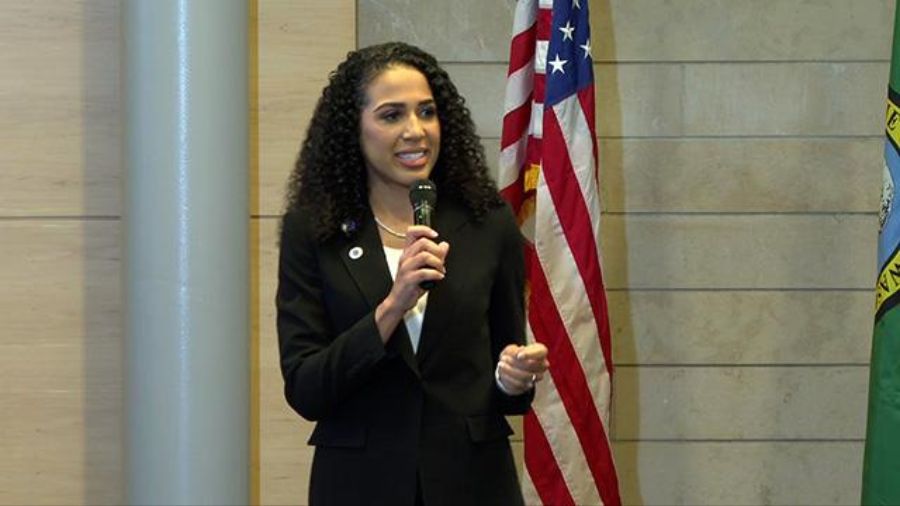
Three months after taking office with a decisive electoral victory, Seattle City Attorney Erika Evans appeared on KIRO Newsradio’s “The Gee and Ursula Show” to discuss her administration’s approach to crime in a city struggling with public safety concerns.
Evans, who defeated incumbent Ann Davison with approximately 67% of the vote, emphasized her background as the foundation for her policy direction. “I think the biggest thing I brought to this role was my experience,” Evans said. “I started my career as a prosecutor for the city, and I have worked for almost a decade now, specifically in public safety.”
During the interview, Evans highlighted her firsthand experience tackling high-level criminal operations. “Being someone that’s been actually boots on the ground going after high-level traffickers, cartels, and getting fentanyl off our streets and firearms, I knew we could be doing more here locally to make sure that our city is safer for all people,” she stated.
When pressed by host Ursula Reutin about specific changes implemented during her first 100 days, Evans returned to her professional background rather than detailing concrete policy shifts. “I think the big difference for me and anyone else that was running was someone that’s actually worked in public safety before,” Evans responded.
The interview took place against a troubling backdrop for the city. An FBI report from 2024 ranked Seattle among the five worst cities nationwide for crime across multiple categories—total crime, violent crime, and property crime—though these statistics predate Evans’ tenure.
Host Gee Scott challenged Evans on the perception that Seattle has been soft on crime. “There’s this narrative that in Seattle, they just let everybody get away with crime. You go to Seattle; you get to get off the hook. What is your response to that?” Scott asked.
Evans dismissed this characterization outright. “It’s incorrect,” she replied. “We are charging people in our office, and I think it’s just a false narrative.” Her brief response, which lacked supporting details, prompted a skeptical “…OK” from Scott.
The conversation shifted to the specific issue of public drug use, a visible problem highlighted by Reutin’s reference to reports that over 660,000 needles had recently been collected from city streets. Reutin asked about the messaging to police regarding enforcement of these offenses.
Evans rejected any suggestion that her office was permissive toward public drug use. “No, absolutely not. That’s not anything close to what I’ve said,” she responded. “The approach that we have is very clear that we are trying to break the cycle.” She emphasized a need to avoid “doubling down on failed policies” without elaborating on specific alternatives.
When asked about metrics for success, Evans offered a vision rather than measurable outcomes. “I think what I want to see and what I want for all of us to feel is safe as we walk in areas of downtown,” she said, citing the waterfront as an example of a safe public space.
The interview prompted immediate skepticism from KIRO listeners, with several texting the show to express frustration over what they perceived as vague responses. “That’s it?!? ‘It’s a false narrative?!?'” wrote one listener. Others commented that Evans seemed to be “talking in circles” and “managed to completely avoid answering any of your questions.”
Seattle’s approach to crime has been a contentious issue in recent years, with debates over prosecution policies, public drug use enforcement, and visible homelessness affecting public perception of safety, particularly in downtown areas. As Evans continues her term, residents appear to be waiting for clearer articulation of how her administration’s approach differs from her predecessor’s and what specific outcomes they can expect.
The City Attorney’s Office plays a critical role in Seattle’s criminal justice system, handling misdemeanor prosecutions and providing legal counsel to city departments. How Evans shapes prosecution priorities and works with police and other stakeholders will be closely watched as she moves beyond her first 100 days in office.
Fact Checker
Verify the accuracy of this article using The Disinformation Commission analysis and real-time sources.

7 Comments
It’s promising to hear the new Seattle City Attorney emphasize her experience in public safety and going after high-level criminal operations. Addressing public safety concerns is crucial for the city’s wellbeing.
Agree, a balanced and pragmatic approach to public safety policies is needed. Curious to see what specific measures the new administration will implement.
As a Seattle resident, I’m hopeful the new City Attorney can bring a pragmatic, balanced approach to public safety challenges. Addressing root causes as well as enforcement will be key to making progress.
The city’s crime issues are complex, but it’s encouraging to hear the new City Attorney emphasize her experience tackling high-level criminal operations. Tackling the fentanyl crisis and firearms trafficking should be a top priority.
Rejecting the ‘false narrative’ of lenient crime policies is a bold stance. I’m curious to learn more about the specific data-driven policies the new administration plans to implement to improve public safety in Seattle.
While it’s good the new City Attorney has a background in prosecution, I hope she can also bring a nuanced, community-oriented perspective to address the root causes of crime. Overreliance on tough-on-crime rhetoric often falls short.
Insightful point. A multi-faceted strategy balancing enforcement and social services is likely needed to make meaningful progress on public safety.