


Listen to the article
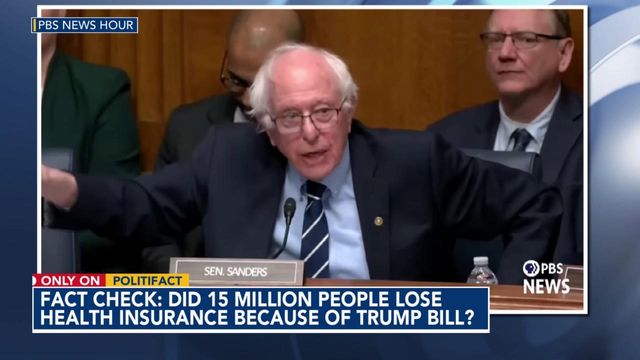
In a tense exchange during a recent Senate committee hearing, Sen. Bernie Sanders sharply criticized what he referred to as the “Big Beautiful Bill,” claiming it has resulted in 15 million Americans losing their healthcare coverage.
The Vermont Independent made the accusation during questioning of Health and Human Services Secretary Robert F. Kennedy Jr., who appeared before the committee to address concerns about the nation’s healthcare system amid ongoing policy changes.
“As a result of the ‘Big Beautiful Bill,’ 15 million Americans have been thrown off the healthcare that they need,” Sanders stated, his voice rising with characteristic intensity as he addressed Kennedy.
The hearing comes at a critical juncture for American healthcare policy, as lawmakers continue to grapple with the aftermath of recent legislative changes that have restructured significant portions of the healthcare marketplace. Industry analysts have been closely monitoring enrollment figures and coverage trends since the bill’s implementation.
Healthcare policy experts note that the legislation in question has been controversial since its inception, with supporters arguing it creates more market competition and choice, while critics contend it has weakened protections for vulnerable populations and reduced overall coverage rates.
The 15 million figure cited by Sanders represents approximately 4.5% of the U.S. population and aligns with preliminary estimates from several healthcare advocacy groups that have been tracking insurance coverage data. However, the administration has disputed these numbers, suggesting that any coverage changes reflect transitions to different types of plans rather than complete loss of insurance.
Kennedy, who has been serving as HHS Secretary for several months, defended the administration’s healthcare policies during the hearing, though he acknowledged challenges in the transition period. He emphasized efforts to improve healthcare accessibility through alternative mechanisms, including expanded community health centers and telehealth services.
The exchange highlights the ongoing partisan divide over healthcare policy that has characterized American politics for more than a decade. Democrats like Sanders have consistently advocated for expanded government involvement in healthcare, while Republicans have generally favored market-based solutions with fewer regulations.
Healthcare industry representatives have expressed mixed reactions to the recent policy shifts. Insurance providers have reported adjustments to their business models, while hospital systems are adapting to changing reimbursement patterns. Patient advocacy groups continue to raise concerns about gaps in coverage and affordability.
The hearing also touched on related healthcare challenges, including prescription drug pricing, rural hospital closures, and the ongoing effects of healthcare workforce shortages that have persisted since the COVID-19 pandemic.
Public health experts watching the proceedings noted that beyond the political rhetoric, real questions remain about how to balance healthcare costs, quality, and accessibility in the American system – issues that transcend any single piece of legislation.
Sanders, who has long championed Medicare for All and other universal healthcare proposals, used the hearing to reinforce his position that healthcare should be considered a right rather than a privilege in American society.
As the committee hearing concluded, it was clear that the debate over the direction of American healthcare policy remains far from resolved, with fundamental differences in philosophy continuing to shape the political landscape. With midterm elections approaching, healthcare accessibility is likely to remain a central campaign issue in districts across the country.
The committee is expected to hold additional hearings on healthcare policy in the coming months, with particular focus on insurance market stability and patient protections.
Fact Checker
Verify the accuracy of this article using The Disinformation Commission analysis and real-time sources.

7 Comments
Fact-checking is essential for informed policy discussions. While it’s concerning if millions lost coverage, we need rigorous analysis to understand the full context and implications. I look forward to seeing a balanced assessment of the legislation’s impact.
Fact-checking is a valuable exercise, but it’s important to acknowledge the complexity of healthcare policy. I hope this analysis provides a nuanced perspective, recognizing the tradeoffs and unintended consequences that can arise from legislative changes. Objective data will be key.
This is a contentious topic, but it’s good to see an attempt at objective fact-checking. Healthcare reform affects so many lives, so it’s vital we get the facts right, rather than relying on partisan rhetoric. I hope this analysis provides clarity on the real-world effects.
Healthcare is a complex and politically charged issue, with valid arguments on different sides. I appreciate the effort to fact-check the claims being made. Objective data and expert analysis will be crucial in assessing the real-world effects of policy changes.
Interesting debate on the healthcare legislation’s impact. It’s important to get the facts straight on coverage changes, rather than making unsubstantiated claims. I’m curious to see the latest data and analysis from independent sources.
The healthcare debate is often polarized, so I appreciate the effort to provide a more impartial assessment of the legislation’s impact. Fact-based policymaking is essential, even if the conclusions are uncomfortable for some. I look forward to seeing the full analysis and supporting data.
Robust fact-checking is always welcome, especially on high-stakes issues like healthcare. Separating political rhetoric from empirical data is crucial for making sound policy decisions. I’m curious to see how this analysis holds up under scrutiny from various stakeholders.