


Listen to the article
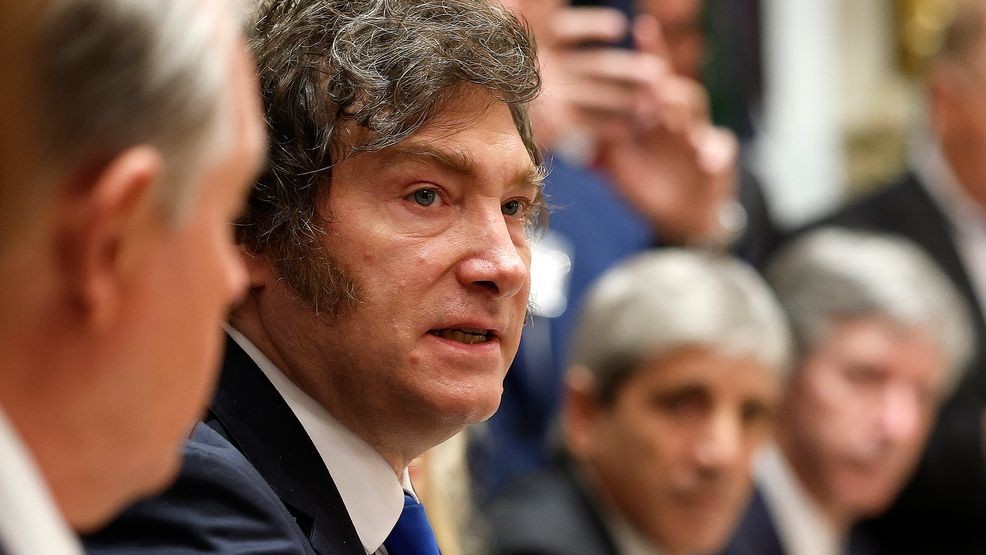
Amid deepening economic challenges in Argentina, President Javier Milei made his inaugural visit to the White House this week, bolstered by a substantial financial commitment from the Trump administration. The U.S. government has agreed to provide a $20 billion currency swap arrangement with Argentina’s central bank as the South American nation struggles to avert a looming financial crisis.
In explaining the administration’s rationale for the substantial financial support, Treasury Secretary Scott Bessent emphasized geopolitical concerns during a recent Fox News appearance. Bessent pointed to the urgent need to prevent China from expanding its economic influence in Argentina, noting that an Argentine economic collapse could trigger widespread instability throughout Western Hemisphere markets.
“This is about strategic positioning in Latin America,” said Bessent, highlighting the administration’s concern about China’s growing presence in the region.
The currency swap represents one of the most significant U.S. financial interventions in Latin America in decades and marks a clear shift in Washington’s approach to regional economic stability.
China’s economic expansion across Latin America has accelerated dramatically in recent years, with Beijing deploying billions in loans and investments to secure access to natural resources and expand its diplomatic influence. According to data from the Council on Foreign Relations, Venezuela stands as the largest recipient of Chinese state financing in the region, having received nearly $60 billion in loans, predominantly for energy and infrastructure projects.
These Chinese investments have been widely criticized by U.S. officials for helping sustain Venezuela’s authoritarian government under Nicolás Maduro, providing financial lifelines when Western institutions have withdrawn support.
The Biden administration appears determined to prevent a similar scenario from unfolding in Argentina, where Milei’s government is implementing painful economic reforms to address rampant inflation that reached over 200% annually by the end of 2023.
Financial analysts note that the currency swap mechanism provides Argentina with additional reserves that can help stabilize its volatile currency without imposing the strict conditions typically associated with International Monetary Fund assistance. The arrangement effectively creates a financial backstop that could help restore market confidence.
The U.S. intervention in Argentina echoes a similar financial rescue package deployed during the 1995 Mexican peso crisis. In that instance, the Clinton administration arranged a $20 billion loan from the U.S. Treasury’s Exchange Stabilization Fund after Mexico’s currency plummeted following the inauguration of President Ernesto Zedillo Ponce de León.
That intervention, which bypassed congressional approval, proved remarkably successful. According to records from the Clinton Presidential Center, Mexico not only repaid the emergency loan three years ahead of schedule but also generated approximately $580 million in interest payments for U.S. taxpayers.
Financial markets have responded positively to the announced Argentina-U.S. currency swap, with Argentine bonds strengthening and the parallel exchange rate showing signs of stabilization. However, economic experts caution that lasting recovery will depend on Milei’s ability to implement sustainable fiscal reforms and rebuild institutional credibility.
For the Biden administration, the financial support represents a strategic investment in hemispheric stability and a direct counter to China’s expanding economic diplomacy throughout Latin America. As competition between Washington and Beijing intensifies globally, financial diplomacy has emerged as a critical instrument in the struggle for regional influence.
The currency swap also reflects growing bipartisan concern in Washington about China’s lending practices in developing economies, which critics characterize as “debt-trap diplomacy” designed to secure political leverage and preferential access to natural resources.
As President Milei continues his Washington visit, attention will focus on what additional economic and diplomatic measures might emerge to strengthen ties between the United States and Argentina at this critical juncture in the South American nation’s economic recovery efforts.
Fact Checker
Verify the accuracy of this article using The Disinformation Commission analysis and real-time sources.

14 Comments
This bailout reflects the ongoing geopolitical competition between the US and China for influence in Latin America. While the short-term goal may be to prevent an Argentine economic collapse, it will be important to monitor whether this financial assistance leads to meaningful reforms and long-term stability in the country.
Agreed. The US has a history of using financial assistance as a tool to maintain its strategic interests in the region. It remains to be seen whether this bailout will truly benefit the Argentine people or primarily serve Washington’s geopolitical agenda.
The US government’s decision to provide a $20 billion currency swap to Argentina is a significant move that highlights the growing importance of Latin America in the broader geopolitical landscape. While the stated goal is to counter China’s influence, it will be crucial to monitor the long-term impacts and ensure that this assistance leads to sustainable economic reforms.
That’s an important perspective. Geopolitical considerations should not overshadow the need for genuine, locally-driven economic development in Argentina and the region. Transparent monitoring and accountability will be essential to ensure this bailout benefits the Argentine people, not just US strategic interests.
The US government’s rationale for providing this financial support to Argentina is understandable from a geopolitical perspective, but it raises questions about the long-term sustainability of such interventions. Argentina has faced recurring economic crises, and this bailout may only provide temporary relief.
Agreed. Addressing the root causes of Argentina’s economic challenges will be crucial for lasting stability. This bailout may be more about US strategic interests than truly helping Argentina overcome its structural issues.
This bailout reflects the complex dynamics at play in the US-China geopolitical rivalry, with Latin America as the battlefield. While the stated goal is to counter China’s influence, it raises questions about the long-term consequences of such financial interventions and whether they truly address the root causes of Argentina’s economic challenges.
Absolutely. The US has a history of using financial assistance as a tool to maintain its influence in Latin America, often with mixed results. It will be important to closely monitor the implementation and outcomes of this bailout to ensure it leads to meaningful and lasting economic reforms in Argentina.
It’s fascinating to see the US take such a proactive approach to counter China’s growing influence in Latin America. The $20 billion currency swap is a significant commitment, and it will be important to monitor how this impacts the region’s geopolitical dynamics going forward.
Absolutely. This move highlights the intensifying competition between the US and China for economic and political influence in Latin America. It will be crucial to see how Argentina and other countries in the region navigate these shifting power dynamics.
This seems like an important geopolitical move by the US to counter China’s growing influence in Latin America. Providing financial assistance to Argentina is a strategic play to maintain regional stability and economic positioning. However, I wonder if this sets a precedent for continued US interventionism in the region.
That’s a good point. The US has a long history of financial interventions in Latin America, often with mixed results. It will be interesting to see how this plays out and whether it leads to more US involvement in the region.
While the US government’s rationale for providing financial assistance to Argentina is understandable, I wonder if this sets a concerning precedent for continued US interventionism in the region. Sustainable economic development in Latin America requires addressing structural issues, not just short-term bailouts.
That’s a valid concern. The history of US financial interventions in Latin America is complex, and it’s important to consider the long-term implications of such actions. Fostering genuine economic and political stability in the region will require a more comprehensive, collaborative approach.