


Listen to the article
Myanmar Military Forms Task Force to Counter Opposition Narratives
The Myanmar military junta has established a new high-level task force dedicated to intensifying information operations against revolutionary forces and countering unfavorable coverage from international media outlets, according to a report published by Myanmar Gazette on February 27.
The 12-member group, officially named the “Information Sheet Publication and Counter-Information Dissemination Group,” was formed in late January and has already begun its mission to conduct psychological warfare against armed insurgent groups while systematically refuting reports from independent media organizations.
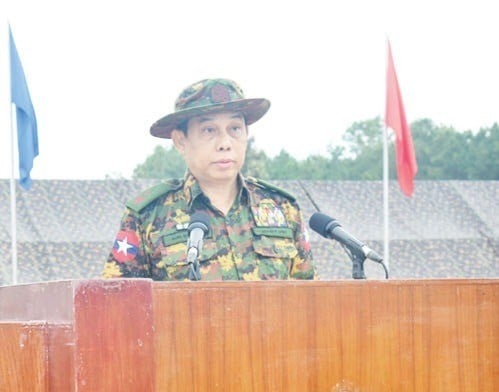
Major General Aung Myo Thant, the junta’s Deputy Minister of Defense, heads the newly formed task force. Brigadier General Soe Nyunt, Deputy Chief of the Training Depot, serves as secretary, while Police Major General Win Bo, Deputy Chief of the Myanmar Police Force, has been appointed joint secretary.
Other prominent members include Major General Aung Khin Thein, Vice Judge Advocate General; Brigadier General San Nyo Win from the Public Relations and Psychological Warfare Directorate; U Aye Kwal, Director-General at the Ministry of Information; and Dr. Thida Tin, who leads the Media Development Department.
According to official statements, the group’s primary mandate is to “conduct information operations against insurgent organizations that are fighting against the state government through armed means.” The initiative represents a significant escalation in the junta’s propaganda efforts amid ongoing resistance to its rule since the February 2021 military coup that overthrew the democratically elected government led by Aung San Suu Kyi.
The task force will focus on multiple fronts of information warfare. One key objective is publishing morale-boosting content specifically targeting military officers, their families, and civil servants working under the military regime – groups whose continued loyalty is crucial for the junta’s survival.
In an apparent attempt to gain international legitimacy, the group will also oversee the translation of key policy-related reports from state-run newspapers into multiple languages, including English, Russian, and Chinese. These translated materials will be distributed to embassies and military attaché offices both within Myanmar and abroad, suggesting the regime is increasingly concerned about its international image.
The task force represents a sophisticated expansion of the junta’s information control apparatus, which has grown increasingly complex since the military seized power. Social media platforms will be leveraged to disseminate pro-regime messaging to both domestic and international audiences, while rapid response teams will work to counter and refute reporting from opposition media outlets.
Media analysts note this development comes amid continued territorial losses for the military regime and growing international isolation. The establishment of such a specialized propaganda unit indicates the junta’s recognition that the information battlefield is as critical as physical confrontations with resistance forces.
This is not the junta’s first formalized attempt at information control. Since mid-2025, it has operated a body known as the Community Development Committee, which focuses on rallying public support for the military while denouncing revolutionary forces through coordinated propaganda campaigns.
The formation of this new task force coincides with intensifying conflict across much of Myanmar, where ethnic armed organizations and People’s Defense Forces have gained significant ground against military forces in recent months. Independent media outlets have documented numerous military defeats and alleged war crimes, reporting that has clearly frustrated the regime’s leadership.
Human rights organizations have expressed concern that the new information unit could signal increased persecution of journalists and media organizations that refuse to comply with the junta’s narratives. Since the coup, dozens of journalists have been detained, media licenses revoked, and independent news outlets forced to operate from exile.
Fact Checker
Verify the accuracy of this article using The Disinformation Commission analysis and real-time sources.

9 Comments
The formation of this psychological warfare task force is a worrying development. It demonstrates the Myanmar military’s fear of losing control over the narrative and its willingness to resort to heavy-handed tactics to maintain power. This is a troubling erosion of democracy and free speech.
This task force seems like another attempt by the Myanmar military to crack down on free speech and independent media. Using propaganda and misinformation to discredit opposition groups is a common authoritarian tactic. I hope the international community continues to call out these undemocratic actions.
You’re right, the military’s efforts to control the narrative are very worrying. Independent journalism is crucial for exposing the truth, even in the face of government propaganda.
The formation of this new task force is a concerning development. The Myanmar military is clearly feeling threatened by the growing opposition and is resorting to heavy-handed tactics to maintain power. This will only serve to further erode public trust and legitimacy.
Concerning to see the Myanmar military creating this new disinformation task force. Suppressing opposition voices and controlling the flow of information is a classic authoritarian playbook. I hope the international community continues to hold the junta accountable for these undemocratic actions.
This new task force sounds like an attempt by the Myanmar military to further tighten its grip on power. Cracking down on independent media and countering ‘unfavorable coverage’ is a classic authoritarian move. The people of Myanmar deserve the truth, not state-sponsored propaganda.
It’s sad to see the Myanmar military doubling down on repressive tactics like this psychological warfare campaign. Silencing dissent and controlling the flow of information is a hallmark of authoritarian regimes. I hope the international community continues to shine a light on these abuses.
I agree, the military’s actions are extremely troubling. Propaganda and misinformation are tools of oppression, not good governance. The people of Myanmar deserve better.
Concerning to see the Myanmar military doubling down on disinformation and psychological warfare. Silencing opposition voices and controlling the narrative is a dangerous tactic that often backfires. Curious to see if this new task force will be effective or just alienate the public further.