


Listen to the article
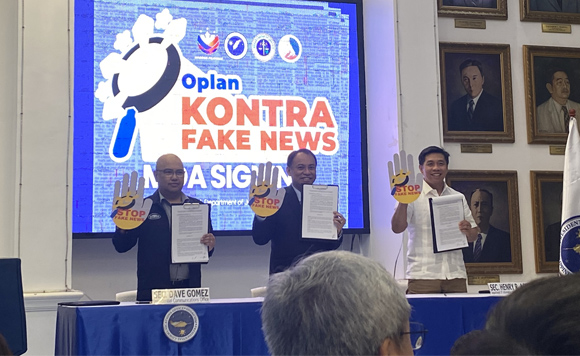
In a significant move to combat online falsehoods, three key Philippine government agencies joined forces Monday in what officials describe as a landmark initiative against digital misinformation. The Department of Justice (DOJ), Presidential Communications Office (PCO), and Department of Information and Communications Technology (DICT) formalized their collaboration through a memorandum of agreement titled “Oplan Fake News” at the DOJ headquarters in Manila.
Justice Secretary Fredderick Vida emphasized that the agreement represents a coordinated government response to address the growing threat of deliberately manufactured online falsehoods, including misinformation, disinformation, and technologically sophisticated deepfakes that have proliferated across digital platforms in recent years.
“This collaborative effort is not just about reactive enforcement; it is about proactive defense,” Vida said during the signing ceremony. “By coordinating our resources, we are building a deterrent against those who use technology to undermine our democratic processes and public safety.”
The initiative comes amid increasing concerns about digital misinformation in the Philippines, which has one of the highest rates of internet and social media usage in Southeast Asia. With approximately 76 million active social media users—roughly 68% of the population—the country has become particularly vulnerable to the rapid spread of false information online.
According to Vida, the agreement incorporates oversight and redress mechanisms designed to maintain accountability while preserving the internet as a space for free expression. “This framework upholds accountability, reinforces trust in government institutions, and sets a standard for responsible conduct in the digital space, which remains a place for the free exchange of ideas,” he explained.
The collaboration arrives at a critical moment for the Philippines, as the country prepares for mid-term elections in 2025. Political misinformation campaigns have previously plagued Philippine electoral processes, with coordinated disinformation efforts influencing public opinion and political discourse.
As part of the initiative, the DOJ committed to consistent law enforcement paired with educational campaigns. “We will promote media literacy, foster citizen resilience, and build critical thinking nationwide through coordinated awareness campaigns,” Vida pledged. This educational component addresses concerns from civil liberties groups who have cautioned that anti-fake news measures must not infringe on freedom of expression.
The secretary painted a stark picture of the threats posed by digital falsehoods, describing them as “potent weapons against our national stability.” He noted that these fabrications range from simple misinformation to highly sophisticated deepfakes—artificially generated videos or images that realistically depict individuals saying or doing things they never actually did.
“These erode public trust, spark division, and fuel disaster and chaos,” Vida warned, adding that “the Philippines cannot afford to ignore these threats.”
The multi-agency approach reflects growing recognition that combating digital misinformation requires coordination across government departments with different expertise. The PCO brings communications strategy, the DICT contributes technical knowledge, and the DOJ provides legal enforcement mechanisms.
Media experts have observed that the Philippines faces unique challenges in tackling online falsehoods due to its high social media penetration rate combined with varying levels of digital literacy across the population. International organizations monitoring digital rights have emphasized that effective solutions must balance content moderation with protecting free speech principles.
While officials did not specify exactly how the agreement will be implemented or what penalties might be imposed for spreading false information, they indicated that details of operational protocols would be developed in the coming weeks.
Fact Checker
Verify the accuracy of this article using The Disinformation Commission analysis and real-time sources.

8 Comments
Building a deterrent against those who misuse technology to undermine public trust is a laudable goal. I’m curious to learn more about the specific measures and strategies this initiative will employ.
Yes, the details on how they plan to coordinate and leverage their combined resources will be interesting to follow.
Addressing digital misinformation is a complex challenge, but this joint effort among the DOJ, PCO, and DICT seems like a step in the right direction. Coordinating resources across agencies is crucial.
Agreed. Tackling online disinformation requires a comprehensive, collaborative approach from different government entities.
While the goals of this initiative are admirable, I hope the implementation ensures a balanced approach that respects free speech and democratic principles. Careful oversight will be key to its success.
Online falsehoods can have serious consequences, so I’m glad to see the Philippine government taking a proactive, multi-agency approach to combat disinformation. Curious to see the initiative’s progress and impact.
This joint government initiative against online disinformation is an important step in protecting democratic processes and public safety. Coordinating resources across agencies is crucial to tackle this growing threat effectively.
Agreed. Proactive defense against digital misinformation and deepfakes is key, rather than just reactive enforcement.