


Listen to the article
Sahel Nations Launch Regional Broadcaster to Challenge Media Narrative
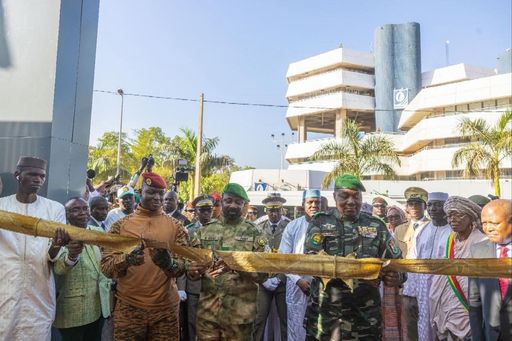
The leaders of Mali, Burkina Faso, and Niger officially launched a new regional television network Tuesday, marking a significant step in their efforts to establish media sovereignty following their withdrawal from the Economic Community of West African States (ECOWAS).
The Alliance of Sahel States (AES) Television, headquartered in Bamako, Mali, was inaugurated during a two-day summit attended by Malian President Gen. Assimi Goita, Burkinabe President Capt. Ibrahim Traore, and Nigerien President Gen. Abdourahamane Tiani. The broadcaſter represents one of the most visible joint initiatives since the three nations formalized their confederation.
According to official communications, the network aims to counter what the alliance considers disinformation about the region and promote narratives that align with their shared interests and perspectives. Media analysts note this move reflects growing frustration among these Sahel nations with international coverage of regional issues, particularly regarding security challenges and political transitions.
The summit, which continues through Wednesday, serves as an opportunity for the three leaders to evaluate the alliance’s progress since its formation and address significant challenges facing the region. A statement from the Burkinabe presidency indicated the leaders would review implementation reports and adopt decisions to consolidate achievements made during their first year of cooperation.
The launch comes at a critical juncture for the three nations, which formally withdrew from ECOWAS in January 2025 after initiating the process a year earlier. Their departure from the regional bloc followed tensions over sanctions and criticism related to the military takeovers in all three countries – Mali in 2020, Burkina Faso in 2022, and Niger in 2023.
Regional experts see the creation of AES Television as part of a broader strategy to establish alternative institutions following the ECOWAS split. Dr. Amadu Diallo, a political analyst at the West African Center for Security Studies, explained: “These countries are attempting to build parallel structures that reflect their current political realities and shared vision of sovereignty. The media platform provides them with a direct channel to their populations without external filtering.”
The Sahel region continues to face significant security challenges from jihadist insurgencies and political instability. All three nations have pivoted away from traditional Western allies, particularly France, the former colonial power, and have increasingly engaged with Russia for security support.
Media freedom advocates have expressed concerns about the new broadcaster, questioning whether it will operate with editorial independence or function primarily as a state propaganda tool. Reporters Without Borders noted that press freedom has deteriorated in all three countries following their respective military takeovers.
“While regional media cooperation can be valuable, the context and stated purpose of countering ‘disinformation’ raises questions about whether this network will contribute to information plurality or further restrict independent journalism,” said Jean-Pierre Lacroix, the organization’s regional director.
Economic analysts are also watching the development of AES institutions closely. The three landlocked nations face significant economic challenges, compounded by international sanctions following their military takeovers and subsequent withdrawal from ECOWAS.
“The viability of AES depends on creating functional institutions that can replace what they’ve left behind in ECOWAS,” noted economist Fatou Sow of the African Development Bank. “A shared media platform is symbolically important but addressing trade barriers, currency issues, and regional mobility will be far more challenging.”
As the summit continues, observers anticipate further announcements regarding defense cooperation, economic integration, and potential partnerships with external powers, particularly as the three nations seek to consolidate their alliance in the face of regional isolation.
Fact Checker
Verify the accuracy of this article using The Disinformation Commission analysis and real-time sources.

10 Comments
The launch of this regional TV network is an intriguing geopolitical development in the Sahel. I’m curious to see if it can strike a balance between promoting local narratives and upholding journalistic standards.
That’s a fair point. It will be important to monitor whether the network provides diverse, fact-based coverage or becomes a mouthpiece for the governments involved.
While I understand the desire to counter perceived disinformation, a regional TV network controlled by three governments raises red flags. Transparency and editorial independence will be crucial for its credibility.
Agreed. The success of this initiative will depend on how open and accountable the new broadcaster is in its operations and reporting.
Establishing media sovereignty is understandable, but the challenge will be ensuring this new broadcaster doesn’t simply become a tool for propaganda. Maintaining credibility and editorial independence should be a top priority.
Well said. The success of this initiative will hinge on its ability to provide impartial, reliable information to the people of the Sahel region.
Interesting to see the Sahel states take steps to control their media narrative. While combating disinformation is important, I hope they uphold journalistic integrity and allow for diverse perspectives, not just pro-government views.
I share your concern. Media sovereignty is important, but it must be balanced with press freedom and objective reporting, not just state propaganda.
This is a bold move by the Sahel alliance to challenge the international media narrative on regional issues. However, I worry it could lead to further suppression of independent voices and critical reporting.
Valid point. A state-run broadcaster runs the risk of pushing an overly partisan agenda. Maintaining credible, impartial journalism should be a priority.