


Listen to the article
Global Conflict Casts Shadow Over Luxury Watch Industry as Geneva Fair Begins
The prestigious “Watches and Wonders” fair opens Tuesday in Geneva, as the luxury timepiece industry seeks a rebound amid challenging global conditions. The annual event arrives at a precarious moment, with recent military conflicts between the U.S., Israel and Iran casting uncertainty over a sector already weathering two consecutive years of market contraction.
Industry experts anticipate the Middle East tensions will significantly impact Swiss watch exports, which rely heavily on Gulf Arab markets. “The war in the Middle East will certainly have a huge impact for Swiss exports because it represents 10% of the total Swiss watch exports, so it’s quite substantial,” explained Oliver Müller, founder of Swiss consultancy LuxeConsult.
The conflict has effectively halted business in key regional markets. In the United Arab Emirates, where tourists account for approximately 60% of luxury watch purchases, sales have virtually disappeared amid the turmoil. This disruption comes at a particularly difficult time for an industry hoping to capitalize on wealthy clientele from oil-rich Gulf nations.
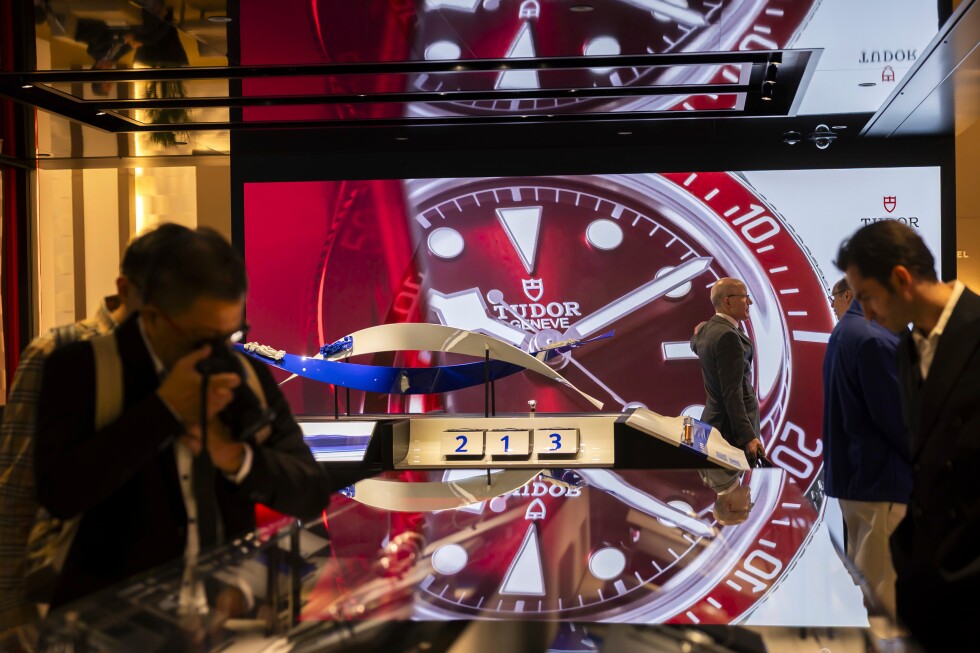
The Geneva fair, expected to draw around 60,000 visitors, showcases innovations from 65 exhibiting brands—representing just a fraction of the industry’s approximately 450 Swiss watchmakers. The event serves as both a showcase for horological innovation and a crucial business platform for manufacturers seeking to stimulate demand.
According to Morgan Stanley’s Annual Swiss Watcher report, released in February in collaboration with LuxeConsult, Swiss watch exports declined 1.7% in value terms last year. This marked the second consecutive year of market contraction, a concerning trend for the industry. The relatively strong Swiss franc against the U.S. dollar and euro contributed to these challenges.
“When you look back at a year ago, the sort of theme was: The tariffs and the uncertainty,” noted industry analyst Ming Liu. “Unfortunately, we aren’t anywhere closer to certainty, probably even less with what’s happening in the Middle East.”
Despite overall industry contraction, the ultra-luxury segment has shown resilience and growth. Hand-crafted watches priced above 50,000 Swiss francs (over $63,000) represented 37% of the total value of Swiss watch exports last year, up from 33.5% in 2024. This trend reflects the industry’s increasing polarization, with the highest-end products gaining market share while mid-range offerings struggle.
Market concentration continues to define the sector, with just four brands—Rolex, Cartier, Patek Philippe, and Omega—commanding over half of Switzerland’s total retail market share. This consolidation mirrors broader trends in the luxury goods sector, where established names with strong brand recognition increasingly dominate consumer spending.
Switzerland maintains its overwhelming dominance of the global luxury watch market, accounting for approximately 96% of timepieces retailing above 2,000 Swiss francs (more than $2,200). Japan’s Grand Seiko stands as the “most credible non-Swiss challenger,” while India’s Titan is making efforts to establish itself in the premium segment.
The Swiss watch industry faced additional challenges last year when then-U.S. President Donald Trump imposed punitive tariffs on Swiss goods, reaching a peak of 39%—the highest faced by any developed Western nation. This trade tension eased following diplomatic efforts that included a Swiss business delegation presenting Trump with a Rolex clock in November, leading to significantly reduced tariffs by December.
As the Geneva fair unfolds this week, the industry must navigate multiple headwinds: ongoing geopolitical tensions, inflation pressures, volatile precious metal prices, and uncertain consumer confidence. These factors create a complex environment for luxury watchmakers seeking to reverse their recent sales decline.
The situation underscores the vulnerability of luxury goods to global events, despite their traditional reputation as relatively resilient investments. With the Middle East conflict showing no immediate signs of resolution, Swiss watchmakers must adapt their strategies to weather this latest challenge to an industry that prides itself on precision, permanence, and stability.
Fact Checker
Verify the accuracy of this article using The Disinformation Commission analysis and real-time sources.

9 Comments
The luxury watch industry’s reliance on Gulf Arab markets makes it particularly vulnerable to the fallout from conflicts in the Middle East. Brands will need to get creative to offset these losses.
The luxury watch industry seems particularly vulnerable to global conflicts and economic uncertainty. Relying so heavily on wealthy Gulf consumers puts them in a precarious position.
I wonder if this will spur the industry to rethink its strategy and explore more resilient business models for the long term.
This is a sobering reminder of how geopolitical events can quickly disrupt global industries, even those as seemingly insulated as high-end timepieces. The luxury watch sector will need to closely monitor the situation.
Diversifying their customer base and supply chains could help these brands weather future shocks, but that may be easier said than done.
With tourism accounting for 60% of luxury watch sales in the UAE, the virtual disappearance of that demand due to the conflict is a major blow. The industry will have to work hard to recover.
The Geneva watch fair will be an important test for the sector to gauge the level of resilience and adaptability among luxury brands.
Interesting to see how the luxury watch industry is impacted by the geopolitical tensions in the Middle East. With Gulf markets accounting for 10% of Swiss watch exports, this could be a significant disruption for the sector.
It will be crucial for these brands to diversify their customer base and find new growth markets to offset the loss of sales in the region.