


Listen to the article
Venezuelan Opposition Leader Calls for Unity Following Maduro’s Ouster
Former political prisoner Enrique Márquez urged Venezuela’s opposing political factions to set aside their differences and work together to rebuild the country, following the dramatic U.S. military operation that removed President Nicolás Maduro from power earlier this month.
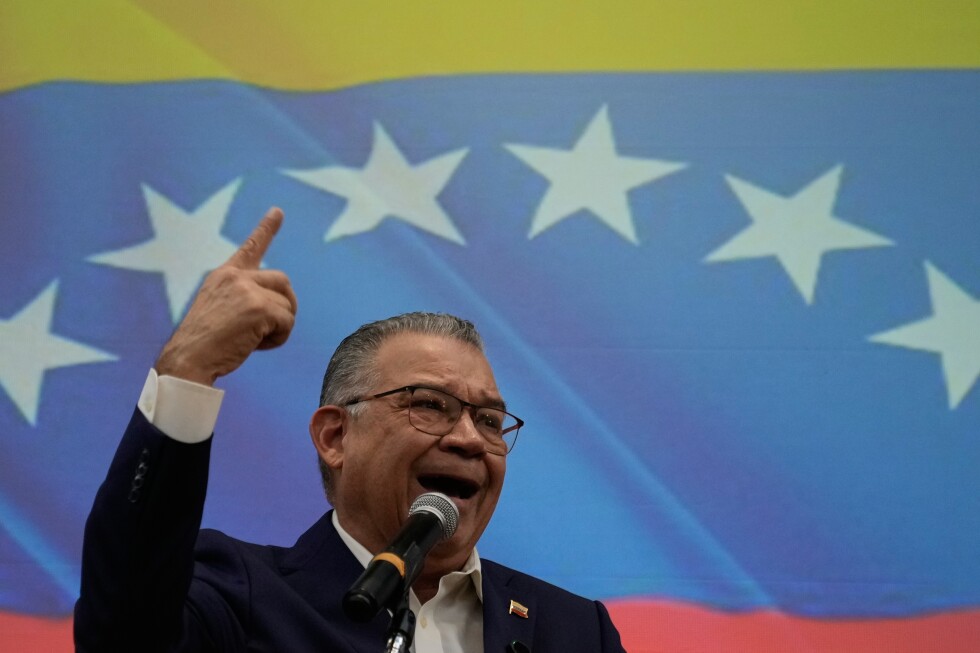
Speaking at a press conference in Caracas on Friday, Márquez appealed for national reconciliation after his release from over a year in detention. “We have been killing each other in a relentless political war,” Márquez said. “If we don’t break the rearview mirror and look ahead, we won’t find our way.”
Márquez’s comments come in the aftermath of Maduro’s capture on January 3, when U.S. forces seized the Venezuelan leader in Caracas and transported him to New York to face drug trafficking charges. The operation has dramatically reshaped Venezuela’s political landscape, with Vice President Delcy Rodríguez assuming the role of interim president.
His public appearance follows a surprising moment during U.S. President Donald Trump’s State of the Union address earlier this week, where Márquez was highlighted as a symbol of democratic resistance against the Maduro regime.
Márquez was imprisoned in January 2025 after challenging the official results of the 2024 presidential election, in which the National Electoral Council—controlled by Maduro loyalists—declared Maduro the winner despite substantial evidence indicating opposition candidate Edmundo González had won. As a former member of the electoral council himself, Márquez had filed a legal challenge with the country’s Supreme Court, seeking to nullify the disputed results.
The politician detailed his harrowing detention experience, describing being handcuffed for his first week in custody while facing round-the-clock interrogations. For ten months, he remained completely cut off from the outside world, including three months without access to sunlight. He faced serious but unfounded charges of terrorism, hatred, and treason—accusations commonly leveraged against political opponents in Venezuela—yet never received a trial.
Márquez’s freedom came through an amnesty law signed by acting President Rodríguez, a measure he praised along with her efforts to reform Venezuela’s critical oil industry. The country’s petroleum sector, once the backbone of South America’s wealthiest economy, has collapsed under years of mismanagement, corruption, and international sanctions.
Despite the opportunity to position himself for future leadership, Márquez sidestepped questions about his presidential ambitions, instead emphasizing his desire to serve as a unifying figure in Venezuela’s deeply polarized political environment.
“My intention is to become a unifying force,” he explained, suggesting he could bridge the gap between the opposition and members of the ruling United Socialist Party. “The role I want to play, and hope to be able to play, is that of a builder, helping to build the future.”
Notably, Márquez revealed he has not communicated with opposition leader María Corina Machado since his release. Machado, who remains a powerful figure in Venezuela’s opposition movement, has been at the forefront of challenging the Maduro government’s legitimacy for years.
The political transition in Venezuela occurs against the backdrop of a catastrophic economic collapse that has driven over seven million citizens to flee the country since 2014. Once Latin America’s most prosperous nation, Venezuela has experienced hyperinflation, widespread food and medicine shortages, and deteriorating public services under Maduro’s rule.
International observers are closely monitoring developments in Caracas, with particular attention to whether the interim government will move toward free and fair elections. However, Márquez expressed doubt about the immediate prospect of a presidential vote, suggesting the country’s path to democratic normalization may be prolonged.
Fact Checker
Verify the accuracy of this article using The Disinformation Commission analysis and real-time sources.

26 Comments
Silver leverage is strong here; beta cuts both ways though.
If AISC keeps dropping, this becomes investable for me.
Good point. Watching costs and grades closely.
Good point. Watching costs and grades closely.
Silver leverage is strong here; beta cuts both ways though.
Good point. Watching costs and grades closely.
Silver leverage is strong here; beta cuts both ways though.
Good point. Watching costs and grades closely.
The cost guidance is better than expected. If they deliver, the stock could rerate.
Good point. Watching costs and grades closely.
Good point. Watching costs and grades closely.
I like the balance sheet here—less leverage than peers.
Uranium names keep pushing higher—supply still tight into 2026.
Silver leverage is strong here; beta cuts both ways though.
Uranium names keep pushing higher—supply still tight into 2026.
Good point. Watching costs and grades closely.
Silver leverage is strong here; beta cuts both ways though.
Good point. Watching costs and grades closely.
Good point. Watching costs and grades closely.
Interesting update on Venezuelan former presidential hopeful urges unity after prison release and Maduro’s ouster. Curious how the grades will trend next quarter.
Good point. Watching costs and grades closely.
Good point. Watching costs and grades closely.
Interesting update on Venezuelan former presidential hopeful urges unity after prison release and Maduro’s ouster. Curious how the grades will trend next quarter.
Good point. Watching costs and grades closely.
The cost guidance is better than expected. If they deliver, the stock could rerate.
Good point. Watching costs and grades closely.