


Listen to the article
Millions of devoted pilgrims converged on Mexico City’s Basilica of Our Lady of Guadalupe in what stands as one of Latin America’s largest Catholic pilgrimages, honoring Mexico’s patron saint with an outpouring of faith and tradition that transformed the capital’s streets into rivers of candlelight and prayer.
The annual December 12 celebration commemorates the 1531 apparition of the Virgin Mary, known affectionately by Mexicans as “La Guadalupana,” and draws faithful from across the country who journey by foot, bicycle, and even on their knees to demonstrate their devotion.
“We came to ask for health,” explained Gladys López, who walked approximately 62 miles from San Felipe Teotlalcingo in Puebla state with her teenage daughter and seven other family members. “We wanted my daughter to see her and we all came from our town,” she added while preparing for the final steps of their pilgrimage.
The expansive plaza surrounding the enormous circular basilica filled with thousands of pilgrims even before the traditional midnight serenade of “Las Mañanitas,” Mexico’s beloved birthday song. As dawn broke, the crowds continued to grow, with devotees carrying images of the Virgin on their backs, lighting candles, and launching colorful fireworks into the sky.
Mexican President Claudia Sheinbaum reported a conversation with Pope Leo XIV, stating she had invited him to visit Mexico. She shared on social media platform X that the pontiff had “sent blessings and greetings to all.” Sheinbaum highlighted the cultural significance of Guadalupe beyond religious boundaries, writing: “We agree that beyond the religion that each person professes and the laity of the state, the Virgin of Guadalupe is a symbol of identity and peace for Mexicans.”
The Pope celebrated a special Mass at the Vatican honoring Mexico’s patron saint, acknowledging the global reach of Guadalupe devotion, which extends well beyond Mexican borders throughout Latin America and among diaspora communities worldwide.
For 82-year-old José Luis González Paredes, this pilgrimage represented the continuation of a three-decade tradition. Carrying a floral-adorned image of the Virgin, his wishes were humble: “I am only going to ask that the Virgin allows me to bring her again next year and gives me the health to endure the journey.”
The Guadalupe tradition centers on her reported appearance to Juan Diego, an Indigenous peasant who became a saint when Pope John Paul II canonized him in 2002. According to Catholic tradition, the Virgin’s image miraculously appeared on Diego’s cloak, or “tilma,” which remains displayed inside the basilica as one of Mexico’s most revered religious artifacts.
The annual pilgrimage holds profound cultural and spiritual significance in Mexico, where approximately 80 percent of the population identifies as Catholic. The Virgin of Guadalupe has transcended purely religious boundaries to become a powerful national symbol, representing Mexico’s complex cultural heritage blending Indigenous and European traditions.
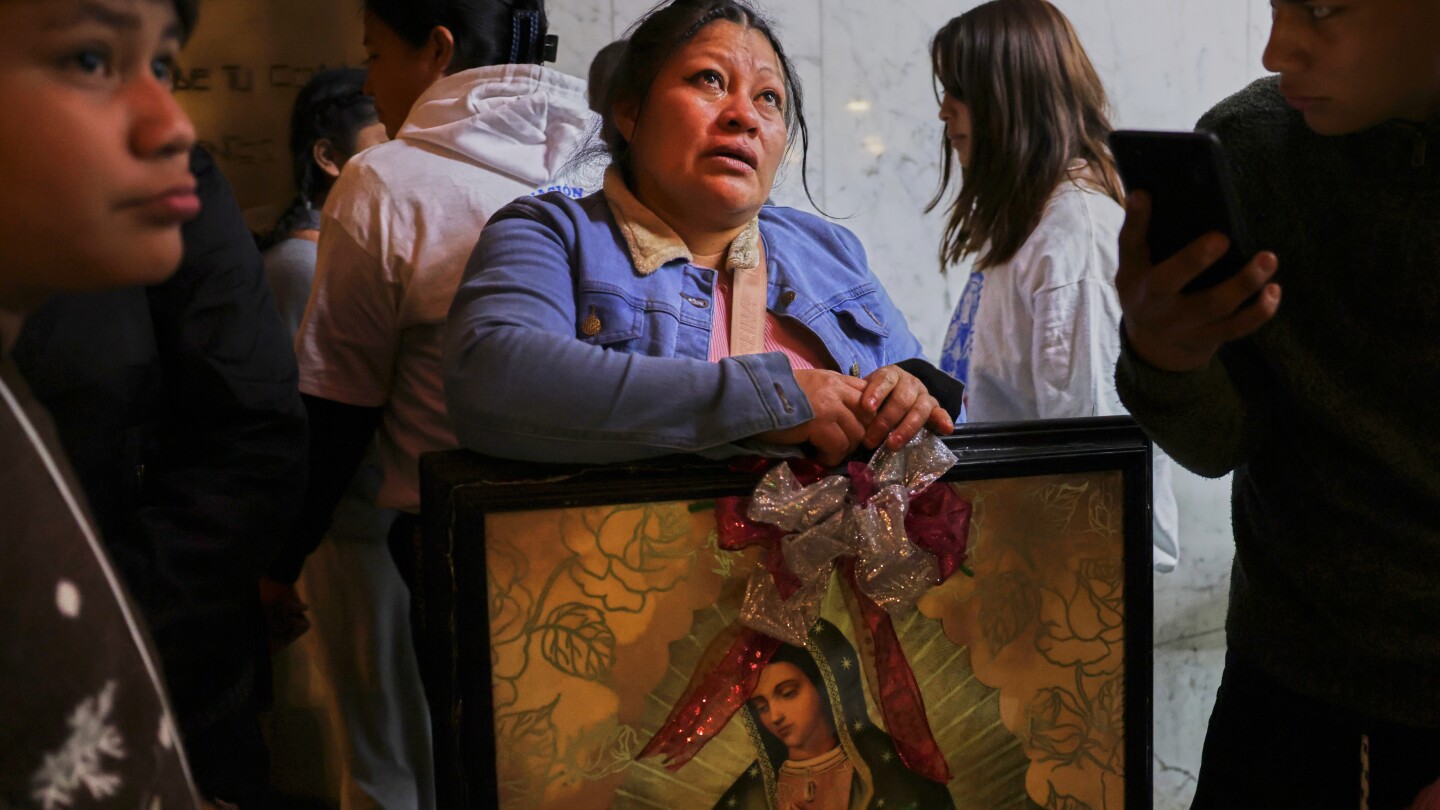
Throughout the celebration, the basilica’s surroundings transformed into both a spiritual center and community gathering place. Taco stands and food vendors provided nourishment to exhausted travelers, many of whom slept on the ground after completing journeys that lasted days. The square filled with emotional scenes as pilgrims lit candles with tears in their eyes, and others waited patiently for priests to bless their Virgin figurines.
The celebration represents the culmination of weeks of smaller pilgrimages from every corner of Mexico, as the saying goes that “all roads in Mexico lead to the Basilica” on December 12. The event’s magnitude highlights not only its religious importance but its role as a powerful expression of Mexican cultural identity that bridges regional, economic, and social divides in a country often defined by its contrasts.
This year’s celebrations continue a tradition that has remained unbroken for nearly five centuries, representing one of the world’s most enduring religious observances and a cornerstone of Mexico’s cultural heritage.
Fact Checker
Verify the accuracy of this article using The Disinformation Commission analysis and real-time sources.

8 Comments
I’m always intrigued by religious pilgrimages and the powerful spiritual connections they represent. The journey these devotees undertake, some even on their knees, is a testament to the strength of their beliefs.
Agreed, the dedication and sacrifice involved is quite humbling. It speaks to the deep cultural and personal significance of this tradition for Mexicans.
While this may not be directly related to mining, commodities, or energy, it’s a fascinating glimpse into an important cultural and religious event. The sheer number of people involved is staggering.
This is a fascinating display of faith and devotion. It’s remarkable how many people make the pilgrimage to honor the Virgin of Guadalupe. The scale of this event is truly impressive.
This pilgrimage highlights the diversity of religious and cultural practices around the world. It’s a powerful reminder of the deep spiritual convictions that motivate people to undertake such arduous journeys.
Absolutely. Events like this provide valuable insight into the rich tapestry of human experience and belief systems across the globe.
The Virgin of Guadalupe holds such a special place in Mexican Catholic faith and identity. It’s wonderful to see this celebration continuing with such fervor and devotion generation after generation.
While this news may not be directly relevant to the mining, commodities, and energy industries, it’s still an interesting cultural phenomenon worth noting. The scale and devotion on display are quite remarkable.