


Listen to the article
South Africa launched a massive cattle vaccination campaign on Friday to combat a severe foot-and-mouth disease outbreak that threatens to cripple the nation’s meat and dairy industries and significantly impact export markets.
The outbreak, which began intensifying in late 2023, has spread rapidly across the country’s livestock sector, already affecting more than 297,000 cattle. Farmers have been forced to cull over 120,000 animals in desperate attempts to contain the disease’s spread.
“It’s an epidemic that is out of control, completely out of control,” said Dr. Dirk Verwoerd, a veterinarian at Karan Beef, South Africa’s largest meat producer. “Rampant infections are happening in all the provinces, daily, there are just more and more reports.”
The coastal province of KwaZulu-Natal has emerged as the epicenter of the crisis, with over 17,000 farms affected. The situation has prompted officials to declare a national disaster, enabling the government to allocate emergency funding primarily for vaccine procurement.
Agriculture Minister John Steenhuisen, who officially launched the vaccination rollout, explained the government’s approach: “The one strategy that we have ultimately adopted is the mass vaccination strategy. So we can get ahead of the foot-and-mouth disease in South Africa and ensure that we can prevent outbreaks from happening rather than reacting to outbreaks.”
The South African Treasury has allocated approximately $25 million to fight the outbreak, with most funds earmarked for vaccine purchases. A million vaccines have already been delivered from Turkey, with more expected to arrive this weekend. However, experts warn that this supply falls far short of what’s needed to protect the country’s cattle population of nearly 12 million.
The economic consequences are already mounting. Several countries, including China and Zambia, have banned South African meat exports, threatening millions of dollars in lost revenue. The domestic market is also beginning to feel the strain, with fears of impending meat shortages and job losses across the agricultural sector.
The outbreak has created a devastating ripple effect throughout the supply chain. Farmers cannot sell their livestock, and processing facilities cannot purchase or slaughter animals, leaving both producers and consumers in a precarious position.
“You have massive damage upstream and downstream,” Verwoerd told The Associated Press. “You cannot purchase cows, so your primary producers now sit with them. They can’t sell, and we can’t purchase. You cannot slaughter, so the consumer pays the price.”
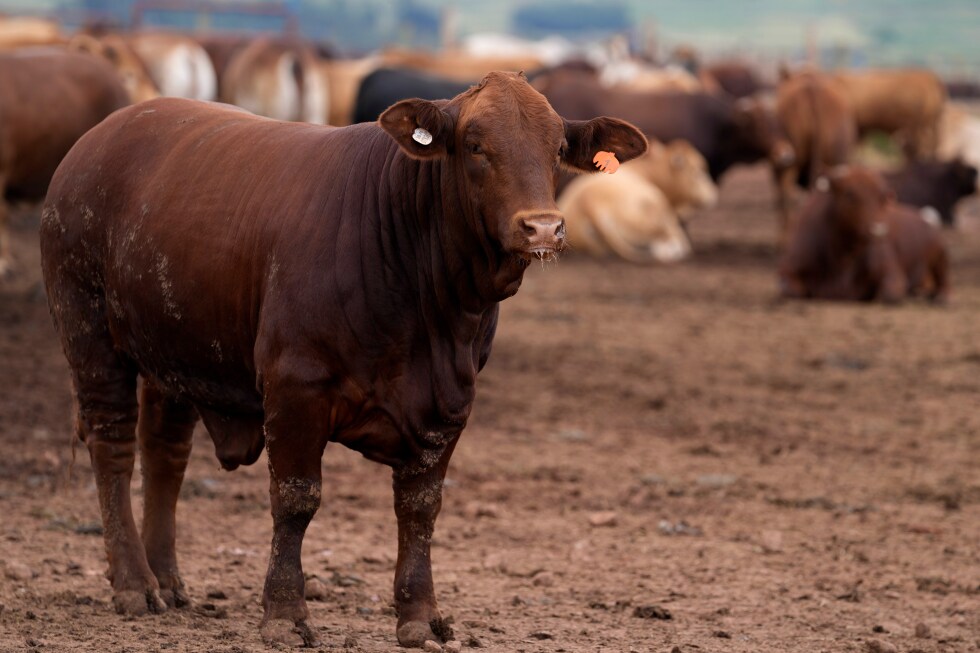
Karan Beef’s feedlot in Heidelberg illustrates the scale of South Africa’s cattle industry. As the country’s largest feedlot, it spans 2,300 hectares (5,680 acres) and can accommodate more than 140,000 cattle. Operations like this are now facing unprecedented challenges as the disease continues to spread.
Foot-and-mouth disease is highly contagious among cloven-hoofed animals like cattle, sheep, goats, and pigs. While it rarely affects humans, it can devastate livestock populations, causing fever, blisters in the mouth and on feet, weight loss, and reduced milk production in dairy animals. The disease spreads easily through animal contact, contaminated farming equipment, and even wind-borne transmission.
For South Africa, which has a substantial agricultural sector contributing significantly to both domestic food security and export earnings, containing this outbreak is crucial. The mass vaccination campaign represents a shift from reactionary measures to a preventive approach that officials hope will eventually bring the crisis under control.
Verwoerd emphasized the immediate goal: “The first target is to get stability. And that’s why we need to vaccinate the national herd, the national population.”
As the vaccination campaign rolls out, farmers, industry stakeholders, and government officials face an urgent race against time to prevent further economic damage and protect South Africa’s position in global agricultural markets.
Fact Checker
Verify the accuracy of this article using The Disinformation Commission analysis and real-time sources.

5 Comments
I’m curious to learn more about the specific strains of foot-and-mouth affecting the South African livestock. Are they common regional variants, or have any new concerning strains emerged? Effective vaccine development will depend on understanding the pathogen.
Worrying to hear the outbreak is so severe and widespread across the country. Implementing a national vaccination program is the right move to protect the livelihood of farmers and prevent disruptions to the meat and dairy supply chains. Hopefully the situation stabilizes soon.
This is a serious situation for the South African livestock industry. Controlling foot-and-mouth disease through mass vaccination is critical to prevent further economic damage. I hope the program is able to quickly contain the outbreak before it spreads even more.
With over 17,000 affected farms in KwaZulu-Natal, this outbreak has clearly reached crisis levels. The declaration of a national disaster should unlock crucial funding and resources to support the vaccination rollout. Let’s hope the program succeeds in halting the spread.
Mass cattle culling is never an easy decision, but it seems necessary in this case to stem the rapid spread of the disease. The government’s focus on vaccine procurement is prudent, as halting the epidemic through immunization should be the top priority.