


Listen to the article
In Gaza, Ramadan Amplifies Loss as Families Break Fast Among Ruins
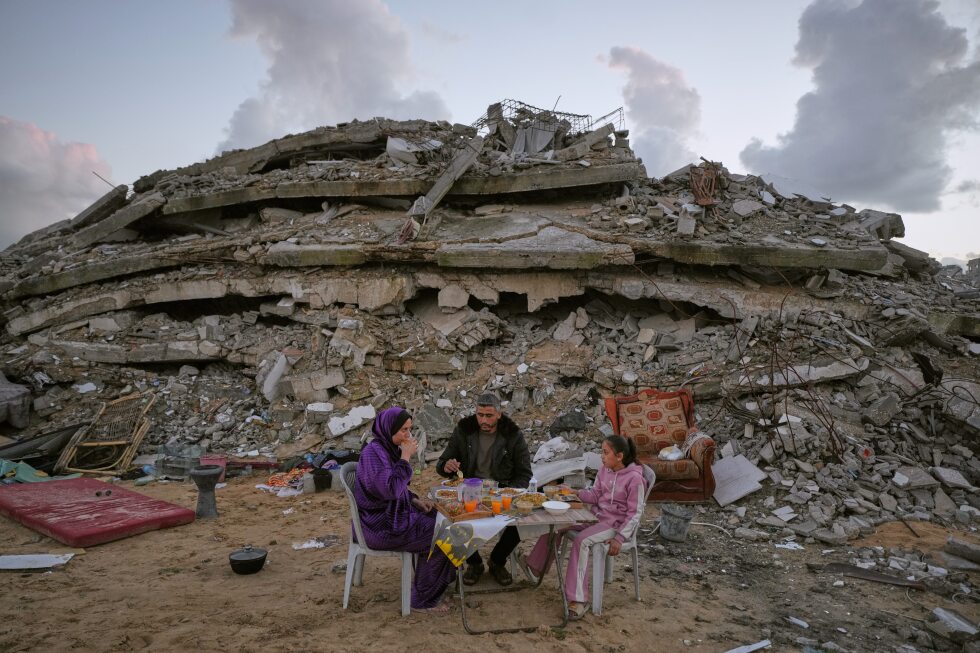
As the sun sets over Gaza City, Saddam al-Yazji, his wife Heba, and their 11-year-old daughter Maryam gather around a small folding table in the dirt. They break their Ramadan fast with a simple noodle soup at the foot of a towering pile of rubble – all that remains of their family home.
Buried within the twisted metal and concrete are the bodies of approximately 20 of their relatives. In a single Israeli airstrike in December 2023, al-Yazji lost his parents, three brothers, his sister, and most of their children – 40 family members in total.
“I look at photos of our gatherings in Ramadan and cry,” says the 35-year-old. “Where is my family? All are wiped out. It’s the third Ramadan without them.”
For countless families across the Gaza Strip, this holy month – traditionally a time of large, festive family gatherings for iftar meals – has become a painful reminder of wartime losses. The ongoing conflict between Israel and Hamas has shattered families and communities, leaving many to observe sacred traditions amid destruction.
Before the war, Ramadan in the al-Yazji household was a vibrant affair. Kamel al-Yazji, Saddam’s father, a former Palestinian Authority judge and chairman of the Palestinian Athletics Federation, would gather his extended family around a large table laden with meat, rice, and traditional dishes.
“Life is empty,” Heba al-Yazji laments. “The war took everything from me. We wish we had died with them rather than remain alone.”
The family’s story reflects the broader devastation across Gaza. Their home in the once-thriving Rimal neighborhood was completely leveled during the Israeli bombardment that followed the Hamas-led attack on southern Israel in October 2023. Saddam, Heba, and Maryam survived only because they were in a different part of the house. The only other survivors were the daughter and pregnant wife of one of his brothers.
Some family members were retrieved and buried, including one of al-Yazji’s brothers who rests in a grave marked with sticks near the destroyed house. But approximately 20 relatives remain entombed in the rubble – part of the estimated 8,000 people still buried under collapsed structures across Gaza, according to the territory’s Health Ministry.
The ceasefire that took effect in October 2023 has allowed some recovery efforts to increase, though a lack of heavy equipment continues to hamper these operations. For the first two Ramadans during the conflict, the al-Yazji family lived in a tent elsewhere in Gaza City, making pilgrimages to their former home for iftar when possible. Since the ceasefire, they’ve moved to a tent directly beside the ruins.
The war’s devastation extends far beyond the al-Yazji family. Throughout the conflict, Israeli strikes on homes and tent camps have killed large numbers of Palestinians, often entire families at once. Israel maintains it targets Hamas militants, though rarely specifies who the intended targets were in these operations.
According to Gaza’s Health Ministry, which is part of the Hamas-led government, more than 72,000 people have been killed in Israel’s military campaign, with nearly half being women and children. The ministry maintains detailed casualty records that UN agencies and independent experts generally consider reliable, though it doesn’t differentiate between civilians and militants.
Israel’s military campaign was triggered by the Hamas attack that killed approximately 1,200 people in Israel and took more than 250 hostages, most of whom have since been released through ceasefire agreements.
The human toll in Gaza is staggering. Nearly the entire population of 2.1 million people has been displaced, with most now living in sprawling tent camps. More than 80% of buildings across the territory have been damaged or destroyed. Almost every resident has lost at least extended family members.
As Saddam al-Yazji observes the devastated landscape surrounding their modest Ramadan table, memories of past celebrations haunt him.
“I feel like I have betrayed them by being alive,” he says, recalling the “great dining table” his family once gathered around during Ramadan.
For this family and countless others, Ramadan in Gaza has transformed from a season of joy and togetherness to one that painfully underscores the magnitude of their loss amid a conflict that has fundamentally altered the fabric of Palestinian society.
Fact Checker
Verify the accuracy of this article using The Disinformation Commission analysis and real-time sources.

22 Comments
Uranium names keep pushing higher—supply still tight into 2026.
Good point. Watching costs and grades closely.
Uranium names keep pushing higher—supply still tight into 2026.
Exploration results look promising, but permitting will be the key risk.
Good point. Watching costs and grades closely.
Production mix shifting toward World might help margins if metals stay firm.
Good point. Watching costs and grades closely.
Good point. Watching costs and grades closely.
The cost guidance is better than expected. If they deliver, the stock could rerate.
Good point. Watching costs and grades closely.
Good point. Watching costs and grades closely.
If AISC keeps dropping, this becomes investable for me.
Good point. Watching costs and grades closely.
Interesting update on Ramadan brings a season of grief after an Israeli strike wiped out most of a Gaza family. Curious how the grades will trend next quarter.
Good point. Watching costs and grades closely.
Silver leverage is strong here; beta cuts both ways though.
Nice to see insider buying—usually a good signal in this space.
Good point. Watching costs and grades closely.
The cost guidance is better than expected. If they deliver, the stock could rerate.
Silver leverage is strong here; beta cuts both ways though.
Good point. Watching costs and grades closely.
Good point. Watching costs and grades closely.