


Listen to the article
Pope Leo XIV Expresses Disappointment Over Illinois Assisted Suicide Law
Pope Leo XIV has publicly voiced his “very disappointed” reaction after Illinois Governor JB Pritzker signed legislation legalizing medically assisted suicide in the state, despite direct appeals from the pontiff to reject the measure.
Speaking to reporters outside Rome on Tuesday, Leo, who grew up in Chicago, revealed he had spoken “explicitly” with Pritzker while the bill was under consideration and urged him not to approve it. The Pope emphasized that the law undermines respect for human life from “the very beginning to the very end.”
“Unfortunately, for different reasons, he decided to sign that bill,” Leo told reporters, expressing his dismay at the outcome of their discussions.
The Medical Aid in Dying Act, also known as “Deb’s Law,” was signed by Pritzker on December 12. The legislation allows eligible terminally ill adult patients to obtain life-ending medication following consultation with their physicians. Named after Deb Robertson, a lifelong Illinois resident with a rare terminal illness who advocated for the bill, the law will take effect in September 2026, providing healthcare providers and the Illinois Department of Public Health time to implement necessary processes and safeguards.
The Pope mentioned that Chicago Cardinal Blase Cupich had also appealed to Pritzker not to sign the bill, but these efforts ultimately proved unsuccessful. The state’s six Catholic dioceses have joined in criticizing the governor’s decision, issuing a statement warning that it puts Illinois “on a dangerous and heartbreaking path.”
In his public comments, Pope Leo called for renewed reflection on human life, particularly during the Christmas season. “I would invite all people, especially in these Christmas days, to reflect upon the nature of human life, the goodness of human life,” he said. “God became human like us to show us what it means really to live human life, and I hope and pray that the respect for life will once again grow in all moments of human existence, from conception to natural death.”
The Pope’s reaction highlights the continuing tension between Catholic doctrine, which opposes euthanasia and assisted suicide, and the growing legislative movement to permit medical aid in dying across the United States.
With the signing of this legislation, Illinois joins eleven other states and the District of Columbia that allow medically assisted suicide, according to the advocacy group Death with Dignity. Seven additional states are currently considering similar legislation, reflecting a broader national shift on end-of-life issues.
Governor Pritzker defended his decision to sign the bill, stating that the legislation would allow patients with terminal illnesses to “avoid unnecessary pain and suffering at the end of their lives.” He added that the law would be “thoughtfully implemented” to guide physicians and patients through what he described as deeply personal decisions.
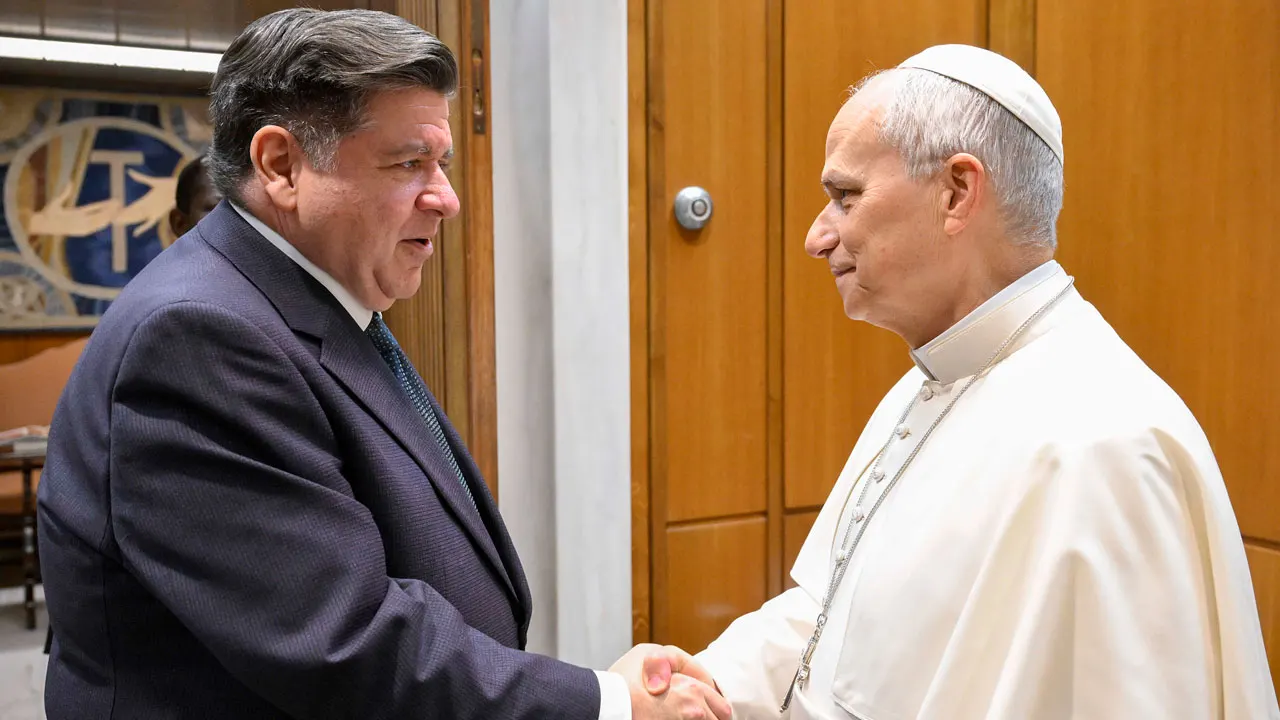
The meeting between Pope Leo XIV and Governor Pritzker had taken place at the Apostolic Palace in Vatican City on November 19, weeks before the bill was signed into law. Images from that meeting show the two leaders engaged in conversation, now revealed to have included discussion of this contentious legislation.
The Pope’s public criticism of an American state law is notable, particularly given his personal connection to Illinois as a Chicago native. His comments reflect the Catholic Church’s longstanding opposition to assisted suicide, which it views as contrary to the sanctity of human life, a core principle of Catholic teaching.
As the implementation date approaches, the debate over assisted suicide in Illinois is likely to continue, with advocates praising increased end-of-life choices and religious leaders maintaining their moral objections to the practice.
Fact Checker
Verify the accuracy of this article using The Disinformation Commission analysis and real-time sources.

11 Comments
I respect the Pope’s perspective, but I’m not sure I fully agree. While I understand the concerns about the sanctity of life, I also believe individuals should have the right to make decisions about their own end-of-life care. This is a difficult balance to strike.
That’s a fair point. There are valid arguments on both sides of this debate. Finding the right approach requires carefully weighing individual rights, ethical principles, and societal impacts.
The Pope’s disappointment is understandable, but I think laws like this can provide an important option for the terminally ill who are suffering. It’s a complex issue without easy answers.
The Pope’s reaction is understandable given the Catholic Church’s stance on end-of-life issues. However, I believe laws like this can provide compassionate options for those facing terminal illness and unbearable suffering. Reasonable people can disagree on the right approach.
That’s a fair perspective. There are often no easy answers when it comes to such sensitive ethical questions. Open discussion is important, even when views differ.
The Pope’s disappointment is understandable given the Catholic Church’s teachings. However, I believe laws like this can provide an important option for the terminally ill. It’s a complex issue without easy answers.
I’m curious to learn more about the Pope’s specific concerns with this law. What aspects does he feel undermine respect for human life? It would be helpful to understand his reasoning in more detail.
This is a complex and sensitive issue that evokes strong feelings on both sides. I appreciate the Pope’s perspective, even if I may not fully agree. Assisted suicide is a difficult topic that requires careful consideration of individual circumstances and beliefs.
I agree, this is a nuanced issue with valid arguments on multiple sides. It’s good to see thoughtful dialogue, even if there are disagreements.
This is a significant development that will likely have broader implications. I’m interested to see how the debate around assisted suicide evolves, both in Illinois and elsewhere. These are challenging issues without clear-cut solutions.
Agreed. This is an emotive topic that touches on fundamental questions about individual rights, quality of life, and the role of the state. Nuanced discussion is needed.