


Listen to the article
In a deeply moving testament to human resilience, the Auschwitz museum unveiled a new permanent exhibition Friday showcasing intimate objects that detail the everyday experiences of prisoners held at the Nazi concentration camp during World War II.
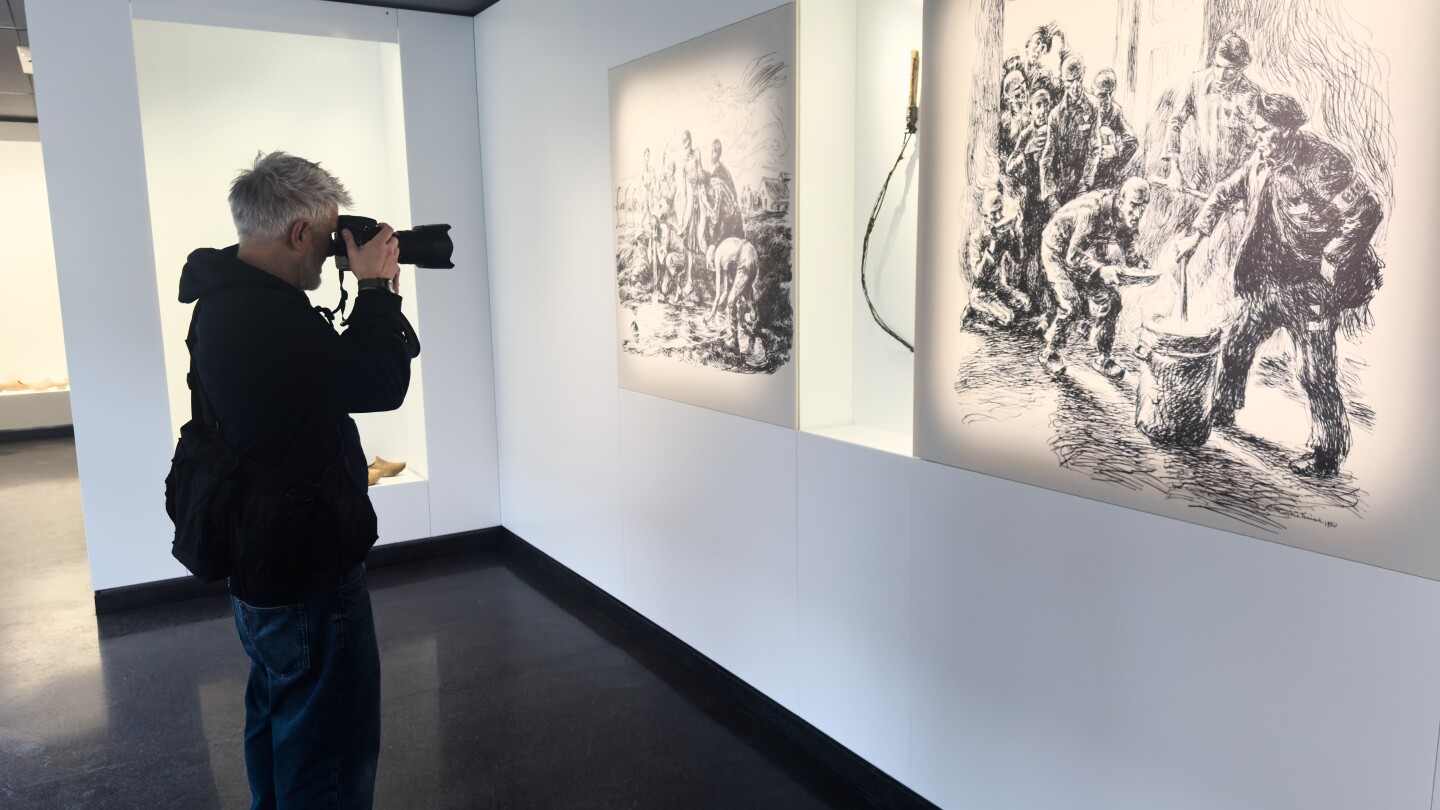
Among the most poignant items on display are animal-shaped stencils crafted by a mother from a concentration camp shoe as a Christmas gift for her son. These delicate remnants of maternal love amid unimaginable horror now stand as powerful witnesses to the human spirit in blocks 8 and 9 of the former death camp complex.
“It’s hard to describe this feeling, we can’t even understand this situation, the extreme situation in which this mother found herself in the camp, what emotions she experienced to do something for her child, to lift his spirits and contribute to his survival,” explained Magdalena Urbaniak, the exhibition’s coordinator.
The exhibition also features a paper cement bag repurposed as thermal underwear and secret drawings made by prisoners. These artifacts illustrate the daily routines that constituted life in the camp—from the morning gong to washing, meals, forced labor, and evenings in the barracks.
Visitors are given glimpses into the prisoners’ emotional world, confronting the extreme hunger, cold, fear, and hopelessness that defined existence at Auschwitz. This focus on individual human experiences represents a deliberate shift in how the museum approaches Holocaust education.
“Witnesses are passing away, the world is changing, technologies are changing, and new generations are emerging, requiring a new approach to the subject,” said Andrzej Kacorzyk, the deputy director of the Auschwitz museum, in an interview with The Associated Press. “Hence the need to portray humanity, the need to portray this individual fate.”
The exhibition marks the first completed phase of an ambitious modernization project for the museum. The full renovation will unfold in three stages, with the final phase scheduled for completion in 2030. The second phase, focusing specifically on the Holocaust in blocks 6 and 7, is expected to be finalized by 2027.
This modernization reflects both advances in historical understanding and changes in visitor demographics. As direct survivors dwindle in number, the museum faces new challenges in conveying the reality of the Holocaust to younger generations who have no living connection to these events.
The Auschwitz complex has a dark, layered history. Nazi Germany initially established Auschwitz I in 1940 as a prison camp primarily for Polish political prisoners. Two years later, they opened Auschwitz II-Birkenau, which became the main site for the systematic extermination of Jews during the Holocaust.
In total, Nazi forces constructed more than 40 concentration, labor, and extermination camps in this area of occupied Poland. By the war’s end, approximately 1.1 million people had been murdered at the Auschwitz-Birkenau complex alone.
While Jews were the primary victims of the Holocaust, targeted for complete annihilation, the Nazis also systematically killed Poles, Roma, Soviet prisoners of war, homosexuals, and other groups deemed undesirable by the regime.
The museum itself was established in 1947 and has since been recognized as a UNESCO World Heritage site. It stands as one of the world’s most significant memorials to the victims of Nazi genocide and serves as a crucial educational resource about the Holocaust.
This new exhibition, with its focus on personal objects and individual stories, represents an evolution in Holocaust remembrance—moving from statistics to intimate human narratives that may better connect with contemporary visitors. Through these modest artifacts of survival and resistance, the museum continues its vital mission of ensuring that the horrors of Auschwitz are never forgotten or repeated.
Fact Checker
Verify the accuracy of this article using The Disinformation Commission analysis and real-time sources.

9 Comments
The Auschwitz museum’s decision to create this permanent exhibition is a crucial step in preserving the memory and experiences of the camp’s victims. These artifacts ensure their stories will continue to be told and their humanity remembered.
This exhibition is a powerful reminder of the human capacity for resilience and compassion, even in the face of unimaginable horror. The personal objects on display provide a poignant window into the daily lives of Auschwitz prisoners.
Seeing the everyday objects used by Auschwitz prisoners is a sobering and humbling experience. It’s a stark reminder of the horrific realities they faced and the inhumane conditions they were forced to endure.
This exhibition is a poignant testament to the human spirit. The personal belongings on display serve as a powerful reminder of the immense suffering endured by the prisoners of Auschwitz, as well as their courage and determination to survive.
It’s heartbreaking to see the everyday items that became symbols of survival and dignity in the camp. This exhibition humanizes the victims and ensures their stories are not forgotten.
The decision to feature these personal belongings is a powerful curatorial choice. They bring the history of Auschwitz to life in a deeply personal and emotive way.
Agreed, these artifacts help us connect with the prisoners as individuals, not just statistics. It’s a sobering yet important reminder of the horrors of the Holocaust.
The ingenuity and resourcefulness of the prisoners, like the mother who crafted Christmas gifts for her son, is truly inspiring. These artifacts speak volumes about the determination to hold onto one’s humanity in the darkest of times.
The attention to detail in this exhibition is commendable. Showcasing the prisoners’ handmade items and repurposed materials provides invaluable insight into their daily struggles and resilience.