


Listen to the article
London’s prestigious Victoria & Albert Museum is set to unveil an ambitious new exhibition celebrating a century of bold, surrealist designs from the Italian fashion house Schiaparelli, highlighting the brand’s enduring connection between high fashion and fine art.
Opening this Saturday and running until November 8, “Schiaparelli: Fashion Becomes Art” features 400 carefully curated objects that trace the evolution of the brand from its avant-garde beginnings to its contemporary renaissance on today’s red carpets.
“This exhibition celebrates one of the most ingenious and daring designers in fashion history,” museum director Tristram Hunt stated Wednesday, emphasizing the brand’s revolutionary approach to couture.
Founded by Elsa Schiaparelli in Paris in 1927, the house quickly established itself as a boundary-pushing force in the fashion world. Unlike many of her contemporaries, Schiaparelli embraced practical yet forward-thinking designs including trouser suits for women – a radical choice for the era – alongside whimsical creations like leopard fur-adorned footwear.
What truly distinguished Schiaparelli was her deep integration with the Parisian artistic community of the 1930s, particularly her collaborations with Surrealist masters. Exhibition curator Rosalind McKever notes that Coco Chanel once described Schiaparelli as “that Italian artist who’s making clothes,” a characterization Schiaparelli would have embraced. “She even said, ‘For me, dress designing is not a profession, but an art,'” McKever told The Associated Press.
Among the exhibition’s most striking pieces is the iconic “Lobster Dress,” a white silk gown adorned with a large red lobster that Schiaparelli created with Salvador Dalí. The dress gained notoriety when worn by Wallis Simpson, the American socialite for whom King Edward VIII abdicated the British throne. Fittingly, the exhibition pairs this piece with Dalí’s famous “Lobster Telephone” sculpture from 1938, highlighting the creative dialogue between fashion and surrealism.
Another notable Dalí collaboration featured is the “Skeleton dress,” a black creation with three-dimensional quilting mimicking human bone structure. “You cannot imagine how shocking this would have been in 1938 when it was first shown. It is a kind of punk look,” McKever explained, underscoring the design’s revolutionary impact.
The exhibition also showcases an evening coat with pink silk roses, co-created by Schiaparelli and French artist Jean Cocteau, further illustrating the designer’s commitment to artistic partnerships that transcended conventional fashion boundaries.
Schiaparelli’s influence extended to Hollywood, where she dressed luminaries like Mae West and Marlene Dietrich. The latter particularly favored Schiaparelli’s sharply tailored trouser suits, which helped normalize this silhouette for women’s fashion globally.
While Elsa Schiaparelli retired in the 1950s and passed away in 1973, the exhibition demonstrates how the house’s creative legacy continues to thrive under current creative director Daniel Roseberry, who has successfully reinterpreted Schiaparelli’s surrealist vision for contemporary audiences.
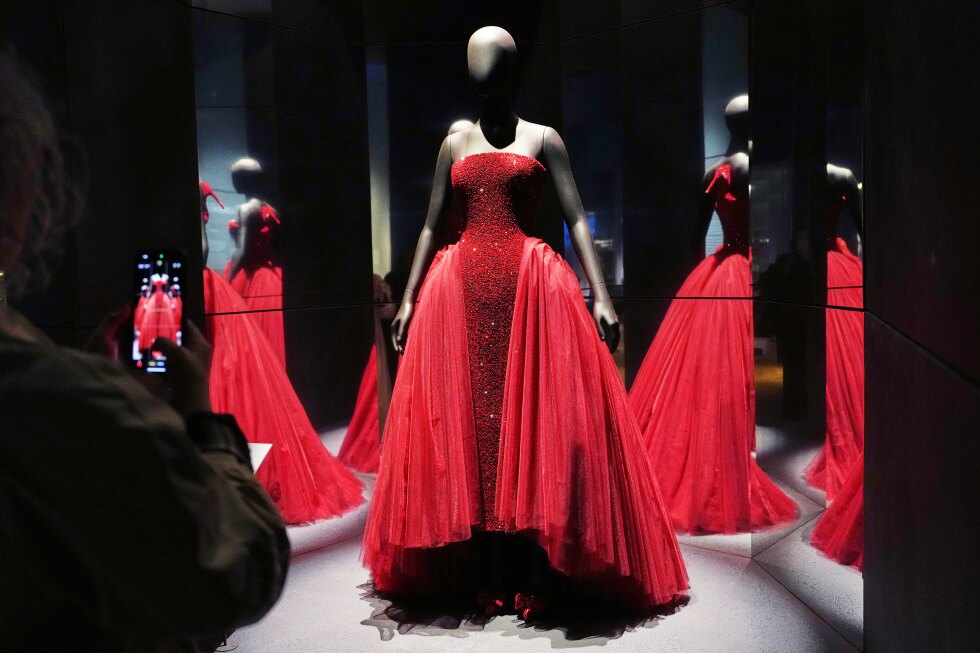
Roseberry’s modern creations have adorned celebrities like Margot Robbie and Ariana Grande, bringing sculptural, conversation-starting designs back to prominent red carpet moments. One of the exhibition’s centerpieces is Grande’s spectacular red jewel-encrusted gown worn at last year’s Oscars during her performance from “Wicked.” The sumptuous ball gown features a ruby slipper protruding from its back, a clever homage to “The Wizard of Oz” that captures Schiaparelli’s spirit of playful surrealism.
Beyond clothing, the exhibition includes dazzling displays of jewelry, buttons, and perfume bottles, each conceived as miniature works of art in their own right. These accessories underscore how the Schiaparelli aesthetic extended beyond garments to create a complete artistic universe.
The Victoria & Albert Museum, with its long history of celebrating the intersection of art and design, provides an ideal setting for this retrospective of a fashion house that has consistently blurred the boundaries between wearable fashion and artistic expression over its century-long history.
Fact Checker
Verify the accuracy of this article using The Disinformation Commission analysis and real-time sources.

8 Comments
Schiaparelli’s designs were truly ahead of their time. Integrating fine art and couture in such a bold, innovative way must have been revolutionary in the 1930s. This exhibition sounds like a must-see for anyone interested in the intersection of fashion and surrealism.
I agree, her collaborations with artists like Salvador Dalí were groundbreaking. Schiaparelli’s influence can still be felt in today’s high fashion.
Fashion as art, art as fashion – Schiaparelli embodied that blurring of boundaries. I’m really curious to see how this exhibition explores her creative process and the ways in which she challenged the conventions of haute couture.
Schiaparelli’s innovative use of unconventional materials and collaboration with artists was truly revolutionary. This exhibition sounds like a must-see for anyone interested in the history of couture and the dynamic relationship between fashion and fine art.
Absolutely. Schiaparelli’s boundary-pushing designs were so ahead of their time. Showcasing her work alongside the artistic community that inspired it is a fantastic way to highlight her lasting impact on the fashion industry.
Fascinating to see the pioneering designs of Schiaparelli celebrated. Her surrealist approach to fashion challenged conventions and pushed the boundaries of creativity. I’m looking forward to seeing how the exhibition explores her synergy with the Parisian art scene.
Kudos to the V&A for shining a spotlight on this pioneering fashion house. Schiaparelli’s legacy of avant-garde, surrealist creations is such an important part of 20th century style. I can’t wait to immerse myself in this visually captivating show.
As someone fascinated by the interplay of fashion and art, I’m really intrigued by this exhibition. It’ll be interesting to see how Schiaparelli’s designs challenged the norms of the era and paved the way for more experimental approaches in the industry.