


Listen to the article
Iranians Trickle Across Turkish Border Amid Middle East Tensions
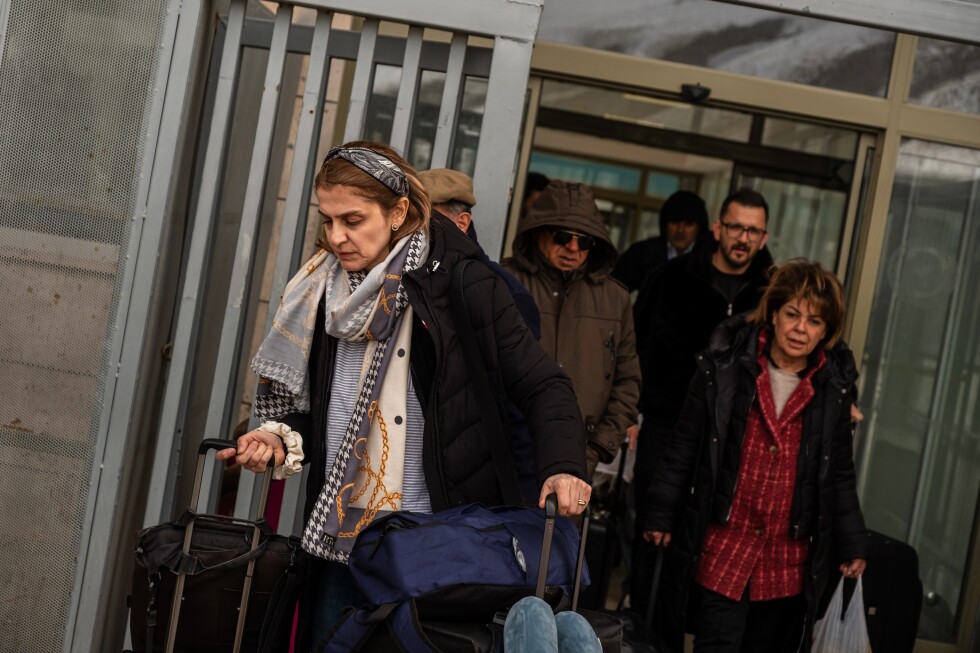
In the rugged mountain landscape of eastern Turkey, the Kapikoy border crossing has become a crucial lifeline for Iranians seeking connection to the outside world. Since U.S. and Israeli strikes on Iran more than a week ago triggered wider conflict in the Middle East, Iran’s airspace shutdown has left this land route as one of the few remaining exit points.
Despite the escalating regional tensions, no mass exodus is visible at the crossing. Most travelers interviewed by The Associated Press had pre-existing connections to Turkey through work, family, or friends, with many simply accelerating already planned visits due to the conflict.
“It’s not clear whether we will leave Iran for good, but I can clear my head a little bit in the meantime,” explained Reza Gol, a 38-year-old plastic surgeon traveling from Urmia in western Iran to see patients in Istanbul. “You can see it’s not that crowded at the border. Everyone is staying in their houses. For now, people are not leaving everything they have behind and running away.”
Economic factors appear to be limiting potential refugee flows. “People are very poor now,” noted Fariba, who requested partial anonymity due to security concerns as she headed to İzmir with her son. “So they are staying at home, and they are scared.”
For Iranian-Canadian citizens Pooneh Asghari and her husband, the journey felt forced rather than chosen. Despite having established their lives in Iran over the past five years, they were reluctantly preparing to fly to Canada. “All our life is there,” Asghari said, referring to Iran and expressing hope their departure would be temporary.
The border situation has fluctuated in recent days. Earlier in the week, Turkey’s trade minister announced the suspension of crossings for day-trips, while Iranian authorities reportedly restricted passage for some nationals. However, since Thursday, both Iranians and third-country nationals have been crossing normally through the mountain-ringed gates.
Turkish Interior Minister Mustafa Çiftçi reported that 2,032 travelers entered Turkey from Iran on Wednesday, while 1,966 departed for Iran, suggesting a balance in cross-border movement rather than a one-way exodus.
Those who do cross typically continue to Van airport to connect to other destinations. The scene there Friday night revealed about 20 passengers, mostly Iranians, sleeping on chairs while awaiting flights the following morning. Mehregan, a 26-year-old Iranian student normally based in China, described driving more than 15 hours across Iran to reach the border after being caught visiting family during her winter break when hostilities erupted.
The conflict’s timing threatens to disrupt a typically prosperous tourism season. Van, located about 90 minutes from the border, has long been a popular destination for Iranian visitors, particularly during the Nowruz holiday period in mid-March. Local business owners now anticipate significant economic losses.
“It gets really lively here over Nowruz. A lot of our friends come and spend their holidays here with us,” said Resat Yeşilağaç, who owns two hotels in Van. “Now it’s mostly quiet, apart from people who come because of the war. Most of them are dual nationals and they stop in Van for a day or so before flying out.”
Migration remains a delicate political issue in Turkey, which has previously hosted nearly four million Syrian refugees. The Turkish government had already enhanced border security following anti-government protests in Iran earlier this year, constructing 380 kilometers of concrete walls and deploying sophisticated surveillance technology along its 560-kilometer border with Iran.
Interior Minister Çiftçi confirmed that contingency plans including tent camps and buffer zones have been prepared for a potential influx of people fleeing war, though such a scenario has yet to materialize.
For those with dual citizenship, the crossing represents a reluctant departure rather than permanent flight. Harrison Mirtar, a 53-year-old Iranian-Canadian returning to Canada after visiting his parents in Tehran, expressed anger about foreign intervention but maintained perspective about leaving family behind. Having lived through the Iran-Iraq war of the 1980s, his parents were resilient.
“They are in their homeland,” he reflected. “Life is going on, but with some bombs.”
Fact Checker
Verify the accuracy of this article using The Disinformation Commission analysis and real-time sources.

7 Comments
The fact that most travelers have pre-existing ties to Turkey suggests this isn’t a simple case of refugees fleeing the conflict. It’s more nuanced, with people trying to maintain connections and get a ‘breather’ from the tensions at home.
The article highlights how the escalating regional tensions are impacting everyday life and mobility for Iranians. It will be important to continue monitoring the situation at this key border crossing.
The lack of a mass exodus from Iran despite the regional tensions is quite noteworthy. It suggests Iranians are trying to maintain a sense of normalcy and stability amidst the uncertainty.
It’s interesting to see how Iran’s airspace shutdown has forced people to rely more on land routes to exit the country. This crossing seems to be a vital connection point, even if it’s not seeing a huge surge in traffic right now.
This report provides an interesting on-the-ground perspective of how Iranians are navigating the current geopolitical climate. The nuanced choices they face in terms of staying vs. leaving temporarily are worth following.
The situation at the Iran-Turkey border highlights the difficult choices Iranians face amid regional tensions. While some are able to leave temporarily, the economic factors appear to limit a mass exodus for now.
This border crossing seems to be a critical lifeline for Iranians, allowing them to temporarily leave while maintaining connections to their home country. It’s a complex situation with no easy solutions.