


Listen to the article
Senate to Vote on Trump’s Iran War as Conflict Intensifies
The U.S. Senate is set to vote Wednesday on a resolution that could limit President Donald Trump’s military actions against Iran, marking a significant constitutional test amid a rapidly escalating Middle Eastern conflict with no clear exit strategy.
The war powers resolution would require the president to seek congressional approval before conducting further military operations against Iran. While the measure faces steep odds in the Republican-controlled Congress and would likely meet a presidential veto even if passed, the vote represents a critical moment for lawmakers weighing their constitutional responsibilities against executive war powers.
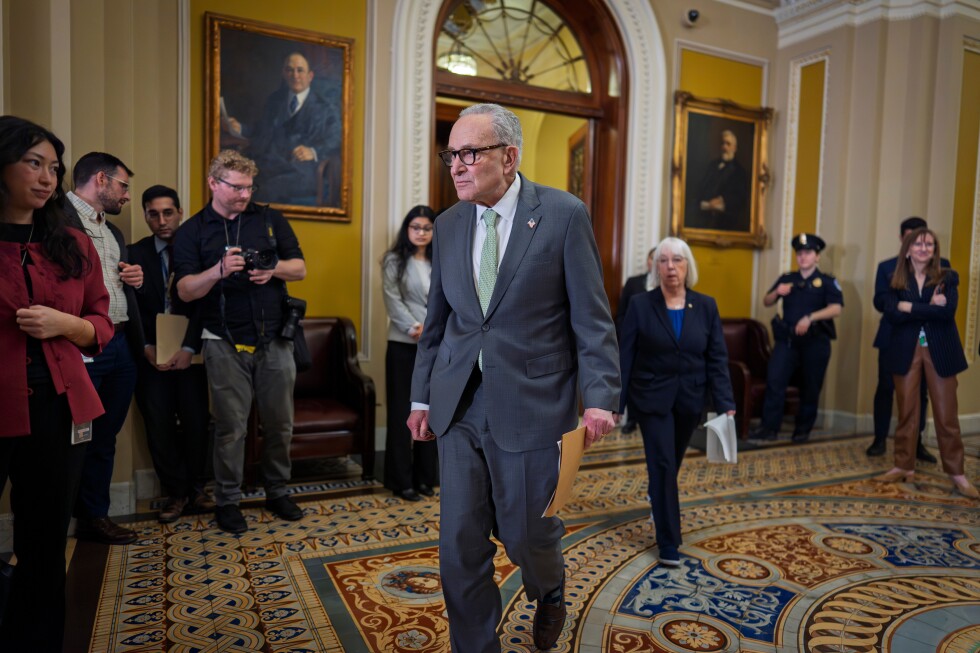
“Wars without clear objectives do not remain small. They get bigger, bloodier, longer and more expensive,” Senate Democratic Leader Chuck Schumer warned during a Tuesday news conference. “This is not a necessary war. It’s a war of choice.”
The conflict, now in its fifth day following Trump’s surprise attack against Iran on Saturday, has already claimed American lives. Six U.S. military members were killed over the weekend in a drone strike in Kuwait, escalating concerns about military involvement in the region.
Trump administration officials have descended on Capitol Hill this week, attempting to reassure skeptical lawmakers from both parties that they have the situation under control. Secretary of State Marco Rubio told reporters during a chaotic news conference: “We are not going to put American troops in harm’s way.”
However, the president has not ruled out deploying ground troops, complicating the administration’s messaging. Trump’s stated goals for the war have also shifted multiple times – from regime change to stopping Iran’s nuclear program to crippling its naval and missile capabilities.
Senate Majority Leader John Thune expressed support for the administration’s military campaign, saying: “I think they are achieving great success with what they’ve done so far.” He added that what happens next in Iran will be “largely up to the Iranian people.”
Almost all Republican senators are expected to vote against the war powers resolution, though several have expressed reservations about potential troop deployments. “I don’t think the American people want to see troops on the ground,” said Sen. Bill Cassidy (R-La.) after exiting a classified briefing Tuesday, noting that administration officials left that possibility open but weren’t emphasizing it.
Senator Todd Young, who had previously been undecided, announced Wednesday morning he would oppose the resolution, arguing that limiting the president’s military options now would only increase dangers as the conflict progresses. He instead called for robust congressional oversight and careful evaluation of any requests for additional wartime funding or authorities.
For lawmakers facing midterm elections, the vote carries significant political implications. “Nobody gets to hide and give the president an easy pass or an end-run around the Constitution,” said Sen. Tim Kaine, the Virginia Democrat spearheading the war powers resolution. “Everybody’s got to declare whether they’re for this war or against it.”
Republican leaders have previously defeated similar resolutions related to other conflicts initiated by Trump, but the Iranian situation represents a more substantial escalation. Unlike limited campaigns against drug vessels or threats against Venezuela’s Nicolás Maduro, the attack on Iran has initiated an open-ended conflict with regional repercussions.
For Republicans accustomed to Trump’s previous promises to keep the U.S. out of foreign entanglements, the sudden shift toward major military action has created political dissonance. Senator Markwayne Mullin (R-Okla.) defended the operation, saying: “War is ugly, it always has been ugly, but we’re taking out a regime that has been trying to attack us for quite some time.”
Meanwhile, Senator Lindsey Graham (R-S.C.), a longtime advocate for overseas intervention, framed the widening conflict as an opportunity for Arab and European countries to join the fight against Iran and its proxy groups. While supporting the vote, Graham criticized the War Powers Act itself as giving Congress too much control over military operations.
In the House, a parallel debate is underway with a vote expected Thursday. “I do believe we have the votes to defeat it, I certainly hope we do,” House Speaker Mike Johnson said following an all-member briefing Tuesday night. House Democratic leader Hakeem Jeffries predicted strong Democratic support for the resolution.
Representative Gregory Meeks, the top Democrat on the House Foreign Affairs Committee, made an emotional plea for the Trump administration to directly address Congress and the American people about its war rationale. “Our young men and women’s lives are on the line,” he said, his voice filled with emotion as lawmakers left a closed-door briefing.
Fact Checker
Verify the accuracy of this article using The Disinformation Commission analysis and real-time sources.

8 Comments
This is a critical moment for Congress to assert its war powers and ensure a clear strategy and exit plan before further escalation. While the outcome remains uncertain, the debate is an important check on executive authority.
Congress’s war powers are an important check on executive authority, and I’m glad to see lawmakers grappling with this difficult issue. While the outcome remains uncertain, the debate itself is a vital part of the democratic process.
As someone interested in geopolitics, I’ll be closely watching this debate. The stakes are high, and I hope Congress can chart a responsible course that avoids further escalation and prioritizes diplomacy to resolve tensions.
Debates over the use of military force always raise challenging questions about the appropriate balance of power between the legislative and executive branches. I’ll be interested to see how this vote unfolds and what it signals about Congress’s role in foreign policy decisions.
With lives already lost, Congress must thoughtfully weigh the risks and long-term implications of this conflict. A war without clear goals and an exit strategy could have devastating consequences for the region and global stability.
This is a complex and delicate situation that requires careful deliberation. I appreciate Congress taking up this critical issue and hope they can find a way to assert their oversight role while avoiding a broader regional conflagration.
Debates over the scope and objectives of military action are always challenging, but it’s crucial Congress fulfills its constitutional responsibilities. I hope lawmakers can find a path forward that prioritizes diplomacy and de-escalation.
The tense situation with Iran highlights the need for greater transparency and accountability around US use of military force. I’m curious to see how the Senate vote unfolds and what it signals about the balance of power on foreign policy.