


Listen to the article
Church Cherub Resembling Italian Premier Sparks Religious Art Controversy
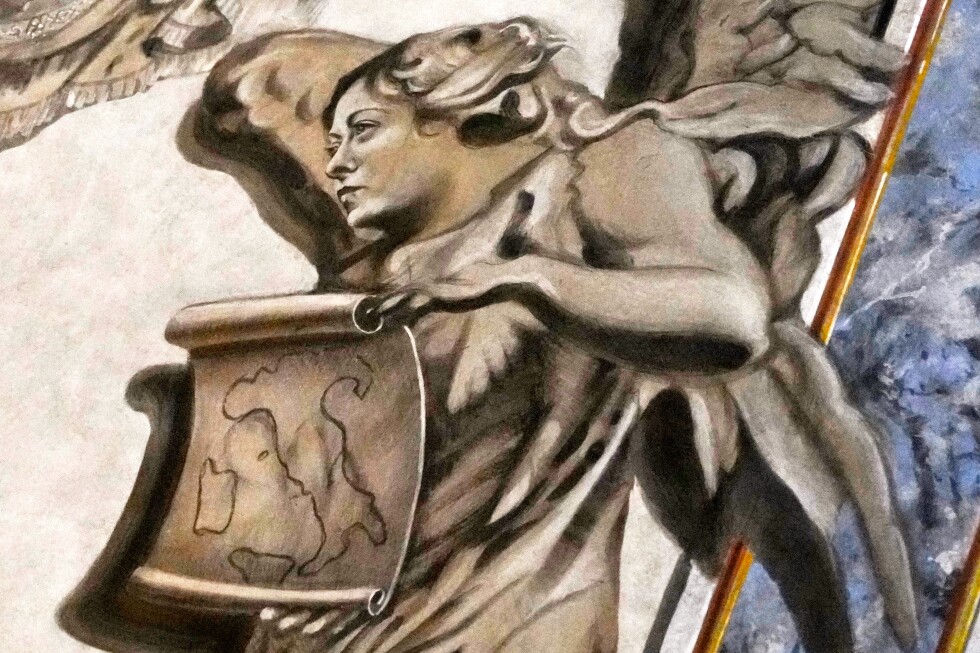
A centuries-old Roman church has found itself at the center of an unexpected controversy after the recent restoration of a cherub bearing a striking resemblance to Italy’s Premier Giorgia Meloni. The unusual artistic choice has prompted swift investigations from both religious and governmental authorities concerned about the blending of sacred art with contemporary politics.
The Basilica of San Lorenzo in Lucina, one of Rome’s oldest churches dating back to 440 CE, has seen a surge in visitors since Italian newspapers published photographs of the cherub this weekend. Curious onlookers have flocked to the historic site near the Spanish Steps, at times disrupting religious services as they attempt to photograph the angelic figure in a side chapel near the front altar.
Meloni herself attempted to defuse the situation with humor, writing on social media: “No, I definitely don’t look like an angel,” accompanied by a laughing emoji.
The controversy centers on a renovation completed in 2000 when one of the basilica’s front chapels was redesigned to include a bust of Italy’s last king, Umberto II. The decoration featured a cherub holding a map of Italy while kneeling before the monarch. Following water damage in 2023, the chapel underwent restoration work, resulting in the cherub’s face now appearing distinctly similar to Premier Meloni.
The political implications are particularly sensitive given Italy’s complex history with monarchy. Italians rejected the monarchy after World War II due to the royal family’s support for Fascist dictator Benito Mussolini. Meloni’s right-wing party has historical connections to the neo-fascist movement that succeeded Mussolini’s regime, making the image of a Meloni-like figure in a position of deference to the king especially problematic.
Both the Diocese of Rome and the Italian Culture Ministry have launched investigations into the restoration. The Culture Ministry, which oversees the basilica’s maintenance through the Interior Ministry, sent special delegate Daniela Porro to “ascertain the nature of the work” and determine appropriate next steps.
Cardinal Baldassare Reina, the vicar of Rome, issued a stern rebuke, emphasizing that “images of sacred art and Christian tradition cannot be misused or exploited, as they are intended exclusively to support liturgical life and personal and communal prayer.” This statement signals the church’s unwillingness to allow sacred spaces to become venues for political imagery.
The parish priest, Rev. Daniele Micheletti, has distanced himself from the controversy, noting that the basilica’s decorations ultimately fall under government jurisdiction as the property owner. “The priest is not responsible for the decorations in the sense that the owner is someone else,” Micheletti told The Associated Press. “So, what do they want from me? I did not do the painting.”
The restorer, Bruno Valentinetti, who also worked on the original 2000 painting, has denied deliberately modeling the cherub after Meloni, suggesting any resemblance exists only in the eye of the beholder. Investigators are now working to determine what the original cherub looked like before the recent restoration.
While this particular incident has created a stir, religious art has a long history of incorporating contemporary figures. Micheletti pointed out that Caravaggio reportedly modeled the Virgin Mary on a prostitute in one work, while Michelangelo included his own likeness as St. Bartholomew in the Sistine Chapel’s “The Last Judgment.”
As authorities continue their investigations, the basilica’s newfound celebrity status ensures the centuries-old church will remain in the spotlight far beyond its traditional religious significance, highlighting the sometimes uneasy relationship between contemporary politics and sacred spaces.
Fact Checker
Verify the accuracy of this article using The Disinformation Commission analysis and real-time sources.

6 Comments
Interesting bit of religious art controversy. I wonder what the church and state hope to uncover in their investigations. Meloni’s tongue-in-cheek response was probably the best approach.
It’s fascinating when sacred art takes on political undertones, even if unintentionally. I wonder if the church will make any changes to the cherub display in response to the investigations.
Ah, the age-old tension between church and state. This cherub controversy seems like a relatively harmless case, though I’m curious to hear the explanations from the religious and governmental bodies involved.
Art and religion often intersect in intriguing ways. I hope the authorities can look into this situation without being too heavy-handed. A light touch may be best to avoid further controversy.
This is a curious case of religious art blending with contemporary politics. I’m curious to see if the investigations shed any light on the artistic choices made during the church’s renovation.
Indeed, it will be interesting to learn more about the decision-making process behind this unusual cherub depiction.