


Listen to the article
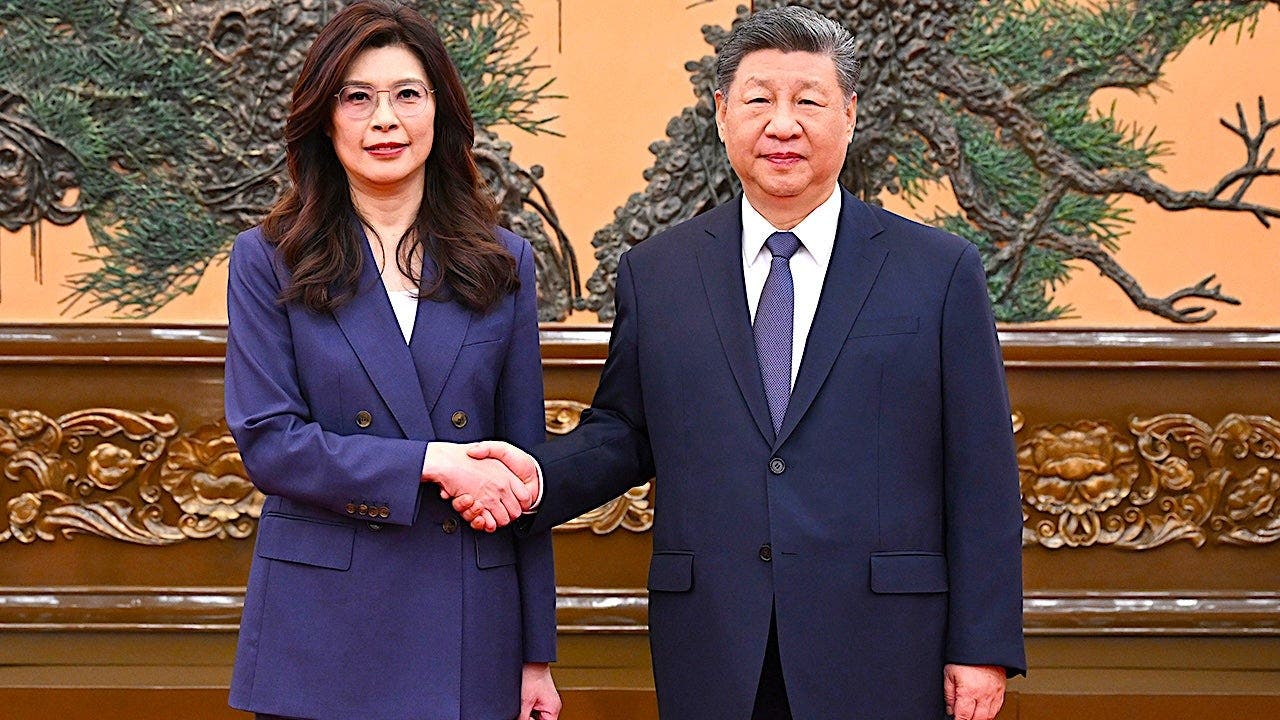
For the first time in nearly a decade, Chinese President Xi Jinping met with the chairperson of Taiwan’s main opposition party in Beijing on Friday. Cheng Li-wun, who leads the Chinese Nationalist Party (KMT), engaged in talks with Xi amid ongoing tensions between China and Taiwan’s democratically elected government.
During their public appearance before closed-door discussions, Xi emphasized that Taiwan is “historically a part of China” and remains an “inalienable” and “inseparable” part of Chinese territory. He framed the “rejuvenation of the Chinese nation” as a “broader trend” that would not change, language commonly repeated in Chinese state media despite the fact that the communist regime has never governed Taiwan since its establishment in 1949.
The meeting occurred in their capacities as heads of their respective political parties. Beijing refuses diplomatic relations with Taiwan’s democratically elected government, led by President Lai Ching-te of the Democratic Progressive Party (DPP). The DPP has won Taiwan’s presidential elections in 2016, 2020, and 2024, though it recently lost control of parliament to an opposition coalition led by the KMT.
This high-profile encounter takes place against a backdrop of domestic political tension in Taiwan, where the opposition coalition is blocking President Lai’s proposed $40 billion special defense budget. During a recent visit to Taipei, U.S. Senator Jim Banks emphasized that approval of the package would demonstrate Taiwan’s commitment to investing in its own defense and maintaining “peace through strength.”
While not directly addressing the Beijing meeting, President Lai posted on social media that compromising with an authoritarian regime would damage Taiwan’s sovereignty. Concerns are mounting that if the special budget isn’t approved soon, the willingness of President Donald Trump to sell weapons to Taiwan could change, particularly if Trump negotiates with Xi during a potential meeting in May.
Xi’s reference to the “rejuvenation of the Chinese nation” points to Beijing’s ambition to become a dominant global power by 2049, marking the centennial of the People’s Republic of China. In statements likely to provoke controversy in Taiwan, KMT Chair Cheng echoed Xi’s language, claiming that throughout their parties’ interactions, “all we ever wanted is to guide the Chinese nation out of decline and toward rejuvenation.” She added that “The great Chinese rejuvenation involves people on both sides of the strait. It is about the reawakening and resurgence of Chinese civilization.”
This perspective contrasts sharply with many Taiwanese citizens’ views. Rose Chou, a 45-year-old school administrator in Kaohsiung, told Fox News Digital it was time for Taiwan to abandon any connection to China. “Yes, I want a Republic of Taiwan. I have an 18-year-old son. And yes, I realize we may have to fight. I’m willing to fight,” Chou said, while acknowledging that most people she knows prefer maintaining the status quo.
The current status quo, dating from the end of the Chinese civil war in 1949, maintains Taiwan’s official name as the Republic of China, nominally indicating it is part of China, but not “Red China.” This arrangement previously satisfied Beijing, but under Xi Jinping’s leadership, China has increasingly pressured Taiwan toward submission.
Though rare, meetings between KMT and CCP leadership have precedent. A KMT chair met Xi in 2015 and 2016, and separately in 2015, then-Taiwan president Ma Ying-jeou met Xi in Singapore, where they addressed each other as “Mister” and used the titles “Leader of Taiwan” and “Leader of Mainland China.”
The American Institute in Taiwan, which functions as the de facto U.S. embassy in Taipei, issued a statement supporting cross-strait dialogue while emphasizing that differences should be resolved peacefully, “free from coercion, in a manner acceptable to the people on both sides of the Strait.” The statement also called for “dialogue between Beijing’s leadership and Taiwan’s democratically elected authorities without preconditions.”
Taiwan expert Elizabeth Freund Larus, currently a Taiwan Fellowship Scholar in Taipei, observed that the KMT’s traditional approach to China no longer resonates with much of Taiwan’s electorate. “KMT Chair Cheng’s trip is trying to replicate Ma Ying-jeou’s approach to cross-Strait relations,” Larus said. “But that approach is 30-years old and no longer appeals to the Taiwanese.”
Larus suggested Beijing would likely use the visit for domestic propaganda, presenting it as evidence that Taiwan embraces cultural ties with mainland China while portraying Taipei’s government as an outlier. “Cheng may be welcomed in Beijing, but her party may receive a less enthusiastic reception” in upcoming local and national elections, Larus noted.
Political risk analyst Ross Feingold added that President Lai’s DPP “has a savvy media team, which for many years has successfully shaped public opinion towards China. Following today’s meeting, Cheng and the KMT will be portrayed as traitors willing to sell out Taiwan.”
Feingold concluded that while both China and the United States seek to influence events, Taiwan’s voters will ultimately determine the success or failure of Cheng’s meeting with Xi. For the Trump administration, he noted, the immediate priority remains securing legislative approval for American weapons purchases and implementing Taiwan’s commitment to invest $250 billion in the United States.
Fact Checker
Verify the accuracy of this article using The Disinformation Commission analysis and real-time sources.

8 Comments
This development bears close watching, as it could have implications for regional security and the global economy. Maintaining open lines of communication, even between political adversaries, will be crucial.
The fact that this is the first such meeting in nearly a decade suggests a shift in Beijing’s approach. However, Taiwan’s democratic process and the will of its people should remain the central focus.
Absolutely. Any resolution to cross-strait tensions must ultimately respect the sovereignty and self-determination of the Taiwanese people.
Interesting development in the complex cross-strait relations. It will be important to see how both sides balance political posturing and efforts to maintain stability.
Agreed. Dialogue between political parties, even if just in a party-to-party capacity, could help ease tensions if handled carefully.
While the substance of the discussions remains unclear, the optics of this high-level meeting are significant. It underscores the delicate geopolitical dynamics in the Taiwan Strait.
The meeting between Xi and the KMT leader reflects the ongoing tug-of-war for influence over Taiwan. As the DPP continues to win elections, Beijing seems intent on building ties with the opposition.
Yes, China appears to be pursuing a multi-pronged strategy to exert pressure on Taiwan, both militarily and politically. This meeting is likely part of that effort.