


Listen to the article
Albanian Parliament Erupts in Chaos During Ombudsman Vote
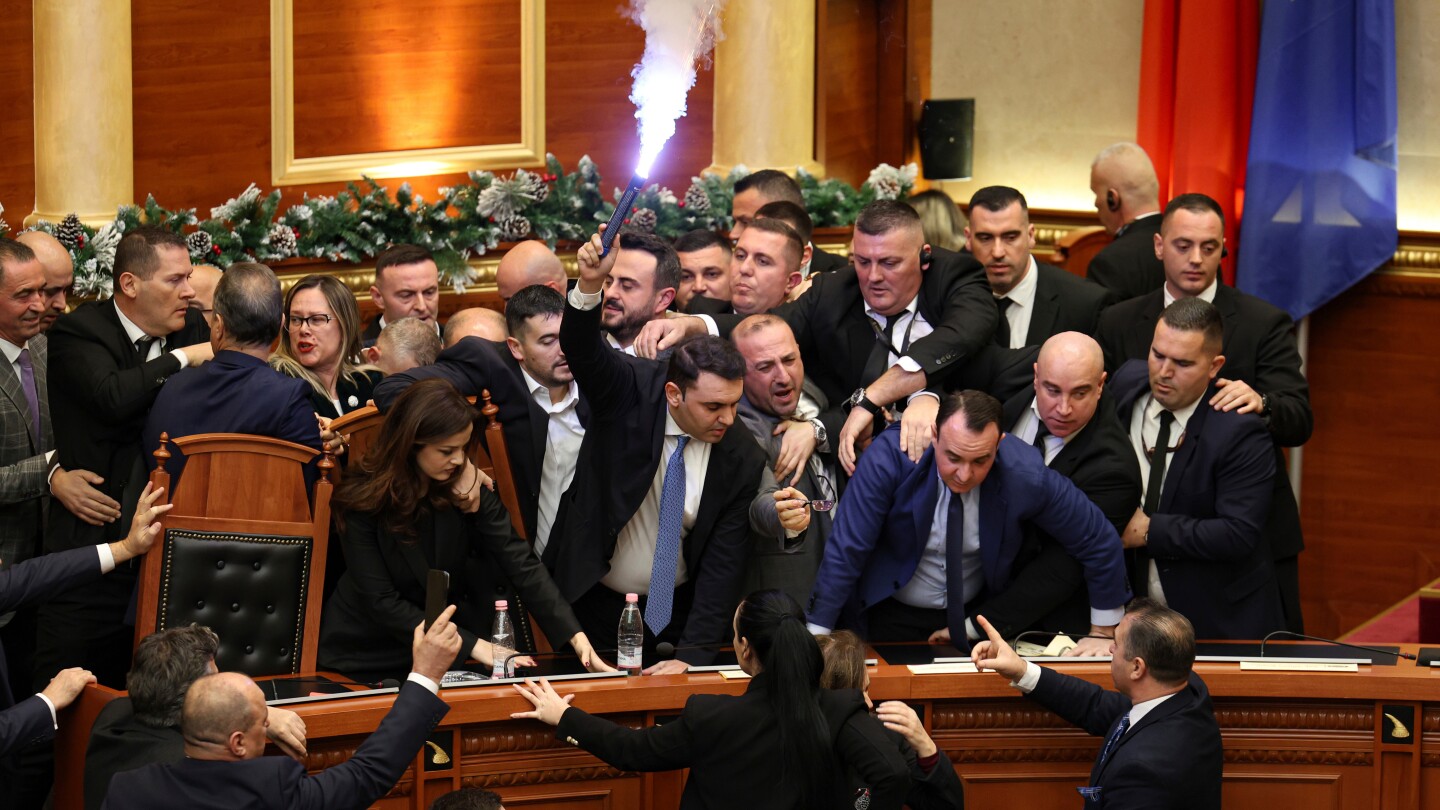
Chaos erupted in Albania’s parliament on Thursday as opposition lawmakers clashed with security guards during a contentious session to elect the country’s new ombudsman. The scene in Tirana quickly deteriorated into physical confrontations, with lawmakers setting off flares, tugging at microphones, and throwing bottles at Parliament Speaker Niko Peleshi.
The disruption was orchestrated by members of the Democratic Party of Albania, who occupied cabinet ministers’ seats before the session began. When parliamentary guards attempted to remove them, physical altercations broke out across the chamber floor, culminating in opposition members lighting flares in protest.
“We cannot destroy the state like this,” Peleshi pleaded as he attempted to maintain order and continue with the scheduled vote. “Respect the institution of the parliament.”
The Democratic Party’s actions represent the latest escalation in months-long protests against Prime Minister Edi Rama’s Socialist government, which has ruled Albania since 2013. Opposition lawmakers held placards comparing Rama to Panamanian dictator Manuel Antonio Noriega Moreno, with slogans dubbing him “The Noriega of Europe.”
At the heart of the opposition’s grievances are allegations of election fraud and democratic backsliding under Rama’s leadership. A key demand is the resignation of Deputy Prime Minister and Minister of Infrastructure and Energy Belinda Balluku, who faces serious corruption allegations.
Balluku’s case has become particularly contentious after the country’s Special Court Against Corruption and Organized Crime (SPAK) issued an arrest warrant for her. Prosecutors have accused Balluku of interfering with public procurement procedures in multiple construction projects. SPAK has formally requested parliament to lift her immunity, an issue scheduled for discussion in an upcoming special session. Balluku has not publicly addressed the accusations.
The parliamentary turmoil reflects deeper tensions in Albania’s political landscape. Despite being considered a frontrunner alongside Montenegro for European Union membership among Western Balkan nations, Albania continues to struggle with systemic issues that could hamper its EU aspirations.
International watchdog organizations have consistently highlighted Albania’s challenges with widespread corruption and the concentration of power within the ruling Socialist Party. These concerns have intensified scrutiny of Albania’s democratic institutions and governance practices.
The position of ombudsman—the top human rights official in the country—has taken on heightened significance amid these tensions. The role serves as a critical check on government power, investigating human rights violations and advocating for citizens against potential state abuses.
Thursday’s disruption underscores the increasingly polarized political environment in Albania, where institutional processes are regularly contested and democratic norms challenged. The parliamentary chaos also raises questions about the country’s ability to implement reforms necessary for EU accession.
Albania received candidate status for EU membership in 2014 and began formal accession negotiations in 2022. However, the European Commission has emphasized that continued progress requires strengthening the rule of law, combating corruption, and ensuring democratic institutions function effectively.
As Albania navigates these challenges, the international community continues to monitor developments closely. The European Union has repeatedly stressed that political stability and functional democratic institutions remain prerequisites for Albania’s continued progress toward integration with European structures.
Meanwhile, ordinary Albanians watch with concern as their democratic representatives engage in physical confrontations rather than substantive debate, raising questions about the health and future of the country’s young democracy.
Fact Checker
Verify the accuracy of this article using The Disinformation Commission analysis and real-time sources.

15 Comments
Watching lawmakers engage in physical altercations and disruptive behavior in parliament is deeply troubling. While political disagreements are inevitable, the opposition’s tactics here seem to cross a line and risk further inflaming tensions. I hope the authorities can get the situation under control and find a way for all sides to debate the issues civilly and constructively.
The scenes of disorder and violence in the Albanian parliament are deeply concerning. While political tensions are understandable, resorting to physical confrontation and property damage risks further polarizing the political landscape and undermining the integrity of democratic institutions. I hope the authorities can restore order and create an environment where all sides can engage constructively on the issues facing the country.
It’s disheartening to see lawmakers resorting to such disruptive tactics rather than focusing on the substance of the issues. While I understand the opposition’s frustrations, their actions risk further polarizing the political environment and damaging Albania’s democratic institutions. I hope both sides can find a way to engage more constructively going forward.
The opposition’s actions, including setting off flares, seem rather extreme and disruptive. While I understand the desire to make a strong political statement, damaging property and endangering others is not the right way to go about it. I hope cooler heads can prevail.
I agree, the opposition’s tactics here seem counterproductive. Resorting to violence and destruction undermines their credibility and legitimacy. If they have legitimate grievances, they should pursue them through proper parliamentary channels.
This kind of chaotic and confrontational behavior in parliament is never a good sign for a democracy. While I understand the opposition may have legitimate grievances, their actions here seem more focused on creating disruption than addressing the substance of the issues. I hope cooler heads can prevail and the lawmakers can find a way to resolve their differences through proper parliamentary channels.
This is a concerning development in Albanian politics. While robust political debate is healthy, violence and destruction in parliament erodes public trust and undermines the democratic process. I hope the authorities can restore order and find a way for all sides to engage constructively on the issues.
This kind of political drama is unfortunate to see, but not entirely surprising given the long-running tensions in Albania. I hope the authorities can restore order and allow the democratic process to move forward, even if it means taking a firm hand against disruptive tactics.
Absolutely. The institutions of government need to be able to function, even in the face of political disagreements. Allowing chaos and violence to take over sets a dangerous precedent that could destabilize the whole system.
Interesting to see the political tensions flare up in Albania’s parliament. These kinds of physical clashes between lawmakers are never a good sign for the democratic process. I wonder what specific issues are driving the opposition to be so confrontational.
Yes, it’s concerning when parliamentary debate descends into physical altercations. Healthy democracies rely on institutions like parliament to resolve political differences through dialogue, not violence.
It’s a shame to see lawmakers resorting to physical confrontation instead of focusing on the issues at hand. While I understand the opposition’s frustrations, their actions risk further polarizing the political landscape in Albania. I hope cooler heads can prevail and they find more constructive ways to voice their concerns.
I agree, the opposition’s tactics here are counterproductive and concerning. Damaging parliamentary property and endangering others is not the way to resolve political differences in a democracy. They need to find more responsible and constructive ways to make their case.
This kind of chaos in parliament is never a good sign. While I’m not familiar with the specific political dynamics in Albania, it’s clear that the opposition has deep grievances against the government. However, their tactics of physical confrontation and property damage are counterproductive and risk undermining the integrity of the democratic process. I hope cooler heads can prevail.
The scenes of lawmakers clashing and setting off flares in the Albanian parliament are very concerning. While political tensions are understandable, resorting to violence and disruption is not the way to resolve them in a democracy. I hope the authorities can restore order and find a way for all sides to engage constructively on the issues facing the country.