


Listen to the article
Youth Essential in Combating Extremism and Digital Misinformation, Experts Say
Experts at a recent seminar in Quetta highlighted the critical role young people must play in countering violent extremism and tackling the proliferation of false information on digital platforms.
The gathering, organized by the Press Information Department (PID) under its Counter Violent Extremism (CVE) Project, brought together academics, journalists and university students from across Balochistan to address growing concerns about radicalization and misinformation in Pakistani society.
“Extremism has infiltrated our society like a cancerous growth, and the wrongful propagation of news on social media has further fueled this evil,” speakers told the audience. They emphasized that young people, as digital natives and future leaders, are uniquely positioned to combat these challenges.
The seminar comes amid rising concerns about the impact of digital misinformation on social cohesion in Pakistan, particularly in regions like Balochistan that have historically faced security challenges. Project Director Shahid Imran Ranjha outlined the CVE initiative’s objectives, highlighting the government’s commitment to addressing extremism at its roots.
Prominent speakers included professors Babrak Niaz and Dr. Muhammad Rahim Nasar, senior journalist Ayub Tareen, and Deputy Director PID Quetta Asad Khan Mandokhail. They collectively stressed the necessity of a multi-faceted approach to counter extremism, including educational reforms, media literacy campaigns, and grassroots awareness efforts.
The rapid expansion of social media access across Pakistan has created new vulnerabilities, experts noted. With smartphone penetration reaching unprecedented levels even in remote areas, the ability to disseminate unverified information has grown exponentially, creating fertile ground for extremist narratives.
“The prevention of false news is only possible when we meticulously scrutinize the truth and the sources of the news we share,” one speaker explained. “If we engage in this critical reflection, we can stop the spread of false news.”
This emphasis on critical thinking represents a shift in counter-extremism strategies, moving beyond mere content removal toward building resilience within communities. Participants discussed how young people could be equipped with the analytical skills needed to identify manipulation techniques and propaganda.
The seminar reflects growing recognition among Pakistani authorities about the link between misinformation and extremism. Security analysts have increasingly warned that digital platforms serve as vectors for radicalization, with extremist groups adapting their recruitment strategies to target tech-savvy youth through sophisticated online campaigns.
Education was identified as a crucial battleground. Speakers advocated for curriculum reforms that would incorporate media literacy and critical thinking skills from an early age. They suggested that universities should play a leading role in researching extremism’s root causes and developing evidence-based intervention strategies.
Journalists participating in the event highlighted their profession’s responsibility to uphold truth and accuracy in reporting. They acknowledged that mainstream media outlets must maintain high standards to serve as reliable alternatives to unverified social media content.
For Balochistan, Pakistan’s largest yet least populated province, addressing these issues takes on particular significance. The region has experienced periods of instability that extremist narratives have sometimes exploited, making youth engagement in counter-extremism efforts especially important.
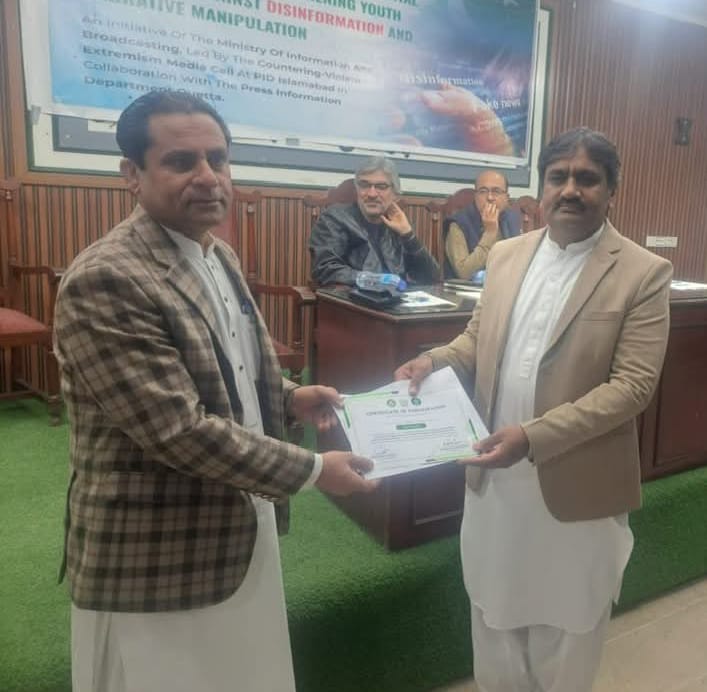
The seminar concluded with Project Director Ranjha and Deputy Director Mandokhail distributing shields and certificates to participants, recognizing their commitment to combating extremism and misinformation.
As digital platforms continue to evolve and information flows accelerate, the insights shared at the Quetta seminar underline that technological challenges require human solutions—with young people at the forefront of these efforts. The message was clear: combating extremism in the digital age requires not just policy interventions, but active citizenship and critical engagement from the next generation.
Fact Checker
Verify the accuracy of this article using The Disinformation Commission analysis and real-time sources.

10 Comments
The seminar’s emphasis on the unique potential of youth to combat extremism and fake news is a wise approach. Tapping into their digital fluency and forward-looking mindset will be key to making real progress on these complex issues.
Balochistan has faced significant security challenges, so tackling extremism and misinformation there is especially critical. Kudos to the organizers for bringing together diverse stakeholders to chart a path forward with youth leadership at the forefront.
Absolutely. Young people in Balochistan and across Pakistan must be empowered to lead the charge against these societal ills. Their voices and actions can have a transformative impact.
The seminar’s focus on the importance of youth leadership in countering extremism and fake news is a timely and necessary initiative. Harnessing the digital skills and future-oriented mindset of young people is a smart approach to tackling these complex problems.
It’s encouraging to see the government and experts recognize the crucial role of youth in addressing the challenges of extremism and misinformation. Equipping young people with the right tools and platforms to lead this fight is a smart long-term investment.
Agreed. Empowering youth as agents of positive change in the digital sphere is an essential strategy. Their energy, digital savvy, and fresh perspectives will be invaluable in combating these societal threats.
Extremism and misinformation are indeed major threats that require a concerted effort, especially from the youth who are most impacted. Kudos to the experts for highlighting this and driving initiatives to empower young people as agents of positive change.
Agreed. Empowering youth to lead the fight against these issues is a smart strategy. Their energy, digital fluency, and fresh perspectives will be invaluable.
Interesting that the government is recognizing the important role young people can play in combating extremism and fake news on digital platforms. Their digital savvy and leadership potential make them well-suited to tackle these critical challenges.
It’s great to see the government taking proactive steps to address the spread of extremism and fake news, which can have such corrosive effects on society. Harnessing the digital savvy of young people makes a lot of sense as part of the solution.