


Listen to the article
Social Media Use for News Declines as Users Seek More Private Spaces
Social media’s dominance as a news source is showing signs of decline in several major markets after years of steady growth, according to the 2018 Digital News Report published by the Reuters Institute. The comprehensive study, covering 37 countries across five continents and based on an online survey of 74,000 people, reveals a six percentage point drop in social media news consumption in the United States, with similar downward trends observed in the UK and France.
Facebook appears to be bearing the brunt of this shift, with researchers noting that most of the decline stems from decreased news discovery, posting, and sharing on the platform. As users retreat from more public forums, messaging apps are emerging as alternative channels for news consumption, with people increasingly seeking more private and less confrontational spaces to communicate.
The migration to messaging platforms is particularly pronounced in certain markets. WhatsApp has become a significant news source for approximately half of online users in Malaysia (54%) and Brazil (48%), and about a third in Spain (36%) and Turkey (30%). This trend reflects broader changes in how audiences are engaging with news content globally.
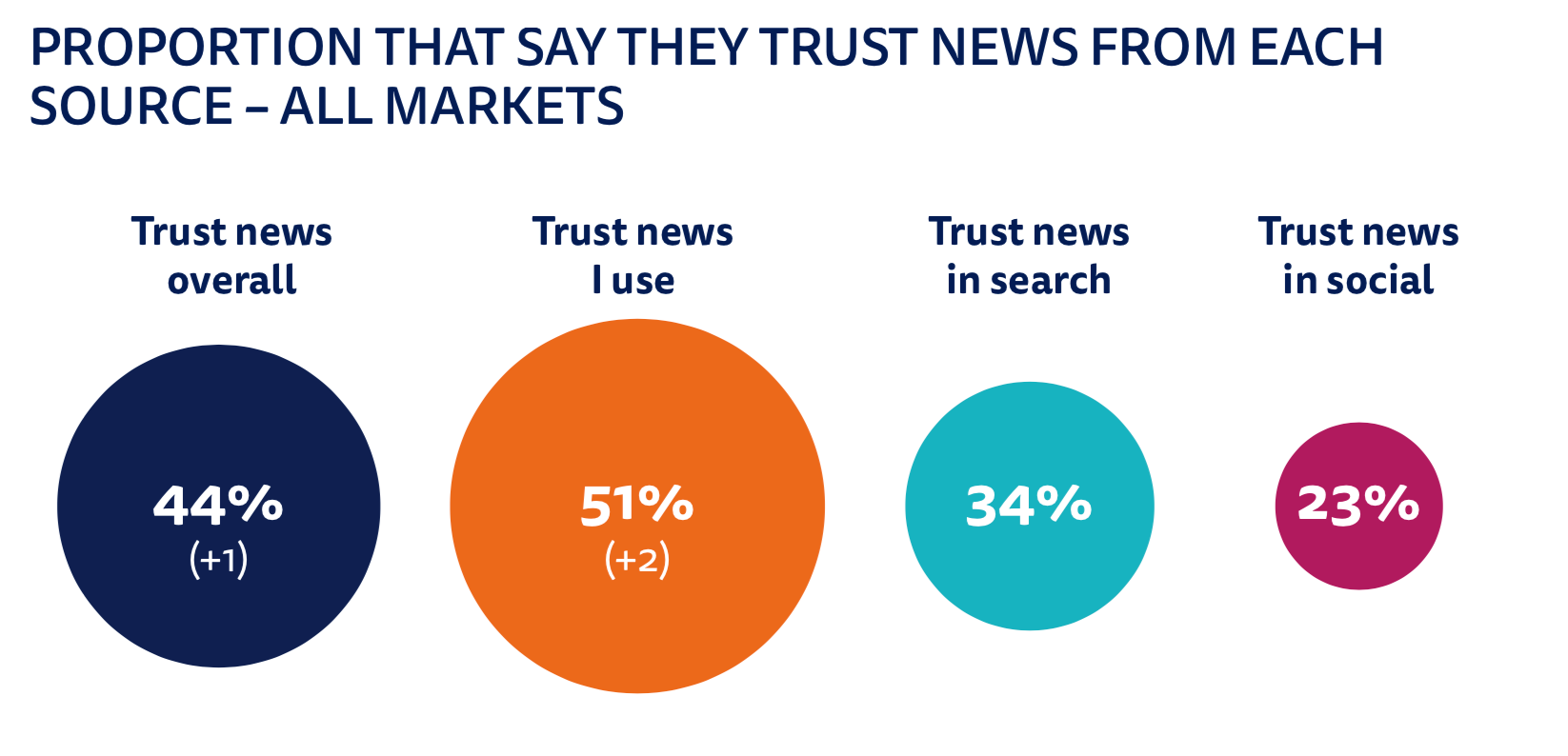
Trust in news media remains a critical issue across markets. The study found the average level of trust in news holds relatively stable at 44%, with just over half (51%) of respondents trusting the news sources they personally use most frequently. However, trust levels drop significantly for news found via search engines (34%) and plummet to less than a quarter (23%) for news encountered on social media platforms.
Concerns about misinformation continue to shape the media landscape. Over half (54%) of respondents expressed worry about distinguishing between real and fake content online. These concerns peak in countries experiencing polarized political environments combined with high social media usage, such as Brazil (85%), Spain (69%), and the United States (64%). By contrast, countries like Germany (37%) and the Netherlands (30%), where recent elections were relatively unaffected by fake content concerns, show lower levels of anxiety.
When it comes to addressing misinformation, respondents primarily place responsibility on publishers (75%) and platforms (71%). Interestingly, there’s notable regional variation regarding government intervention, with greater appetite for official action in Europe (60%) and Asia (63%) compared to the United States, where only 41% of respondents support increased government involvement.
The report also examines emerging trends in news consumption behaviors. Despite the social media decline, digital engagement continues to evolve with growing importance of news apps, email newsletters, and mobile notifications. However, some users report feeling overwhelmed by message volume, particularly due to the proliferation of alerts from aggregators like Apple News and Upday.
Paid news subscriptions show modest growth in several markets, with significant increases in Nordic countries including Norway (+4 percentage points), Sweden (+6), and Finland (+4), where publishers have aggressively pursued various paywall strategies. The “Trump Bump” in U.S. subscriptions observed in 2017 has been maintained, while donation-based memberships are gaining traction in Spain, the UK, and the United States, particularly among younger, politically engaged audiences.
Privacy concerns continue to influence media consumption habits, with more than a quarter of respondents (27%) now using ad-blocking software on some device. The prevalence varies widely by country, from 42% in Greece to just 13% in South Korea.
Traditional television remains a vital news source for many consumers, though ongoing audience declines raise questions about public broadcasters’ future relevance and their ability to attract younger viewers. Meanwhile, news organizations continue to struggle with video consumption on their own platforms, as over half of video viewing occurs on third-party environments like Facebook and YouTube.
Audio formats show promising growth, with podcasts gaining popularity worldwide due to improved content and easier distribution methods. Podcast adoption is nearly twice as high in the United States (33%) as in the UK (18%), with young people significantly more likely to consume podcasts than traditional speech radio. Voice-activated assistants like Amazon Echo and Google Home have more than doubled in usage across the United States, Germany, and the UK, with approximately half of device owners using them for news and information.
The comprehensive report provides critical insights for news organizations navigating the rapidly evolving media landscape, highlighting both challenges and opportunities as consumption habits continue to transform.
Fact Checker
Verify the accuracy of this article using The Disinformation Commission analysis and real-time sources.
