


Listen to the article
Russian Disinformation Campaigns Gain Foothold Across Africa
A Facebook post showcasing Moscow’s modern skyline with luxury yachts gleaming in the golden hour light recently circulated widely on social media. There was just one problem: the image wasn’t of Moscow at all, but Dubai.
This easily debunked falsehood came from an account that regularly shares pro-Russian content and presents itself as a news platform to its 180,000 followers. Despite its Russian identity—including a profile picture of President Vladimir Putin—the account appears to operate from Burundi in East Africa, according to phone number details.
While some posts from the account contain outlandish fabrications, such as claims that a Russian laser weapon destroyed 750 American fighter jets, many feature more subtle messaging. This aligns with growing evidence that Russia is strategically cultivating a positive image across politically important African nations.
According to a March 2024 report by the Africa Center for Strategic Studies, a U.S. military think tank, Russia has emerged as the primary source of state-sponsored disinformation campaigns across Africa. The study identified 80 out of nearly 200 campaigns as Russian in origin—significantly outpacing other nations like China, the UAE, Saudi Arabia, and Qatar. Overall, deliberate disinformation campaigns have increased fourfold since the previous survey two years earlier.
“In Africa, there is a natural juxtaposition of East versus West, in which the West is historically the villain,” explains Aldu Cornelissen, co-founder of South African digital consultancy Murmur Intelligence. “You don’t need lies or disinformation to remind people of this.”
Cornelissen, whose organization analyzes social networks for various clients, describes Russia’s approach as a “global network of key accounts that are interwoven with other key accounts in the African context,” with local influencers adapting narratives to specific regional contexts.
Beverly Ochieng, a researcher with the U.S. Centre for Strategic and International Studies based in Senegal, offers an illustrative example: “When a civil rights group from Mali posts in Bambara, it doesn’t look like it’s coming from a Russian civil servant. It looks like a genuine opinion from someone who speaks the local language and knows the sensitivities of the people.”
This represents a significant evolution from earlier tactics that relied primarily on distant troll factories. Now, local agents familiar with linguistic and cultural nuances generate much of the content, making it appear more authentic to target audiences.
These local participants, whom Cornelissen calls “nano-influencers,” often receive modest payments—around €10 or $11 each—to establish narratives. “If you pay a thousand people 200 Rand each, it’s a very cheap campaign to establish a narrative in one day,” he notes, adding that some eventually internalize these narratives and continue spreading them without compensation.
The ecosystem also includes “buzzers”—human-operated or automated accounts that amplify content through sharing and mutual mentions. The Centre for Analytics and Behavioural Change has documented such a network surrounding the Russian embassy in South Africa, involving pro-Russian U.S. activists and self-proclaimed “alternative media” sources.
Beyond social media, Russia has established direct channels across Africa. In the Central African Republic (CAR), Russian agents reportedly launched radio station Lengo Songo in Bangui in 2018. Last November, European media outlets published an exposé based on a whistleblower who fled CAR after revealing Russia’s media strategy there, which included arranging pro-Russian experts for radio appearances and writing newspaper articles semi-dictated by Russian intermediaries.
Russia’s state broadcaster RT also plays a central role despite being banned in many Western countries following Russia’s invasion of Ukraine. RT has established an English-language media center in South Africa and broadcasts via satellite to several African countries. In Francophone Africa, RT broadcasts in French, featuring journalists from established outlets like Radio Emergence or L’Elite praising Russia’s actions in the Sahel region.
Other Russian-operated outlets include the online news site African Initiative, reportedly linked to the late Yevgeny Prigozhin, founder of the Wagner mercenary group. This self-described “news agency” maintains accounts across various social platforms and has established connections with local journalism schools in Mali, directly recruiting top students as correspondents.
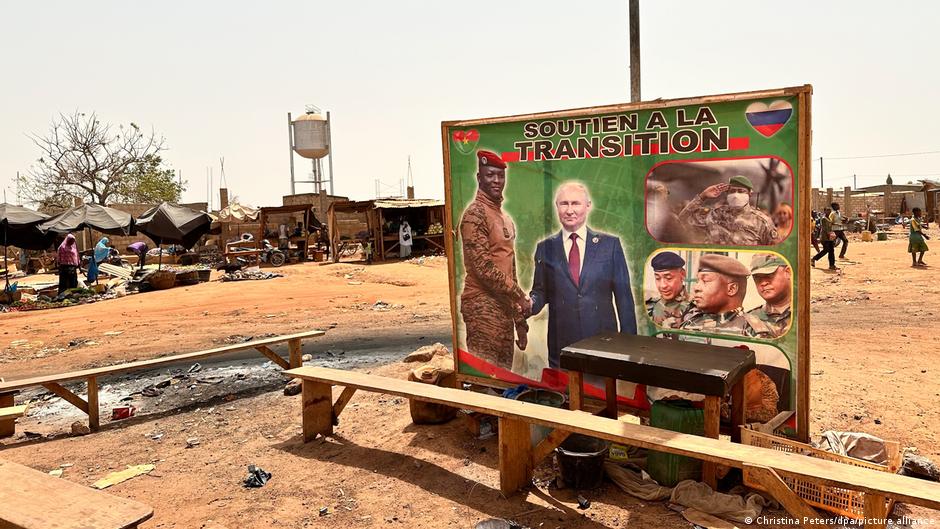
In Burkina Faso, African Initiative frequently hosts public events, including a May 2024 exhibition in Ouagadougou showcasing Russia’s military achievements from World War II to the conflict in Ukraine’s Donbass region. According to local sources, the Burkinabe population is “particularly receptive to stories of military victories against terrorists,” viewing Russian military equipment as proof of effective cooperation.
Russia’s influence extends into pop culture through films like the 2021 action movie “Tourist,” featuring a Russian soldier fighting in the Central African Republic, and the video game “African Dawn,” which allows players to control Sahel armies with Russian support against Western-backed forces.
These campaigns skillfully exploit historical ties and current frustrations with Western nations. When French President Emmanuel Macron suggested in January that Sahel states had forgotten to thank France for protection against militants, African Initiative quickly amplified the outrage, quoting a Russian political scientist on the need for “alternative players” like Russia who would treat African countries with more respect.
The narratives often emphasize the Soviet Union’s historical support for African liberation movements and newly independent states, creating what Ochieng calls “a notion of sentimental glorification” that “Russia remained a friend after being on their side from the beginning.”
This calculated combination of historical references, cultural integration, and strategic messaging has proven effective, with many African nations increasingly receptive to pivoting away from Western relationships toward stronger ties with Russia.
Fact Checker
Verify the accuracy of this article using The Disinformation Commission analysis and real-time sources.

9 Comments
This is a concerning development. Russia seems to be leveraging social media to sow division and erode trust in institutions across Africa. Monitoring and exposing these tactics will be vital to protecting the integrity of information in the region.
I’m not surprised to see Russia targeting African nations with disinformation campaigns. They likely view the continent as a strategic arena to expand their geopolitical influence. Fact-checking and media literacy efforts will be key to pushing back against this.
It’s disturbing to see Russia exploiting social media to spread propaganda and undermine trust in African institutions. This is a troubling trend that merits closer scrutiny and a coordinated response from the international community.
This report highlights the scale and sophistication of Russia’s propaganda machine. The use of fake accounts and subtle messaging to influence public opinion is particularly worrying. We need more transparency and fact-checking to counter these campaigns.
Agreed. Disinformation poses a serious threat to democracy and global stability. Robust media literacy and digital hygiene education will be crucial to equipping citizens to identify and resist these manipulative tactics.
Interesting to see Russia’s disinformation efforts extend to Africa. Curious to know more about the specific tactics and narratives they are pushing in the region. Seems like a concerning trend that merits closer scrutiny.
The scale of Russia’s disinformation efforts in Africa is alarming. Fabricating images and narratives to shape public opinion is a serious abuse of social media. Robust fact-checking and digital literacy programs will be essential to counter these manipulative tactics.
Absolutely. Disinformation poses a grave threat to democratic discourse and stability. Collaborative efforts between governments, tech platforms, and civil society will be crucial to combat this challenge.
This report highlights the sophisticated and multifaceted nature of Russia’s disinformation campaigns in Africa. The use of fake accounts, subtle messaging, and outlandish claims is deeply concerning. Rigorous fact-checking and media literacy efforts will be essential to push back against these manipulative tactics.