


Listen to the article
In an age of rapidly evolving artificial intelligence, social media users find themselves increasingly trapped in a digital hall of mirrors, struggling to distinguish reality from fabrication. The once-simple act of scrolling through social media feeds has transformed into a complex exercise in discernment, with AI-generated content flooding platforms like Facebook, Instagram, and TikTok.
Users now routinely question the authenticity of what they see—from manipulated photos of deceased public figures to entirely fabricated news stories. This proliferation of AI-generated content has created a fundamental breach of trust in media platforms that traditionally served as conduits for factual information.
“Is this real or AI?” has become a common refrain in comment sections, highlighting a growing crisis of confidence in digital information. As the line between fact and fiction blurs, the very foundation of information sharing is being undermined at a time when accurate data remains crucial for research, knowledge development, and informed decision-making.
Social media platforms, originally designed as spaces for entertainment, communication, and connection, have inadvertently become powerful vehicles for disseminating false information. The problem takes multiple forms, each with distinct characteristics and impacts.
Information integrity experts categorize false information into three types. Misinformation refers to inaccurate content shared without malicious intent. Disinformation involves deliberately created deceptive content designed to manipulate audiences. Malinformation uses factual information taken out of context to cause harm, such as leaking private information to damage someone’s reputation.
The current information ecosystem is driven by an attention economy where engagement equals profit. Social media algorithms favor content that generates high engagement, meaning posts that trigger strong emotional responses—particularly outrage or fear—spread more rapidly than fact-based reporting.
Further complicating matters are deepfakes—AI-generated audio and video content so sophisticated that viewers struggle to identify them as fabrications. These technological developments arrive at a time when many users already exist in digital echo chambers that reinforce existing beliefs rather than challenging them, making people less likely to question content that aligns with their worldview.
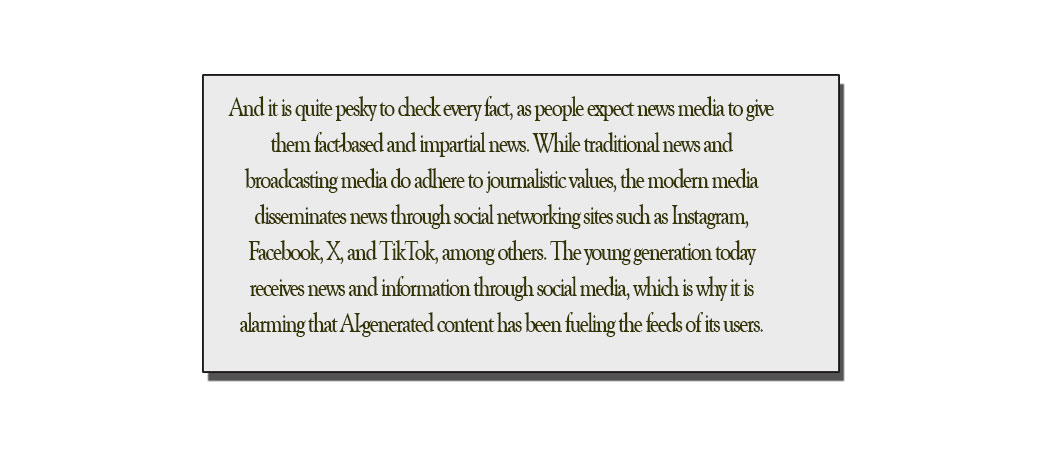
The burden of constant fact-checking is exhausting for users who reasonably expect news media to provide factual, impartial information. While traditional news organizations typically adhere to established journalistic standards, today’s media landscape has expanded to include social networking sites that often lack rigorous editorial oversight.
This shift is particularly significant for younger generations who primarily receive news through social platforms rather than traditional media outlets. The prevalence of AI-generated content in these spaces represents a serious challenge to information literacy and public discourse.
For those seeking to navigate this complex landscape, several verification strategies can help. Checking the reliability of sources, confirming publication dates, and using reverse image search tools can assist in identifying suspicious content. However, these steps require time and effort that many users may not consistently invest in their daily media consumption.
In this AI-dominated era, accurate information remains valuable but increasingly elusive. The digital world has become an authenticity minefield where determining truth requires vigilance, skepticism, and media literacy skills that many are still developing. As technology continues to advance, the challenge of maintaining an information ecosystem grounded in reality will likely intensify.
Fact Checker
Verify the accuracy of this article using The Disinformation Commission analysis and real-time sources.

7 Comments
The blurring of fact and fiction online is troubling, especially for industries like mining that require reliable data. I hope social media companies take stronger action to combat AI-generated content and restore user trust.
This is a critical issue as AI-generated content continues to flood social media. Discerning fact from fiction is becoming increasingly challenging for users. I hope platforms can find solutions to restore trust and credibility.
As someone who follows the mining and commodities space, I’m concerned about the potential spread of misinformation. Accurate information is vital for understanding market trends and making informed investment decisions.
I agree, misinformation can have serious consequences in the mining and energy sectors. Fact-based reporting is essential for these industries.
As someone with a keen interest in the mining and energy space, I’m concerned about the proliferation of AI-generated content on social media. Fact-checking and transparency are essential to maintaining credibility in these industries.
Maintaining the integrity of information online is crucial, especially for industries like mining that rely on accurate data for research and decision-making. More robust fact-checking and transparency from platforms is needed.
This is a complex issue with major implications for mining and related sectors. Accurate, unbiased information is critical for these industries to function effectively. I’m curious to see what solutions emerge to address the misinformation crisis.