


Listen to the article
Pakistan’s battle against climate disinformation is undermining resilience efforts in one of the world’s most climate-vulnerable nations, according to new research released last week.
A comprehensive study by the Institute for Research, Advocacy and Development (IRADA), supported by International Media Support (IMS), reveals how false narratives surge during extreme weather events, hampering response efforts and disproportionately affecting Indigenous and rural communities.
The report, “Climate Disinformation in Pakistan: Silencing Indigenous Peoples’ Voice,” documents over 200 instances of climate misinformation during recent disasters. The findings show that 95% of disinformation cases occurred during high-impact events like floods, heatwaves, and droughts—precisely when accurate information is most critical.
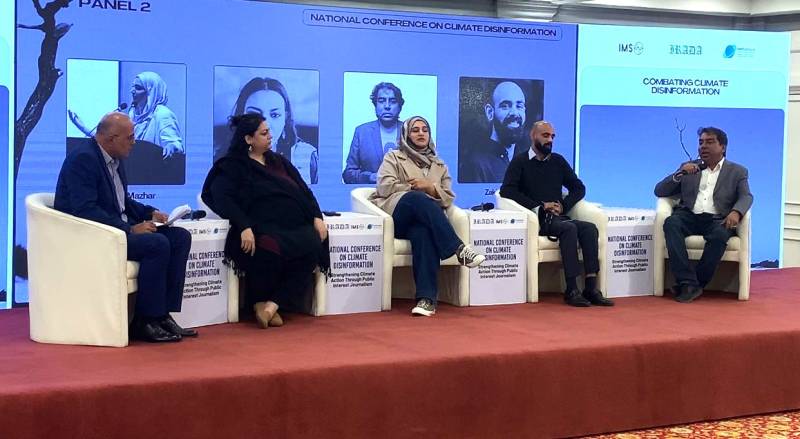
“Climate resilience depends not only on infrastructure and adaptation planning but also on ensuring accurate information in climate governance,” said Muhammad Aftab Alam, Executive Director of IRADA, during the National Conference on Climate Disinformation held in Islamabad on December 11.
The 2025 monsoon floods exemplify this challenge, when misleading claims of a “cloudburst” phenomenon quickly overshadowed scientific evidence about the disaster’s true causes. Despite repeated warnings from the Intergovernmental Panel on Climate Change (IPCC) about erratic rainfall patterns in South Asia, climate change in Pakistan continues to be dismissed by many as foreign propaganda or divine punishment.
The study highlights how social media platforms serve as primary vectors for misinformation, with 98% of documented cases spreading through these channels. Content predominantly circulates in Urdu and regional languages, creating information vacuums that official sources fail to fill promptly.
Adnan Rehmat, IMS Programme Manager, emphasized this communication breakdown: “Climate communication is the road that connects climate policy with climate action. In Pakistan, that road is often broken.”
For Pakistan’s estimated 4-5 million Indigenous people, the consequences are severe. These communities—which include diverse ethnic, tribal, pastoral, forest-dependent, and coastal populations—face confusion over evacuation decisions, psychological distress from disaster uncertainty, and further exclusion from climate policy decisions when misinformation flourishes.
Lead researcher Humera Qasim Khan observed that women in these communities bear a disproportionate burden. “During my visits to flood-affected areas, I witnessed how mountain communities are disproportionately impacted, with women bearing the heaviest burden,” Khan said. “Many women do not have access to mobile phones to contact family members, nor do they possess the disaster-response skills that men typically have.”
The research also exposes serious deficiencies in climate journalism in Pakistan. Coverage remains largely reactive, focusing on immediate events rather than underlying causes or adaptation strategies. During the devastating 2022 floods, fewer than half of television bulletins featured flood news as their top headline.
Environmental journalist Amar Guriro highlighted the structural challenges: “Environmental journalism is expensive and often rejected by newsrooms. Covering a glacial lake outburst flood properly can cost up to one lakh rupees, leading editors to abandon such reporting in favor of cheaper political stories.”
Climate activist Afia Salam pointed to government sources themselves as origins of misinformation, noting that authorities frequently highlight climate impacts on agriculture while ignoring emissions from methane gas, machinery, and fertilizer production.
The Pakistani findings mirror global concerns about climate disinformation. For the first time, the recent COP30 climate conference formally recognized climate disinformation as a global threat, launching the Global Declaration on Information Integrity to protect truth in climate communication.
Modern climate disinformation rarely relies on outright denial, according to international research. Instead, it creates confusion, portrays climate solutions as unrealistic, and isolates supporters of climate action by amplifying misleading content—tactics evident in the Pakistani context as well.
Dr. Abid Suleri, Executive Director of the Sustainable Development Policy Institute, emphasized that effective solutions must be locally grounded: “Climate plans should flow upwards from districts to the national level, not the other way around,” he warned, cautioning against top-down policymaking that ignores community experiences.
As the conference concluded, participants reached a consensus that resonates beyond Pakistan’s borders: a nation cannot effectively fight climate change while simultaneously battling misinformation about climate change itself.
Fact Checker
Verify the accuracy of this article using The Disinformation Commission analysis and real-time sources.

17 Comments
The report highlights a critical challenge in building climate resilience – the need to combat false narratives and misinformation, especially during extreme weather events. Empowering local voices and improving climate governance are crucial steps.
Well said. Accurate, timely information is essential for effective disaster response and recovery efforts. Addressing the spread of climate misinformation should be a key priority for policymakers and community leaders.
This is a stark reminder of the real-world impacts of climate misinformation. Ensuring vulnerable populations have access to reliable information during emergencies is critical for saving lives and livelihoods. Tackling this issue should be a top priority.
The report highlights a critical challenge in addressing the climate crisis – the need to combat the spread of misinformation, especially during high-impact events. Strengthening climate governance and resilience must include strategies to identify and counter false narratives.
Exactly. Accurate, trusted information is essential for effective disaster response and recovery. Tackling climate misinformation should be a key priority for policymakers and community leaders working to build climate resilience.
Disturbing to see how climate disinformation can undermine emergency response efforts and disproportionately impact marginalized groups. Fact-based reporting and communication are critical for protecting lives and livelihoods during extreme weather events.
This is a sobering example of how climate misinformation can have devastating real-world consequences, especially for vulnerable populations. Ensuring access to reliable information during emergencies is critical for protecting lives and livelihoods.
Worrying to see how climate misinformation can undermine disaster response efforts in vulnerable regions. Accurate, timely information is critical during extreme weather events. Hope Pakistan can find ways to combat these false narratives and empower local communities.
Absolutely. Misinformation can be deadly when it comes to climate-related emergencies. Fact-based reporting and communication are essential for effective disaster preparedness and recovery.
This is a sobering example of how climate misinformation can have devastating real-world consequences. Protecting vulnerable populations requires robust efforts to identify and counter false narratives, especially during emergencies.
This is a stark reminder of the real-world consequences of climate misinformation. Disproportionately impacting marginalized groups makes it an even more serious issue. Strengthening climate governance and resilience should be top priorities.
Agreed. Tackling climate misinformation is a critical part of building climate resilience, especially for vulnerable populations. Empowering local voices and ensuring access to accurate information are key steps.
Disturbing to see how climate disinformation can undermine emergency response efforts during extreme weather events in Pakistan. Accurate, timely information is vital for protecting lives and livelihoods. Addressing this challenge should be a priority.
The findings underscore the importance of combating climate misinformation, especially in regions like Pakistan that are on the frontlines of the climate crisis. Strengthening climate governance and resilience efforts must include strategies to identify and counter false narratives.
Absolutely. Misinformation can have devastating consequences when it comes to disaster response and recovery. Empowering local communities with accurate, timely information is essential for building climate resilience.
The findings highlight the urgent need to combat climate misinformation, especially during high-impact disasters when reliable information is most crucial. Strengthening climate governance and resilience efforts must include tackling false narratives.
Exactly. Disinformation can severely hamper disaster response and recovery. Ensuring marginalized communities have access to accurate, trusted information should be a key part of climate adaptation planning.