


Listen to the article
The Legacy of G.I. Jane: When Breaking Glass Ceilings Comes at a Cost
The 1990s marked a significant era for women in action roles, with female characters increasingly appearing in uniform across film and television. From Jamie Lee Curtis in “Blue Steel” to Jodie Foster in “The Silence of the Lambs” and Michelle Yeoh as a supercop in “Police Story 3,” the decade measured female empowerment through institutional advancement and breaking glass ceilings.
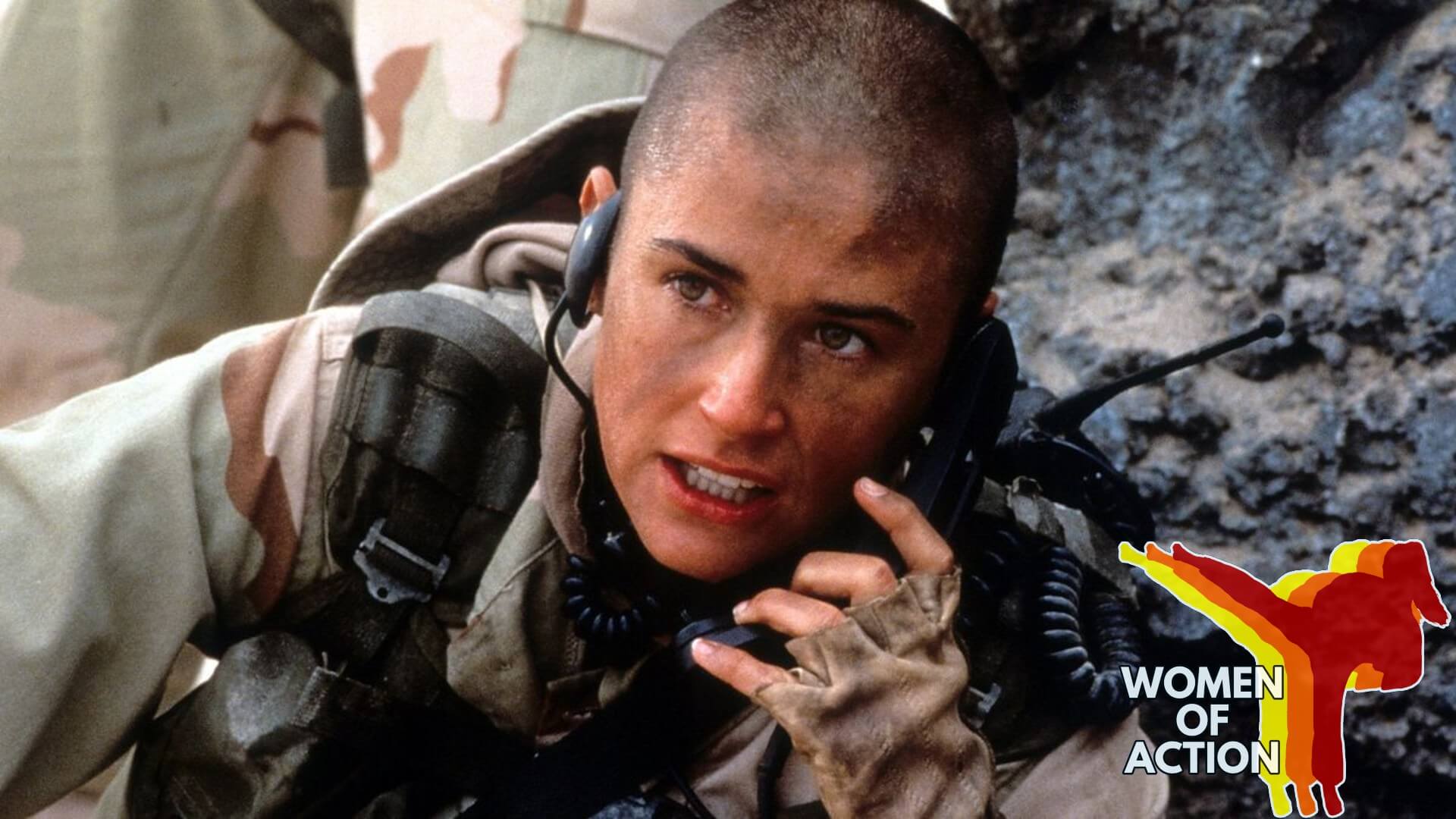
Perhaps no film encapsulates this trend more directly than Ridley Scott’s 1997 military drama “G.I. Jane,” a production that remains a fascinating cultural artifact nearly three decades after its release. The film stars Demi Moore as Lieutenant Jordan O’Neil, a topographical analyst chosen to be the test case for integrating women into the elite Navy SEALs program.
What makes “G.I. Jane” particularly intriguing today is its unapologetically blunt approach to gender politics. The film opens with Senator Lillian DeHaven (played with Southern swagger by Anne Bancroft) grilling a Navy Secretary nominee about the military’s treatment of women. As DeHaven pointedly explains, because women were barred from combat roles, nearly one-quarter of military positions – and many paths to advancement – remained off-limits to them.
The film deserves credit for addressing institutional sexism head-on, though its directness occasionally feels heavy-handed. This straightforwardness has become what some critics now call “the Barbie monologue problem” – where explicit discussions of sexist double standards can feel awkward even when they’re accurate. That discomfort itself represents a tool of patriarchy: making it seem “uncool” to directly address misogyny.
Where “G.I. Jane” finds its most compelling moments is in Ridley Scott’s cynical examination of political and military institutions. The Department of Defense wants O’Neil’s experiment to fail, deliberately putting her through the most grueling training program with its 60% dropout rate. Meanwhile, Senator DeHaven focuses primarily on optics, ruling out candidates who look “too butch” and immediately asking O’Neil if she has a boyfriend, concerned about perceptions.
Despite Moore’s committed performance – complete with a famously shaved head and impressive one-armed push-ups – the film struggles to define O’Neil beyond her determination and professionalism. Unlike “Top Gun,” which gave its characters distinct personalities and off-duty lives, “G.I. Jane” offers little insight into who O’Neil is outside her military ambitions. The script, originally conceived by Danielle Alexandra before “The Fugitive” co-writer David Twohy was brought in for a more action-oriented rewrite, presents her more as an ideological symbol than a fully realized character.
This one-dimensional characterization underscores the film’s central contradiction. To root for O’Neil’s success means cheering for her to subsume her identity to an institution that the film itself portrays as abusive and dehumanizing. Training sequences show recruits being stripped of their humanity and transformed into obedient components of a military machine – including a controversial scene where Command Master Chief Urgayle (Viggo Mortensen) threatens to rape O’Neil during an enemy prison simulation.
The film doesn’t critique this military culture so much as celebrate those who can endure it. Media scholars have noted that even movies that don’t explicitly glorify the military can serve as effective recruiting tools simply by portraying it as honor-bound and action-packed. Scott opted not to collaborate with the Pentagon after they demanded script changes (including removing the head-shaving sequence), yet “G.I. Jane” still evokes François Truffaut’s famous observation that “Every film about war ends up being pro-war.”
The strongest thesis of “G.I. Jane” centers on choice – not that gender parity in the military is inherently desirable, but that women deserve the same career opportunities available to men. This pro-choice message, however, is complicated by depicting a system that ultimately strips trainees of their autonomy.
For Moore, the film represents a strange inflection point in her career. Following her record-setting $12.5 million payday for the critically panned “Striptease” (which the press deemed excessive despite male stars earning substantially more that same year), “G.I. Jane” received positive reviews for Moore’s performance but still earned her a Razzie for Worst Actress. The public backlash contributed to her decision to step away from Hollywood at age 35 to raise her children in Idaho.
“G.I. Jane” ironically limited Moore’s choices as an actress rather than empowering her. As she later reflected, “With ‘Striptease,’ it was as if I had betrayed women, and with ‘G.I. Jane,’ it was as if I had betrayed men.” Despite this, Moore has called the film her proudest professional achievement, highlighting the contradictory nature of its legacy.
Today, “G.I. Jane” stands as both a product of its time and a still-relevant examination of gender barriers in traditionally male institutions. While the film’s execution may feel dated, the questions it raises about institutional power, assimilation, and the true meaning of equality remain unresolved. For a mainstream 1990s action movie, “G.I. Jane” offered considerable depth – even if its ultimate message remains ambiguous.
Fact Checker
Verify the accuracy of this article using The Disinformation Commission analysis and real-time sources.

12 Comments
As someone with a keen interest in military and defense topics, I found this a thought-provoking read. G.I. Jane was a landmark film that raised important questions about women’s roles and representation. It’ll be fascinating to see how these issues continue to evolve.
Absolutely. The film may have been made decades ago, but the underlying themes around gender, power, and institutional change remain highly relevant today. Continuing to examine these dynamics through a critical lens is so important.
The article raises good points about how G.I. Jane grappled with gender politics in the military. It’s a complex issue without easy answers, but stories like this can help foster important discussions.
Absolutely. Nuanced portrayals that don’t shy away from the challenges can be valuable in advancing more inclusive representation, even if they don’t provide simple solutions.
Interesting to see the evolution of female representation in military media. G.I. Jane shined a spotlight on the challenges women faced in breaking into elite combat roles. It’ll be fascinating to see how this narrative continues to unfold.
You’re right, the film highlighted the barriers and costs that came with pushing those boundaries. It’ll be important to keep examining how media reflects and shapes these complex social and political dynamics.
The article’s analysis of G.I. Jane as a cultural artifact is really insightful. It’s a complex film that grapples with important issues around gender, power, and institutional change. Looking forward to seeing how this narrative continues to unfold.
Agreed, unpacking these types of films through a critical lens can yield a lot of valuable insights. It will be interesting to see how future works in this space build on or challenge the themes explored in G.I. Jane.
As a fan of military/action films, I’m curious to see how the depiction of women in these roles has evolved over time. G.I. Jane was a landmark film, but there’s still room for progress in reflecting the diverse experiences of female service members.
That’s a great point. Continuing to expand the range of perspectives and stories told will be key to driving more authentic and empowering representation in this genre.
Really enjoyed the nuanced analysis of G.I. Jane in this article. It’s a complex film that grappled with some challenging issues around female empowerment and the costs of breaking through glass ceilings. Looking forward to seeing how the representation of women in military media continues to evolve.
Great point. G.I. Jane was a landmark film that pushed boundaries, but as the article highlights, it also revealed some of the difficulties and trade-offs that came with that. Examining these dynamics through a critical lens is crucial as the landscape continues to shift.