


Listen to the article
U.S. Military Post Features Extremist Symbol Alongside Defense Secretary Hegseth
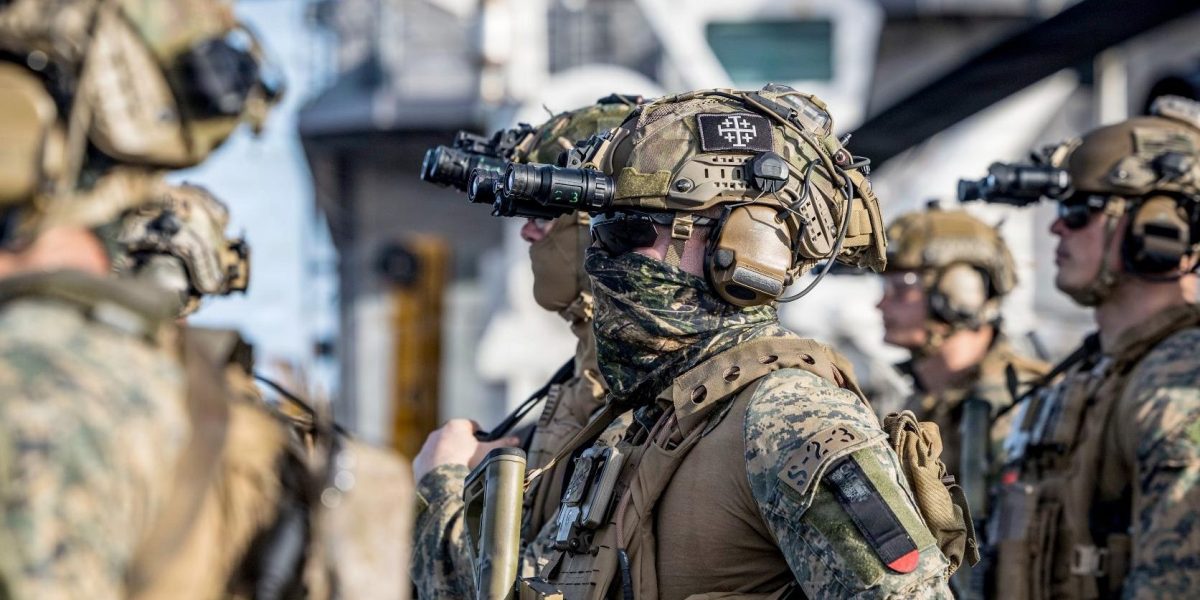
A U.S. Southern Command social media account sparked controversy Monday after sharing a photo collage featuring a Jerusalem cross, a symbol associated with extremist groups, alongside Secretary of Defense Pete Hegseth.
The post on X highlighted troops deployed to the Caribbean and prominently displayed the so-called “Crusader cross” on a masked commando’s helmet. While not inherently extremist, the Jerusalem cross has gained popularity among right-wing groups as a symbol representing Christian civilization’s advancement, with anti-Muslim connotations that made it something of an unofficial emblem during America’s war on terror.
The symbol’s appearance coincides with President Donald Trump’s military buildup against Venezuela—an overwhelmingly Catholic country—and controversial maritime operations in the Caribbean.
“As with all things Trump, it’s a continuation, with some escalation, and then a transformation into spectacle,” explained Yale University historian Greg Grandin, whose research focuses on U.S. empire in Latin America.
The social media controversy emerges amid growing scrutiny of Operation Southern Spear, a series of strikes against boats allegedly carrying drugs off Venezuela’s coast. Hegseth is alleged to have ordered a “double-tap” strike—a controversial follow-up attack that killed survivors clinging to wreckage for approximately 45 minutes. Since the campaign began in September, U.S. forces have conducted 22 strikes, resulting in 87 deaths.
When asked about the Jerusalem cross, the Pentagon directed inquiries to SOUTHCOM. Joel Valdez, Hegseth’s deputy press secretary, appeared to approve of the post, responding with salute and American flag emojis. SOUTHCOM spokesperson Steven McLoud denied any religious or far-right messaging in the image.
“The graphic you’re referring to was an illustration of service members in a ready posture during Operation SOUTHERN SPEAR,” McLoud told The Intercept. “There is no other communication intent for this image.”
The original image apparently came from a Pentagon-published album showing Marines training aboard the USS Iwo Jima in October. However, the specific photo featuring the cross was removed after social media users highlighted its origins. Amanda Saunders, a spokesperson for the Defense Visual Information Distribution Service, noted that individual military units control what content gets published or removed from the platform.
Hegseth’s Personal Connection
The Jerusalem cross has gained popularity on the right partly through its portrayal in media, including Ridley Scott’s 2005 film “Kingdom of Heaven” and various video games, according to Matthew Gabriele, a Virginia Tech medieval studies professor who specializes in Crusader iconography.
“It supports the rhetoric of ‘defense of homeland,'” Gabriele explained, “because the crusaders, in the right’s understanding, were waging a defensive war against enemies trying to invade Christian lands.”
The symbol’s prominence in official military communications represents another instance of provocative messaging from Trump administration press teams, who often celebrate harsh actions against perceived enemies both domestic and foreign.
For Hegseth personally, the post may serve as a rebuke to Pentagon traditionalists. His own Jerusalem cross tattoo temporarily derailed his military career following the January 6 insurrection, when he was ordered to stand down rather than deploy with his National Guard unit ahead of President Biden’s 2021 inauguration. According to the Washington Post, Hegseth was flagged as a possible “insider threat” after someone shared a photo of his shirtless torso with military leadership.
“I joined the Army in 2001 because I wanted to serve my country. Extremists attacked us on 9/11, and we went to war,” Hegseth wrote in his 2024 memoir “The War on Warriors.” “Twenty years later, I was deemed an ‘extremist’ by that very same Army.”
Far from being deterred, Hegseth has since added more controversial tattoos, including the Arabic word for “infidel” on his bicep and the Latin phrase “Deus vult” (“God wills it”)—another Crusades slogan adopted by extremist groups.
The use of such imagery to advertise military operations in predominantly Christian Latin America might seem peculiar. However, it symbolizes the shift of U.S. military focus from the Middle East to the Western Hemisphere, aligning with Trump’s recently released National Security Strategy. The 33-page document explicitly compares Trump’s approach to the Monroe Doctrine, the historical policy asserting U.S. dominance in Latin America against foreign colonialism.
“They’re globalizing the Monroe Doctrine,” Grandin observed. “I’m no fan of the hypocrisy and arrogance of the old liberal international order, but there’s something to be said for starting from a first principle of shared interests, which does keep great conflict at bay to some degree.”
Fact Checker
Verify the accuracy of this article using The Disinformation Commission analysis and real-time sources.

14 Comments
The use of the Crusader symbol on military equipment is concerning. While the symbol has a complex history, its association with religious extremism and anti-Muslim sentiment makes it inappropriate for official use. The military should exercise caution when depicting symbols that could be seen as divisive or inflammatory.
I agree, the military should avoid using symbols with such a contentious history, even if unintentional. Maintaining neutrality and professionalism is crucial, especially in sensitive geopolitical contexts.
The appearance of the Crusader symbol in official military imagery is highly problematic and merits immediate attention. While the symbol may have a complex history, its modern associations with religious extremism and anti-Muslim sentiment make it an unacceptable choice for official use, especially in sensitive geopolitical contexts. The military must exercise greater care and sensitivity in their visual branding and symbolism.
I agree completely. The military should be extremely cautious about the symbolism they choose to represent their operations, as even unintentional associations with extremist ideologies can be extremely damaging to their credibility and public trust. Professionalism and neutrality should be the top priorities.
The use of the Crusader symbol in official military imagery is highly concerning and raises serious questions about the military’s awareness of the symbol’s associations with religious extremism and anti-Muslim sentiment. The military should exercise greater caution and sensitivity when it comes to the visual branding and symbolism they choose to represent their operations.
You make a valid point. The military must be extremely mindful of how their visual messaging and symbolism can be perceived, even if unintentional. Maintaining a neutral, professional stance is crucial for building public trust and international credibility.
This seems like a concerning use of imagery that could be interpreted as promoting religious or ideological agendas. The military should strive for impartiality and avoid symbols that could be seen as exclusionary or biased, especially in operations involving diverse populations.
You raise a good point. The military should be mindful of how their visual messaging and symbolism can be perceived, even if unintentional. Maintaining a neutral, professional stance is important for public trust and international credibility.
While the Crusader symbol has a complex history, its contemporary associations with religious extremism make it an unwise choice for official military use. The military should be cognizant of how their imagery and symbolism could be interpreted, especially in geopolitical contexts involving religious or ideological tensions.
I agree, the military needs to be extremely cautious about the symbolism they use, as even unintentional associations with extremist groups can be very damaging. Professionalism and neutrality should be the top priorities.
The use of the Crusader symbol in official military imagery is concerning and merits closer scrutiny. While the symbol may not inherently be extremist, its modern associations with anti-Muslim sentiment make it a problematic choice. The military should strive for greater awareness of how their visual branding can be perceived.
You raise a valid point. The military should be very mindful of the broader cultural and political implications of the symbols they choose to depict, even if the intent is not to promote any particular ideology. Maintaining an impartial, professional image is crucial.
This is a complex issue, as the Crusader symbol has a long and nuanced history. However, its modern association with religious extremism and anti-Muslim sentiment makes it an unwise choice for official military use, especially in sensitive geopolitical contexts. The military should exercise greater care in their visual branding and symbolism.
I agree that the military needs to be extremely cautious about the symbolism they choose to depict, even if unintentional. Maintaining a neutral, professional image should be the top priority, especially when operating in diverse international contexts.