


Listen to the article
Switzerland Cancels Screening of Russian Propaganda Film After Ukrainian Protests
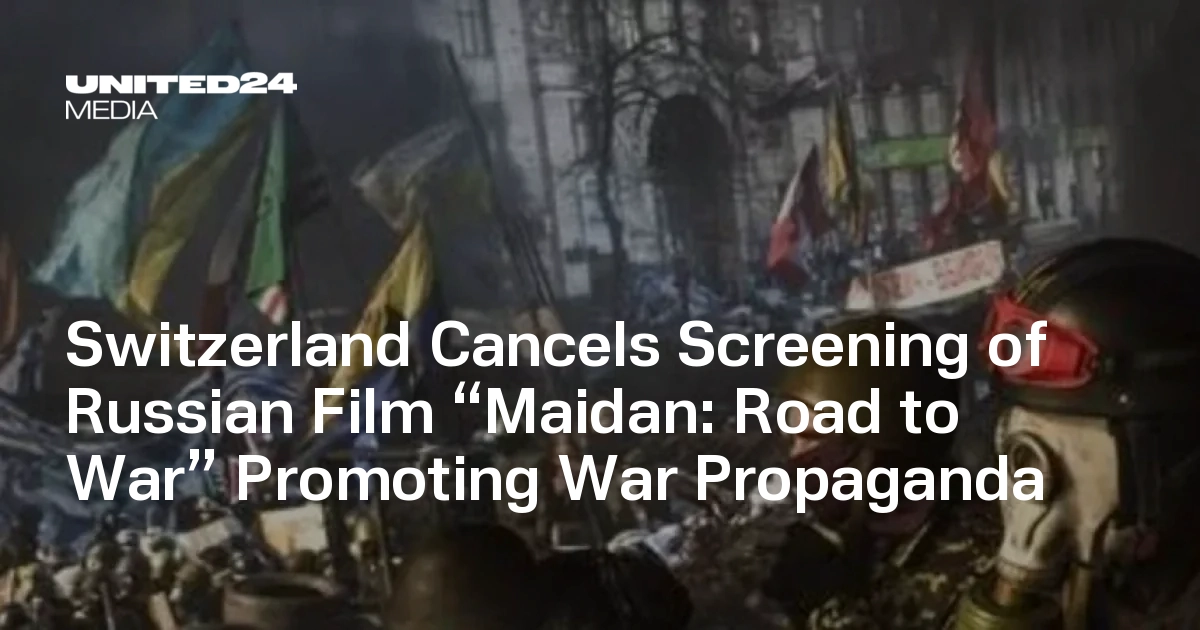
Swiss officials have canceled the screening of “Maidan: Road to War,” a controversial film produced by Russian state media outlet Russia Today, following coordinated protests from Ukrainian diplomats and civil society activists. The decision was announced by Ukraine’s Foreign Minister Andrii Sybiha on January 12.
The film, which was scheduled to be shown in the municipality of Muralto, became the center of diplomatic tension after Ukrainian representatives highlighted its propagandistic nature and potential for spreading disinformation about Russia’s ongoing war against Ukraine.
“Kremlin propaganda has no place in public venues,” Sybiha stated. “Free speech must not be a shield for disinformation or war justification.” The minister emphasized that Russia has systematically used cultural platforms across Europe as instruments of information warfare, with the consistent aim of undermining democratic societies and manipulating public opinion.
The controversial film reportedly frames Ukraine’s 2014 Revolution of Dignity, known as Euromaidan, as the primary cause of the current conflict while accusing Ukrainian forces of targeting civilians in the eastern Donbas region between 2014 and 2022 – narratives that align with long-standing Kremlin talking points.
Ukrainian artist Iryna Winnik described the film as “a classic tactic of hybrid information warfare” designed to legitimize Russia’s territorial aggression in the eyes of European audiences, particularly targeting Italian-speaking communities in Switzerland. According to Winnik, the film creates a false impression of presenting an “alternative perspective” while actually promoting Russian state propaganda.
The screening had reportedly been organized by Vincenzo Lorusso, founder of an organization called Donbass Italia, who Ukrainian officials say openly supports Russian-backed separatist entities in eastern Ukraine and raises funds for Russian occupation forces. Also involved was Eliseo Bertolazi, a journalist with established connections to Russian state media who has reportedly served as an “international observer” at what Ukraine and the international community consider illegitimate Russian-organized “referendums” in occupied Ukrainian territories.
This incident highlights the ongoing information battle that parallels the physical conflict in Ukraine. Since Russia’s full-scale invasion in February 2022, media and cultural spaces have become contested ground where narratives about the war compete for legitimacy.
The cancellation in Switzerland represents a significant diplomatic victory for Ukraine in its efforts to counter Russian information operations in Western Europe. It comes at a time when European countries continue to grapple with how to balance free speech protections with the need to prevent the spread of state-sponsored disinformation.
Russia Today, commonly known as RT, has faced widespread restrictions across Europe since the war’s escalation. The European Union banned the network in March 2022, describing it as a “propaganda outlet” that had been instrumental in supporting Russia’s aggression and destabilizing neighboring countries.
The Swiss decision aligns with growing European consensus on the need to limit platforms for Russian state media while the conflict continues. However, Russia has developed various workarounds to these restrictions, creating alternative channels and outlets that continue to disseminate similar content.
According to Ukraine’s Ministry of Culture, Russia’s invasion has resulted in the destruction or damage of 307 cultural heritage sites and 261 cultural infrastructure objects in Ukraine during 2025 alone, underscoring what Ukrainian officials describe as Russia’s “cultural warfare” alongside its military campaign.
The incident demonstrates the complex interplay between freedom of expression, national security concerns, and the fight against disinformation that continues to challenge democratic societies across Europe as the war in Ukraine approaches its fifth year.
Fact Checker
Verify the accuracy of this article using The Disinformation Commission analysis and real-time sources.

16 Comments
The cancelation of this film screening is a positive step, but it’s clear that the Kremlin will continue to exploit cultural and media channels to justify its aggression in Ukraine. Protecting democratic values and preserving the historical record requires sustained, coordinated efforts to combat Russian disinformation.
Well said. Russia’s information warfare is a serious and ongoing threat that can’t be underestimated. Kudos to the Swiss authorities for taking a principled stand, but the work of countering these propaganda efforts is far from over.
This film sounds like a clear attempt by Russia to distort the facts and rewrite the history of the Ukraine conflict. Spreading disinformation under the guise of free speech is a dangerous tactic that undermines democracy. I’m glad Swiss authorities recognized the propaganda nature of this movie and canceled the screening.
Agreed, it’s important to call out these kinds of manipulative efforts to shape public opinion. Allowing Russian state media to spread false narratives would only embolden their information warfare against Ukraine.
This is an important reminder that Russia is actively using cultural platforms to advance its geopolitical agenda. Kudos to the Swiss authorities for recognizing the propagandistic nature of this film and taking action to prevent its screening. Maintaining a free and open society requires vigilance against such manipulation attempts.
Agreed. Allowing Russian state media to freely disseminate their distorted narratives would be a grave mistake. Governments must be proactive in identifying and countering these kinds of information warfare tactics.
This decision by Swiss officials demonstrates an important understanding of the role that cultural platforms can play in the Kremlin’s information warfare strategy. Allowing the screening of this film would have given undeserved legitimacy to Russia’s distorted narrative about the origins of the Ukraine conflict.
Exactly. Protecting free speech is crucial, but it can’t come at the expense of enabling the spread of blatant disinformation. Kudos to the Ukrainian diplomats and activists who worked to raise awareness about the propagandistic nature of this film.
The cancelation of this film screening is a welcome development, but it’s clear that the Kremlin will continue to exploit cultural and media channels to justify its illegal invasion of Ukraine. Combating Russian disinformation requires a sustained, multilateral effort to protect democratic values and the historical record.
Well said. This is just one small battle in a much larger war against the Kremlin’s information warfare tactics. Maintaining vigilance and a coordinated response is essential to countering these attempts to manipulate public opinion.
The decision to cancel this screening is a positive step, but we must remain vigilant against the Kremlin’s ongoing attempts to rewrite history and sway public opinion. Countering disinformation requires sustained efforts from governments, civil society, and the media.
Well said. Disinformation is a serious threat to democratic societies, and we can’t let Russia’s propaganda machine go unchallenged. This is a small victory, but the fight against this kind of information warfare continues.
The cancelation of this film screening is a positive step, but it’s concerning to see Russia persistently using cultural platforms to spread its distorted narratives about the Ukraine conflict. Protecting democratic values and the integrity of historical records requires a concerted, long-term effort to counter Kremlin disinformation.
Absolutely. The Kremlin’s information warfare tactics are a serious threat to democratic societies, and we can’t afford to let our guard down. Kudos to the Swiss authorities for recognizing the propagandistic nature of this film and taking action to prevent its screening.
It’s good to see Switzerland taking a firm stance against Russian propaganda. This film is likely part of a broader Kremlin strategy to justify its illegal invasion of Ukraine. I hope other countries follow suit in protecting their citizens from such blatant disinformation campaigns.
Absolutely. Enabling the spread of Russian propaganda gives it legitimacy it doesn’t deserve. Kudos to the Ukrainian diplomats and activists who worked to get this screening canceled.