


Listen to the article
In a significant shift of federal messaging, the Trump administration has launched a coordinated campaign across multiple departments featuring imagery and language that experts say draws heavily from right-wing and white nationalist rhetoric.
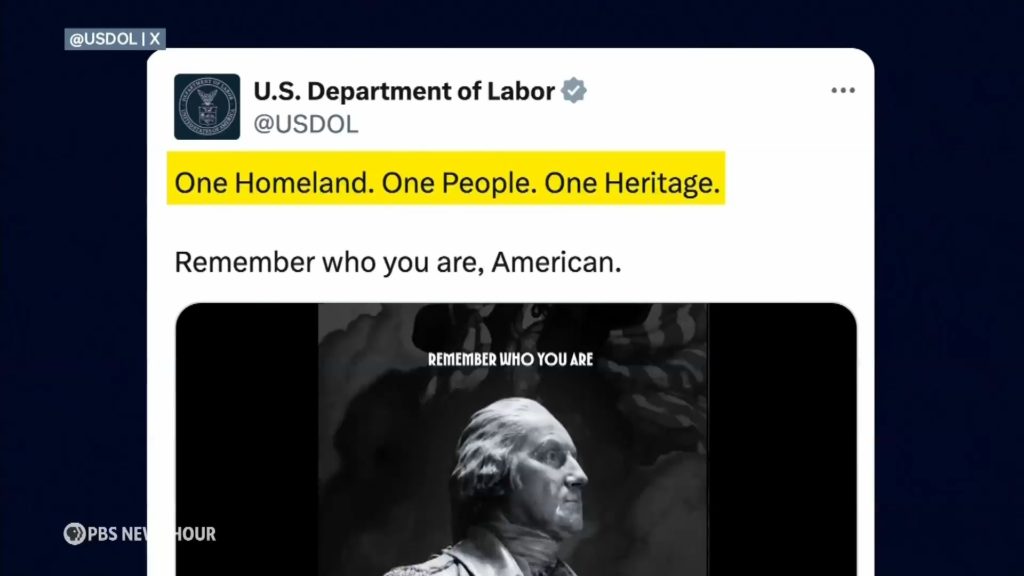
Recent weeks have seen an unprecedented surge in official government communications containing what analysts describe as coded messaging and nostalgic imagery reminiscent of nationalist ideology. The Department of Labor released a video declaring “One homeland, one people, one heritage. Remember who you are, American,” while Immigration and Customs Enforcement (ICE) published recruitment materials calling on potential agents to “defend the homeland” from outsiders.
One particularly controversial ICE recruitment advertisement featured the phrase “We will have our home again” overlaid on an image of a man on horseback with a stealth bomber in the background. Experts note this phrase directly references a white supremacist anthem popular among far-right groups like the Proud Boys.
Other official communications have included phrases like “Trust the plan,” which is widely recognized as a slogan of the QAnon conspiracy theory movement. This group believes in a complex narrative involving a global cabal of pedophiles and “deep state” operatives that Trump is supposedly fighting against. The movement was heavily involved in the January 6, 2021 Capitol insurrection.
The administration recently published a website that reframes the events of January 6th, blaming Democrats for security failures while justifying the president’s pardoning of over 1,500 defendants charged in connection with the attack.
In a recent interview with The New York Times, President Trump offered a controversial assessment of the civil rights movement, acknowledging it “did some good things” but adding that “it also hurt a lot of people. People that deserve to go to a college or deserve to get a job were unable to get a job. So it was a reverse discrimination.”
Shortly after those comments, billionaire Elon Musk, a prominent Trump supporter, endorsed a social media post on his platform X that stated: “If white men become a minority, we will be slaughtered. White solidarity is the only way to survive.” This rhetoric aligns with what experts identify as the “Great Replacement Theory,” a false narrative popular in white nationalist circles claiming the white population is being intentionally replaced.
Cynthia Miller-Idriss, director of the Polarization and Extremism Research Innovation Lab at American University, describes this messaging campaign as “a turning point in the propaganda campaign” designed to change public perception about controversial policies. She notes this comes at a time when ICE faces significant public disapproval, with recent polling showing it as the second least-liked federal agency.
“The American public is seeing what’s happening, are watching abuses, are watching cell phone video,” Miller-Idriss explained. “That, I think, is why we’re seeing this kind of campaign to try to position what ICE is doing as in the public interest, as safety, and, of course, with a lot of dog whistles, or sometimes not even dog whistles, making racist and conspiratorial claims.”
The administration has also used historical imagery like an 1870s painting called “American Progress” that depicts manifest destiny themes, which Miller-Idriss says is designed to evoke positive associations while advancing a particular narrative about American identity and expansion.
Miller-Idriss warned that white nationalist rhetoric, particularly conspiracy theories about replacement, has been linked to deadly terrorist attacks in Pittsburgh, El Paso, Buffalo, Christchurch, and Oslo. “Hundreds of people have died because of that conspiracy theory, because people believe there is a dire threat posed by multicultural societies,” she said.
Experts suggest this communication strategy serves dual purposes: promoting specific ideological messages while potentially distracting from other controversial policy moves, including recent foreign policy actions regarding Venezuela and Greenland.
“One of the very first things undemocratic leaders do is to try to confuse people,” Miller-Idriss noted, referencing Hannah Arendt’s observations about authoritarian tactics. “When you get people to stop knowing what’s true and false, it’s very easy for them to stop knowing what’s right and wrong.”
Fact Checker
Verify the accuracy of this article using The Disinformation Commission analysis and real-time sources.

7 Comments
Concerning to see government communications echoing extremist rhetoric. Nationalism and conspiracy theories have no place in official messaging. We need a return to facts and civil, inclusive discourse.
As a concerned citizen, I’m alarmed to see the government borrowing from the playbook of extremist groups. This is a betrayal of the principles of democracy and inclusivity that the US was founded upon.
While I understand the desire to promote patriotism, this type of coded language is extremely troubling and divisive. The government should represent all citizens, not just a narrow nationalist ideology.
Exactly. Extremist rhetoric has no place in government. Officials should be focused on bringing people together, not stoking division and conspiracy theories.
Deeply disturbing that the administration is adopting the language and imagery of white nationalists. This is a dangerous path that undermines the credibility and legitimacy of the government.
Agreed. This is a blatant attempt to pander to the most extreme elements of the president’s base. Responsible leaders should soundly reject such rhetoric, not embrace it.
This is a worrying development. The government should be a unifying force, not a mouthpiece for fringe ideologies. I hope there is a swift course correction to restore faith in democratic institutions.