


Listen to the article
Sanctions and Russian Science: Publishing Giant’s Controversial Role in Circumventing Restrictions
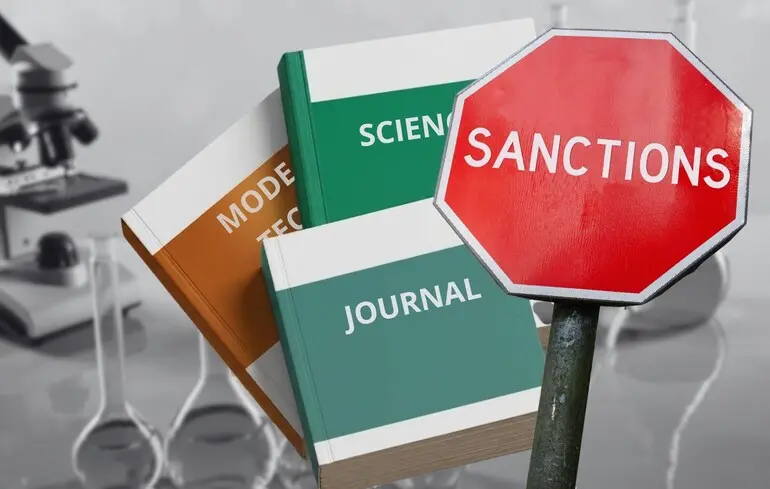
Springer Nature, one of the world’s largest academic publishers with operations in over 50 countries, finds itself at the center of a growing controversy regarding its continued publication of Russian scientific journals despite international sanctions. The publisher, known for prestigious titles like Nature and Scientific American, publicly condemned Russia’s invasion of Ukraine and announced it had halted new sales to Russian research institutions. However, an investigation reveals a significant disconnect between these statements and the company’s actions.
Data collected by researchers shows Springer Nature still publishes approximately 200 Russian journals, circumventing sanctions through an intermediary company called Pleiades. While presenting itself as American, Pleiades predominantly handles Russian content—only nine of its 177 journals have no connection to Russian scientific institutions.
The deliberate nature of this arrangement was confirmed by Pleiades chief Aleksandr Shustorovich at the start of the war, when he stated in an interview on the Russian Academy of Sciences website: “Our scientific products, perceived as American, have been preserved with the understanding that they represent precisely the Russian scientific environment.”
To minimize sanctions risks, Pleiades re-registered the founder’s rights to more than 100 journals of the Russian Academy of Sciences. Payments to Russian authors aren’t made directly but are processed as “salary” through a Cypriot firm called Gertal Holding. This mechanism disguises royalty payments as routine salary transfers, helping bypass anti-money laundering filters and compliance checks applied to cross-border commercial payments.
The investigation has identified several troubling consequences of this arrangement.
First, anti-Ukrainian propaganda is being disseminated under the guise of scholarly articles. For example, an article published in the Springer-distributed “Herald of the Russian Academy of Sciences” blames the war on “irresponsible, provocative policy of the nationalist Ukrainian political elite” and contains standard Russian propaganda narratives about “Bandera,” “Nazis,” and alleged discrimination against Russian speakers—content that would never pass legitimate peer review at a reputable publisher.
Second, Russia’s annexation of Ukrainian territories is being legitimized. Researchers identified nearly 400 cases where Springer classified Ukrainian territories, universities, or scientific institutions as Russian. For instance, on Springer’s official website, Kherson appears as a Russian city, despite remaining under Ukrainian control. Similar misrepresentations affect Crimea and Donbas regions.
Third, academic standards are being violated. The investigation revealed that Russian journals often falsify the composition of their editorial boards, with approximately 70 percent of foreign members either unaware of their “appointment” or playing no real role in the boards’ work—undermining trust in the peer-review process.
Fourth, there are documented violations of intellectual property rights. A striking example involves five journals belonging to the Ioffe Physical-Technical Institute. Despite the institute officially terminating all licensing agreements with Pleiades in July 2022, the publisher continued issuing versions of these journals, preserving their historical titles but without the participation of their lawful editorial teams—effectively creating “clones.”
Finally, information about cooperation with sanctioned individuals is being concealed. In English-language versions of journals on Springer’s website, names of editors who are under sanctions “disappear” or their positions are downgraded.
Ukraine’s Ministry of Education and Science has sent Springer Nature’s management an official inquiry and detailed analytical memorandum. While the publisher confirmed receipt of these documents in February 2026, it has not provided an official response. Instead, the confidential letter from the Ministry appeared in Russian state media.
Springer Nature’s distribution agreements with Pleiades are set to expire in December 2026, presenting a critical decision point for the publisher. The choice to extend or terminate this relationship will reveal whether this European publishing giant is committed to operating in accordance with international law and its own stated standards, or if it will continue to serve as a vehicle for Russian academic influence despite international sanctions.
Fact Checker
Verify the accuracy of this article using The Disinformation Commission analysis and real-time sources.

4 Comments
This is a concerning development. While academic publishing should remain as open as possible, it’s troubling to see companies potentially circumventing sanctions. I wonder what the rationale is behind Springer Nature’s continued involvement with Russian journals.
This seems like a complex issue without easy answers. On one hand, science should transcend politics, but on the other, sanctions are in place for a reason. I’d be curious to hear Springer Nature’s perspective and whether they feel their actions are justified.
It’s understandable that the scientific community would want to maintain access to important Russian research, but this arrangement with Pleiades raises some red flags. I hope Springer Nature can clarify their policies and ensure they are fully compliant with international sanctions.
As someone interested in the mining and energy sectors, I’m closely following this story. The continued publication of Russian content is concerning, even if it’s presented under an American intermediary. Transparency around these practices would be appreciated.