


Listen to the article
Russian Propaganda in North Macedonia Exploits Political Tensions, Threatens EU Path
Moscow’s systematic use of information manipulation as a foreign policy tool has found fertile ground in North Macedonia, exploiting domestic political tensions and social vulnerabilities to undermine the country’s European integration efforts.
The impact of Russian propaganda across the Western Balkans is a well-documented phenomenon that European institutions and civil society organizations have been warning about for years. North Macedonia, which joined NATO in 2020 and holds EU candidate status, faces similar challenges to other countries in the region, with Serbia representing the most prominent example of Russian influence.
Recent political developments in Skopje have heightened concerns about North Macedonia’s Euro-integration trajectory. Prime Minister Hristijan Mickoski and his government have shown reluctance to implement promised reforms, particularly constitutional amendments that were pledged to be adopted within six months of taking office.
On January 29, Mickoski made his position clear: “There will be no constitutional changes as long as I am prime minister, unless at least two conditions are met.” These conditions involve securing rights for the Macedonian community in Bulgaria and guarantees against “bilateral vetoes, humiliation, or degradation based on subjective reasons.”
Murat Aliu, a political scientist at Mother Teresa University in Skopje, suggests the delay in constitutional amendments stems more from internal political dynamics than direct Russian influence. However, the geopolitical implications remain significant.
“Any delay in constitutional amendments also means postponing the country’s accession process to the European Union. And the further away the EU membership perspective is, the greater the space becomes for the influence of third actors, including Russia,” Aliu explains.
A critical aspect often overlooked in analyses of foreign influence is that propaganda requires receptive audiences. External powers cannot impose their narratives without willing segments of society or local elites. In the Western Balkans, growing frustration with prolonged, conditional integration processes has created openings for alternative viewpoints – precisely where Russian narratives gain traction.
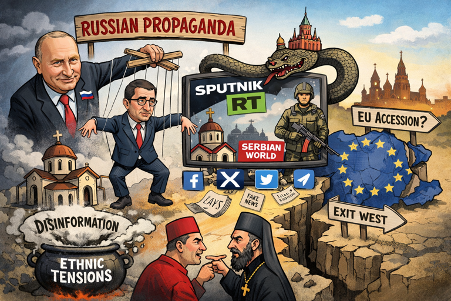
Moscow’s “information warfare” strategy extends beyond conventional diplomacy, targeting emotions, identity, and societal insecurities in what some experts characterize as hybrid warfare. In North Macedonia, Russian propaganda revolves around several consistent themes: Russia portrays itself as a defender of traditional values, Orthodox identity, and pan-Slavism, while depicting the West as a “liberal” force imposing conditions that undermine national identity.
Issues such as the country’s name change, demands for constitutional amendments, and minority rights protections are frequently characterized as “humiliations” imposed by the EU.
Petrit Saraçini from the Institute for Media and Analytics points out that religious and traditional sentiments serve as crucial instruments in this influence strategy. “Church structures and so-called civic initiatives are used as intermediary channels to nurture narratives against the ‘degenerate’ West,” Saraçini notes.
The pro-Russian narrative extends beyond media into domestic politics. Parties like Levica have openly expressed anti-NATO and anti-EU positions, while groups such as “United Macedonia,” led by Janko Baçev, advocate closer ties with Russia and reject Euro-Atlantic integration.
Within the government itself, figures with Moscow connections hold influence. Deputy Prime Minister Ivan Stoilković, who leads the Democratic Party of Serbs, has participated in Russian security forums promoting bilateral cooperation.
The European Parliament acknowledged these concerns in a report dated June 26, 2025. Rapporteur Thomas Waitz warned about the influence of the “Serbian World” concept, supported by government representatives and linked to Russian and Chinese interests in the region.
Research indicates that Russian propaganda primarily spreads through media outlets that rebroadcast content from Sputnik Serbia, RT Serbia, and Serbian tabloids, adapted for Macedonian audiences. Social media platforms amplify these narratives significantly.
“Facebook, X, and Telegram are particularly used by the Russian embassy in Skopje and reinforced by bot farms to spread disinformation, especially regarding Russia’s aggression against Ukraine and so-called ‘traditional values’,” Saraçini explains.
The objective isn’t to dominate public discourse entirely but to fragment the information landscape, create confusion, and erode trust in democratic institutions.
Though Russian influence in North Macedonia isn’t yet dominant, it poses a genuine risk. This propaganda creates illusions, fuels ethnic and religious polarization, undermines institutional trust, and impedes Euro-integration processes.
Addressing this challenge requires professional media, institutional transparency, media literacy, and proper regulation of media ownership and financing. Combating disinformation represents not censorship but protection of the public sphere from misuse of free expression.
Ultimately, North Macedonia faces a societal and political choice: embrace Europe’s project of reforms and standards, or pursue an illusory alternative that offers neither development nor security.
Fact Checker
Verify the accuracy of this article using The Disinformation Commission analysis and real-time sources.

8 Comments
It’s alarming to see how Russian disinformation is exploiting political divisions in North Macedonia. The country’s Euro-integration ambitions must be protected, even in the face of these challenges.
The reports of Russian propaganda campaigns targeting North Macedonia are concerning. Maintaining a strong commitment to democratic reforms and EU integration will be crucial for the country’s long-term stability and prosperity.
North Macedonia’s path toward EU membership is facing significant challenges from Russian disinformation efforts. The government must prioritize transparency, rule of law, and public trust to overcome these obstacles.
Absolutely. Strengthening democratic institutions and civil society will be key to building resilience against foreign manipulation and protecting the country’s Euro-Atlantic aspirations.
Russian propaganda efforts to undermine North Macedonia’s EU accession process are worrying. The government must act decisively to counter these malign influences and regain public trust.
Absolutely. Strengthening democratic institutions, media freedom, and civic engagement will be key to building resilience against foreign manipulation.
This is concerning news. Russian disinformation campaigns can have a real impact, especially in regions with political tensions. Maintaining EU integration will be crucial for North Macedonia’s stability and future.
Agreed. The country needs to stay vigilant against foreign interference and focus on implementing the necessary reforms to advance its Euro-Atlantic path.