


Listen to the article
Centuries of Roman propaganda continue to tarnish the legacy of Cleopatra VII Philopator, Egypt’s last active ruler before Roman conquest, according to historians who argue that the queen’s political acumen and intellectual contributions remain overshadowed by sexualized narratives crafted by her enemies.
The distorted image of Cleopatra as merely a seductress who captivated Julius Caesar and Mark Antony persists in popular culture despite mounting evidence of her diplomatic skills, multilingual abilities, and effective governance during a tumultuous period in Mediterranean history.
“What we’re seeing is the remarkable persistence of character assassination that began over two millennia ago,” says Dr. Kathleen Martinez, an archaeologist leading excavations at Taposiris Magna near Alexandria. “The Romans needed to justify their conquest of Egypt, so they reduced a formidable queen to a manipulative temptress.”
Recent archaeological findings continue to reshape our understanding of the Ptolemaic ruler. Cleopatra, who came to power at age 18, spoke at least nine languages and authored several scholarly works on subjects ranging from weights and measures to toxicology. These intellectual achievements contradict the Roman portrayal of her as relying solely on feminine wiles to maintain power.
The historical record indicates Cleopatra successfully navigated complex political alliances to preserve Egyptian independence in the face of Roman expansion. Her relationships with Caesar and later Mark Antony were as much strategic partnerships as romantic connections, historians argue.
“We need to understand these relationships within their proper political context,” explains Dr. Sarah Parcak, an Egyptologist at the University of Alabama at Birmingham. “Cleopatra was fighting for Egypt’s survival in a world where Rome was consuming everything in its path. Her diplomatic efforts with Roman leaders represented sophisticated statecraft, not mere seduction.”
The queen’s economic policies also demonstrate her capability as a ruler. Under her leadership, Egypt maintained its position as the breadbasket of the Mediterranean despite severe drought conditions. She implemented irrigation improvements and grain storage systems that stabilized the regional food supply.
Yet Roman sources like Plutarch, Cassius Dio, and later Octavian’s propagandists focused almost exclusively on portraying her as morally corrupt—a narrative that served Rome’s imperial ambitions. Octavian, who would become Emperor Augustus after defeating Mark Antony and Cleopatra at the Battle of Actium in 31 BCE, had particular motivation to diminish her stature.
“Octavian needed to explain to Romans why he went to war against a fellow Roman in Mark Antony,” notes classical historian Dr. Mary Beard. “By casting Cleopatra as a foreign temptress who had bewitched Antony, he transformed a civil war into a patriotic defense of Rome against eastern decadence.”
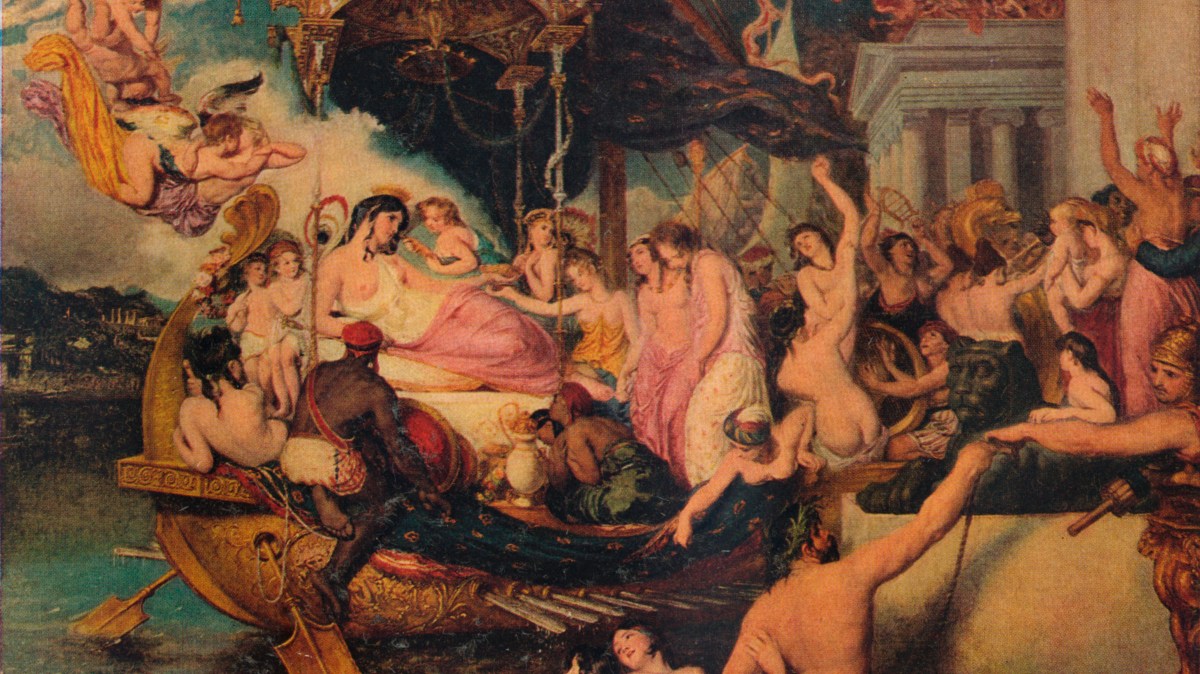
This portrayal gained such cultural traction that it has dominated artistic representations for centuries, from Renaissance paintings to Hollywood films. The 1963 epic starring Elizabeth Taylor perhaps most famously cemented the image of Cleopatra as primarily a love interest rather than a political leader.
Modern scholars point to gender bias as a significant factor in the persistence of these distortions. Female political leaders throughout history have frequently been delegitimized through accusations of sexual impropriety or emotional manipulation.
“We see similar patterns with powerful women across many eras,” says Dr. Joyce Tyldesley, author of “Cleopatra: Last Queen of Egypt.” “Their political achievements are diminished while their personal lives are scrutinized and often scandalously reinterpreted.”
Recent archaeological projects in Egypt aim to recover more accurate information about Cleopatra’s reign. Underwater excavations near Alexandria have unearthed remnants of the royal quarter where she likely resided, while ongoing work at potential tomb sites may yet yield more direct evidence of how she wished to be remembered.
The reconsideration of Cleopatra’s legacy reflects broader efforts in historical scholarship to recognize the biases inherent in ancient sources and to apply more nuanced analysis to figures marginalized by traditional narratives.
“What makes Cleopatra’s case particularly striking is how thoroughly Roman propaganda has dominated the historical record,” concludes Dr. Martinez. “Two thousand years later, we’re still working to separate the powerful queen from the caricature created by her enemies.”
Fact Checker
Verify the accuracy of this article using The Disinformation Commission analysis and real-time sources.

16 Comments
Fascinating how Roman propaganda has endured for so long in distorting Cleopatra’s legacy. It’s a good reminder to be cautious about historical narratives that may have been shaped by the victors.
You’re right, the archaeological findings paint a much more complex and accomplished picture of Cleopatra beyond the simplistic temptress tropes. It’s important to re-examine histories with a critical eye.
As an avid student of history, I find it troubling how Roman propaganda has overshadowed Cleopatra’s true accomplishments for so long. This underscores the importance of challenging simplistic historical narratives.
Agreed, the archaeological evidence highlighting Cleopatra’s intellectual and diplomatic abilities is a welcome development. Hopefully it will inspire a more balanced and accurate representation of this complex historical figure.
The persistence of Roman propaganda in distorting Cleopatra’s image is a sobering reminder of how historical narratives can be shaped by those in power. I’m curious to learn more about the archaeological evidence that is helping to restore a more balanced portrayal of her reign and accomplishments.
Absolutely. Excavations at Taposiris Magna seem to be providing valuable new insights into Cleopatra’s life and legacy beyond the simplistic seductress tropes. It’s important to continually challenge and re-evaluate historical accounts.
The fact that Cleopatra authored scholarly works on diverse subjects like weights, measures, and toxicology is a fascinating and often overlooked aspect of her legacy. I’m glad to see the archaeological evidence shedding new light on her intellectual and diplomatic accomplishments.
Absolutely. It’s a shame that these aspects of Cleopatra’s legacy have been overshadowed by the persistent Roman propaganda that sought to diminish her as a mere seductress. Hopefully, this new research will inspire a more nuanced and accurate portrayal of this remarkable historical figure.
The persistence of Roman propaganda in distorting Cleopatra’s image is a sobering reminder of how historical narratives can be shaped by those in power. I’m curious to learn more about the archaeological evidence reshaping our understanding of her.
Yes, it’s crucial to re-examine history through a more objective, nuanced lens. I look forward to seeing how further discoveries at Taposiris Magna contribute to a more accurate portrayal of Cleopatra’s reign and legacy.
It’s fascinating to see how new archaeological findings are reshaping our understanding of Cleopatra. The fact that she authored scholarly works on diverse subjects like weights, measures, and toxicology is particularly intriguing.
Yes, the multilingual abilities and intellectual contributions of Cleopatra are a crucial part of her legacy that has often been overlooked. I’m glad to see historians working to correct the distortions of Roman propaganda.
It’s disheartening to see how Roman propaganda has endured for so long in diminishing Cleopatra’s remarkable achievements and contributions. I’m glad to see historians working to correct these distortions through rigorous research and archaeological evidence.
Agreed. Cleopatra’s multilingual abilities, intellectual pursuits, and effective governance during a tumultuous period deserve far more recognition than the reductive narratives that have persisted. This serves as an important lesson in the need for critical analysis of historical sources.
It’s a shame that Cleopatra’s intellectual and diplomatic contributions have been overshadowed by sexualized portrayals. Hopefully this new research will help restore a more balanced understanding of her reign and legacy.
Agreed, the multilingual scholarly works she authored are a fascinating and often overlooked aspect of her legacy. Excavations at Taposiris Magna could provide valuable new insights.