


Listen to the article
The Cold War weaponization of George Orwell’s literature has created a lasting political legacy that continues to shape public discourse decades later, according to research published in the Journal of Strategic Security.
Intelligence agencies from both the United States and United Kingdom actively promoted Orwell’s works as anti-communist propaganda during the 1950s, transforming his nuanced political critiques into blunt ideological instruments against the Soviet Union.
Samantha Senn, a Justice, Law, and Criminality scholar, traces how “Animal Farm,” written in 1944, was deliberately reinterpreted and distributed to serve Western political interests. The novel, which Orwell conceived as a “fairy tale” allegory of the Russian Revolution’s descent into Stalinist authoritarianism, depicts ruling pigs who gradually betray revolutionary ideals until they become indistinguishable from the capitalist humans they once opposed.
Though the story implicitly critiques both Soviet communism and Western capitalism, Western intelligence agencies seized upon its anti-Soviet elements while downplaying any criticism of capitalist systems. The CIA and British intelligence services translated the book into multiple languages and distributed copies throughout Eastern Europe and the Middle East to advance anti-communist sentiment.
In 1950, following Orwell’s death, the CIA commissioned an animated adaptation of “Animal Farm” that significantly altered key elements of the original text. The film portrayed Snowball (representing Leon Trotsky) less sympathetically, emphasized contentment among animals on neighboring farms, and completely rewrote the ending to show the oppressed animals successfully overthrowing their pig rulers—a dramatic departure from Orwell’s bleaker conclusion.
While commercially unsuccessful, the animated adaptation found its way into classrooms across the United States and United Kingdom, reaching generations of students with its modified political message. The film was also translated and distributed internationally as part of broader Cold War information campaigns.
Intelligence agencies similarly promoted “1984,” Orwell’s dystopian vision of a world divided between three totalitarian superpowers. Despite being set in England and offering a more universal warning against authoritarianism, Western powers framed the novel primarily as a critique of Soviet-style governance.
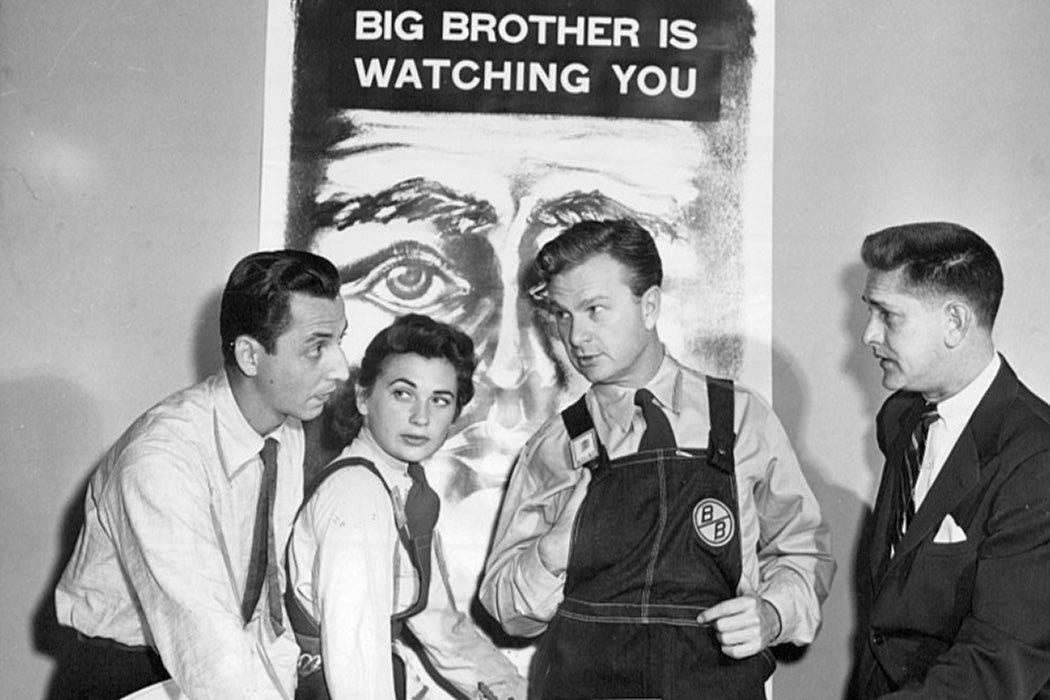
Ironically, Soviet propagandists eventually appropriated “1984” for their own purposes, recasting it as a prediction of America’s future. Soviet media compared figures like FBI Director J. Edgar Hoover and President Ronald Reagan to Big Brother, demonstrating the remarkable adaptability of Orwell’s concepts across political boundaries.
This malleability has contributed to the enduring power of Orwell’s imagery and language in contemporary discourse. Terms like “newspeak,” “thoughtcrime,” and “Big Brother” have transcended their original contexts to become universal shorthand for government overreach, surveillance, and propaganda across the political spectrum.
“By ensuring that Orwellian concepts such as ‘Big Brother,’ and ‘some are more equal than others’ entered into the public lexicon,” Senn writes, these intelligence agencies “unwittingly provided the world with a vocabulary that is potentially well-suited to criticizing the United States in the twenty-first century.”
The lasting impact of these Cold War propaganda efforts is evident in how Orwell’s phrases—”Who controls the past controls the future,” “Some animals are more equal than others,” and “The Party told you to reject the evidence of your eyes and ears”—continue to resonate in modern political commentary across ideological lines.
Senn’s analysis highlights a profound irony: the same Western powers that once weaponized Orwell’s critiques of authoritarianism against their Cold War enemies have inadvertently provided future generations with powerful linguistic tools to critique all forms of state power, including their own.
This historical context provides essential background for understanding how literary works can be transformed into political instruments, and how such transformations can produce unexpected consequences that last well beyond their original strategic purposes.
Fact Checker
Verify the accuracy of this article using The Disinformation Commission analysis and real-time sources.

11 Comments
This is a fascinating and important study. It’s a sobering reminder that even the most celebrated works of literature can be distorted and weaponized for political ends. I wonder how this affects our understanding of Orwell’s legacy and the broader impact of Cold War propaganda.
Absolutely. This research underscores the need to always consider the historical and political context when engaging with literature and art, rather than taking narratives at face value.
The Cold War weaponization of Orwell’s work is a sobering example of how propaganda can distort the legacy of great thinkers. It’s a timely reminder to always question the underlying motives and agendas behind the information we consume.
It’s concerning to see how intelligence agencies can manipulate the public discourse by selectively promoting certain aspects of literature. This highlights the importance of critically examining the context and intentions behind how media and art are disseminated.
You raise a good point. We need to be vigilant about how narratives are framed and shaped, especially when it comes to complex social and political issues.
The findings of this study are deeply concerning. It’s alarming to see how intelligence agencies can manipulate the public discourse by selectively promoting certain aspects of literature while downplaying others. This highlights the importance of media literacy and critical analysis when it comes to cultural works.
This is a fascinating study on the Cold War exploitation of Orwell’s work. It’s a sobering reminder that even great literature can be twisted for political ends. I wonder how Orwell would have felt about his stories being used as anti-communist propaganda.
Orwell was deeply skeptical of both Soviet communism and Western capitalism, so I imagine he would have been dismayed to see his nuanced critiques reduced to crude ideological weapons.
This research underscores the importance of historical context and nuance when interpreting literature and art. It’s concerning to see how Orwell’s critiques of authoritarianism were selectively used to serve Western political interests.
I agree. It’s a cautionary tale about the dangers of oversimplifying complex ideas and using them for narrow ideological purposes.
The findings of this study highlight the need for greater media literacy and critical thinking when it comes to consuming and interpreting cultural works. It’s troubling to see how intelligence agencies can manipulate the public discourse in this way.