


Listen to the article
The Forgotten Heroes of Hungnam: Revisiting History’s Largest Wartime Evacuation
December 2025 will mark the 75th anniversary of what historians consider the largest wartime humanitarian evacuation in history. As Chinese forces dramatically shifted the tide of the Korean War, U.S., United Nations, and South Korean military forces orchestrated a massive southward retreat from the port of Hungnam in North Korea.
The military operation’s original scope was impressive enough: relocating 105,000 soldiers, 17,000 vehicles, and 350,000 tons of supplies. But what began as a strictly military evacuation with plans to include only 300 civilian political personnel evolved into something far more significant.
As enemy forces encircled the port, tens of thousands of desperate Korean refugees converged on the departing ships. Many were Christians fleeing religious persecution, with local leaders warning American commanders: “The Communists will kill everyone, including women and children.”
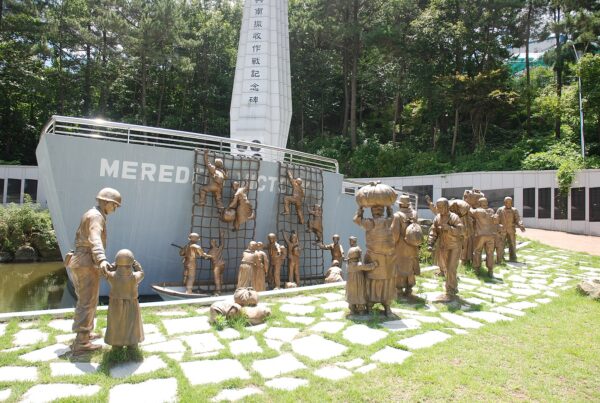
Dr. Hyun-Bong-hak, a South Korean Christian serving as a civil affairs advisor to U.S. forces, successfully advocated for these civilians to X Corps Commander Major General Edward Almond. The resulting humanitarian mission evacuated over 90,000 refugees from the warzone to the relative safety of South Korea’s Geoje Island.
Today, an estimated one million descendants of these refugees live primarily in South Korea. Among them was former President Moon Jae-in, whose parents and sister escaped on the evacuation ships. Five babies born during the voyage were affectionately nicknamed Kimchi 1 through Kimchi 5.
The SS Meredith Victory, a U.S. Merchant Marine cargo freighter, played a particularly heroic role as the final ship to leave harbor, carrying a record-setting 14,500 refugees. Burley Smith, the vessel’s last surviving crew member, has helped preserve this remarkable story for future generations.
While South Korean culture has immortalized the evacuation, most notably in the popular 2014 film “Ode to My Father,” North Korea’s government has either ignored or distorted the historical record through state propaganda.
“This story showcases Americans and Koreans overcoming national differences for humanitarian goals,” explains Dr. Joshua Smith, director of the U.S. Merchant Marine Academy Museum. “It could help erode decades of anti-American sentiment cultivated by the Kim regime among ordinary North Korean citizens.”
Competing Historical Narratives
North Koreans are systematically exposed to a dramatically different version of the Korean War. Officially named “the Fatherland Liberation War” in North Korea, the conflict remains far from forgotten. Each year, from June 25 to July 27, the country observes a month of “anti-U.S. struggle” filled with movies, rallies, and media depicting American soldiers committing atrocities against civilians.
The official North Korean narrative insists the war was initiated by South Korea under U.S. influence, claiming “the U.S. imperialists ignited the war of aggression in Korea to stifle the young Democratic People’s Republic of Korea in its cradle.” This version attributes North Korea’s “great victory” to Kim Il Sung’s strategic brilliance while minimizing the crucial roles played by the Soviet Union and China.
When North Korean state media has mentioned the Hungnam evacuation—rarely and reluctantly—it portrays North Koreans boarding U.S. ships only because they feared an American nuclear attack or were deceived by propaganda. Those evacuees are characterized as victims suffering “the heartrending pain of family division.”
This narrative persists despite Soviet archives released in 1994 confirming North Korea initiated the conflict with Soviet support and Chinese intervention. The Kim regime maintains these historical distortions because the Korean War forms a cornerstone of the family’s legitimacy myth, portraying them as rightful defenders against foreign aggression.
Shifting Perceptions Among North Koreans
Despite North Korea’s tightly controlled information environment, cracks have appeared in the regime’s narrative monopoly. Since the 1990s famine, foreign media has increasingly penetrated the country, creating more diverse perspectives among citizens.
Research by Seoul National University, based on defector surveys, reveals complex attitudes. While many North Koreans still express trust in state media, they increasingly rely on word of mouth from friends and family for information about the outside world. Approximately 15 percent now access foreign sources like South Korean media, though this represents a decline from nearly 30 percent in 2015.
“When the government says there is prosperity in terms of food and rice, we see it ourselves and see that there is a drought and there is no food for us,” explained Kim Young-il, a human rights advocate who defected in 1997 during the famine.
North Koreans have become progressively more interested in the outside world. Less than 43 percent of defectors who left before 2001 expressed interest in foreign countries, compared to 67 percent of those who left between 2016 and 2020, according to South Korea’s Ministry of Unification.
Exposure to foreign media significantly impacts worldviews. Over 90 percent of surveyed defectors reported their opinion of South Korea improved after consuming South Korean culture. One defector noted that “watching South Korean dramas helped break prejudices she learned in school, such as that South Korea is filled with thieves and beggars.”
Two North Korean sources told Radio Free Asia that people with access to foreign media have started questioning the regime’s portrayal of the Korean War, with one stating that “any factory worker who has heard a foreign broadcast about the Korean War knows full well that it wasn’t South Korea that attacked first.”
As the Korean Peninsula approaches the 75th anniversary of this remarkable humanitarian mission, the Hungnam evacuation stands as a powerful counterpoint to decades of propaganda—a true story of cooperation and compassion amid conflict that continues to resonate across generations.
Fact Checker
Verify the accuracy of this article using The Disinformation Commission analysis and real-time sources.

22 Comments
Uranium names keep pushing higher—supply still tight into 2026.
The cost guidance is better than expected. If they deliver, the stock could rerate.
Good point. Watching costs and grades closely.
Good point. Watching costs and grades closely.
Silver leverage is strong here; beta cuts both ways though.
Good point. Watching costs and grades closely.
Good point. Watching costs and grades closely.
Nice to see insider buying—usually a good signal in this space.
Good point. Watching costs and grades closely.
The cost guidance is better than expected. If they deliver, the stock could rerate.
Good point. Watching costs and grades closely.
Interesting update on North Korean Rescue Mission During War Challenges Regime’s Official Narrative. Curious how the grades will trend next quarter.
Good point. Watching costs and grades closely.
Good point. Watching costs and grades closely.
The cost guidance is better than expected. If they deliver, the stock could rerate.
The cost guidance is better than expected. If they deliver, the stock could rerate.
Silver leverage is strong here; beta cuts both ways though.
Good point. Watching costs and grades closely.
I like the balance sheet here—less leverage than peers.
Good point. Watching costs and grades closely.
Good point. Watching costs and grades closely.
The cost guidance is better than expected. If they deliver, the stock could rerate.