


Listen to the article
Kremlin Intensifies Propaganda Against Armenia’s Western Pivot
Armenia’s dramatic shift in foreign policy over the past two years has triggered an intensifying campaign of Russian propaganda aimed at undermining the country’s growing ties with Western nations. Following the resolution of the Nagorno-Karabakh conflict and Russia’s invasion of Ukraine, Armenia has significantly reoriented its geopolitical alignment away from Moscow and toward the European Union and United States.
The transformation in Armenia’s foreign policy has been swift and substantial. In February 2023, an EU civilian monitoring mission was deployed along the Armenia-Azerbaijan border at Armenia’s request. By April 2024, the EU had allocated €270 million in funding to Armenia for 2024-2027, while in November 2025, the European Commission provided Armenia with a visa liberalization action plan. This March, Armenia’s National Assembly adopted legislation to begin the process of EU accession, culminating in December with the adoption of a new EU-Armenia Strategic Partnership Agenda focused on democratic reforms and strengthening Armenia’s resilience.
Simultaneously, Armenia has deepened relations with the United States, signing a Charter on Strategic Partnership in January 2025. From 2021 to 2025, the U.S. allocated $340 million to Armenia for democratic reforms. Perhaps most significant was the U.S.-mediated peace agreement signed in Washington this August between Armenia and Azerbaijan, with then-President Donald Trump’s involvement. Armenia has also expanded defense cooperation with France since 2023 and signed a Strategic Agenda Declaration with Germany in December 2025.
Russia’s response to these developments has been swift and hostile. As Armenia drifts from Moscow’s orbit, Kremlin officials and state-linked media have ramped up propagandistic messaging targeting Armenia’s Western partnerships.
“The Kremlin often responds immediately and from high-level platforms with propagandistic statements to specific foreign policy steps taken by Armenia to move closer to the United States, the EU, and European countries,” according to media analysis.
When Armenia confirmed its intention to establish strategic cooperation with the United States in January 2025, Kremlin spokesperson Dmitry Peskov claimed that “the United States plays a destabilizing role in the South Caucasus, including in Armenia.” Similarly, Russian Foreign Ministry spokesperson Maria Zakharova has repeatedly accused the EU of viewing “the South Caucasus as a frontline of a global hybrid war against Russia” and singled out France for allegedly trying to “undermine centuries-old Russian-Armenian relations.”
This messaging fits within Russia’s broader regional narrative portraying the EU and Western nations as “destructive actors” in the Caucasus while positioning Russia as “a guarantor of stability and peace.” The Kremlin consistently emphasizes Russia’s supposed exclusive role in the region, arguing that its influence over neighboring countries is “legitimate” while characterizing the U.S. and EU as unwelcome “non-regional actors.”
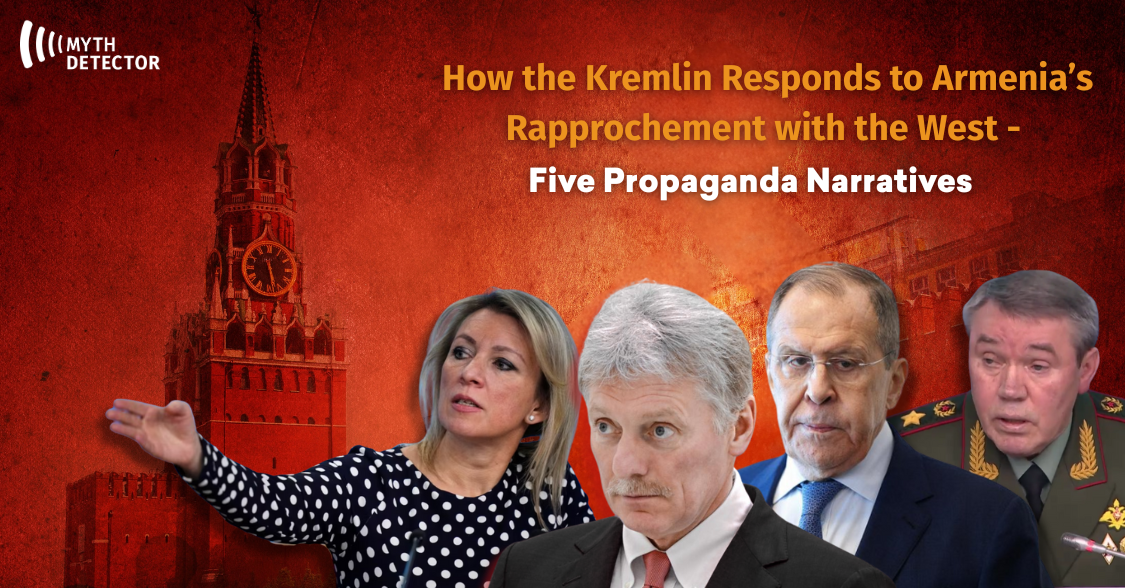
The Russian propaganda targeting Armenia follows five main themes that mirror messaging used against Georgia and other former Soviet states:
First, Russia claims Western engagement threatens regional security, alleging that “the West uses Armenia to provoke conflict/war and to ‘Ukrainize’ it.” Russian Foreign Minister Sergey Lavrov has stated that “the goal of the United States and the European Union in Armenia and the South Caucasus is not to establish peace and stability but to replace Moscow and other regional actors and to create another hotspot of tension.”
Second, Russian propaganda promotes bio-conspiracy theories, claiming the West is “creating bio-ethnic weapons in Armenia” through U.S.-funded laboratories. These allegations echo similar disinformation campaigns targeting Georgia’s Lugar Laboratory.
Third, the Kremlin portrays Armenia’s Western integration as threatening national sovereignty, with Russian media claiming “EU visa liberalization comes at the price of losing sovereignty” and characterizing EU funding as “a classic example of enslavement.”
Fourth, Russia warns of economic catastrophe if Armenia deepens EU ties. Russian Deputy Prime Minister Alexey Overchuk claimed “if Armenia leaves the Eurasian Union, energy and food prices will rise, and exports of Armenian products will fall by 80 percent,” presenting a false choice between economic survival with Russia or ruin with the EU.
Finally, Russian propaganda frames Western partnership as a threat to Armenian identity, with claims that it endangers Armenia’s Christian heritage and will lead to “depopulation of Armenia” through visa liberalization.
Armenia’s case illustrates Russia’s broader strategy toward former Soviet states asserting independence from Moscow’s influence. By portraying Western integration as existentially threatening, the Kremlin hopes to instill “skepticism toward Armenia’s integration with the West” and “foster fear, skepticism, and distrust in society” — tactics it has deployed across its perceived sphere of influence as its regional dominance continues to erode.
Fact Checker
Verify the accuracy of this article using The Disinformation Commission analysis and real-time sources.

18 Comments
I like the balance sheet here—less leverage than peers.
Good point. Watching costs and grades closely.
The cost guidance is better than expected. If they deliver, the stock could rerate.
Good point. Watching costs and grades closely.
Good point. Watching costs and grades closely.
Nice to see insider buying—usually a good signal in this space.
If AISC keeps dropping, this becomes investable for me.
Good point. Watching costs and grades closely.
Good point. Watching costs and grades closely.
I like the balance sheet here—less leverage than peers.
Good point. Watching costs and grades closely.
I like the balance sheet here—less leverage than peers.
Good point. Watching costs and grades closely.
Uranium names keep pushing higher—supply still tight into 2026.
The cost guidance is better than expected. If they deliver, the stock could rerate.
Nice to see insider buying—usually a good signal in this space.
I like the balance sheet here—less leverage than peers.
Interesting update on Kremlin’s Five Propaganda Narratives in Response to Armenia’s Western Pivot. Curious how the grades will trend next quarter.