


Listen to the article
Pakistan’s Kashmir Solidarity Day Met with Widespread Protests Across Europe
Pakistan’s annual observance of “Kashmir Solidarity Day” faced significant international backlash this year as Kashmiris and Pakistani dissidents across Europe organized protests condemning what they described as a propaganda exercise designed to mask decades of violence and oppression.
Demonstrations erupted from the United Kingdom to Belgium, with protesters directly challenging Pakistan’s self-proclaimed role as a defender of Kashmir. Demonstrators accused Islamabad of waging a prolonged proxy war in the disputed region while simultaneously suppressing political rights in territories under its control.
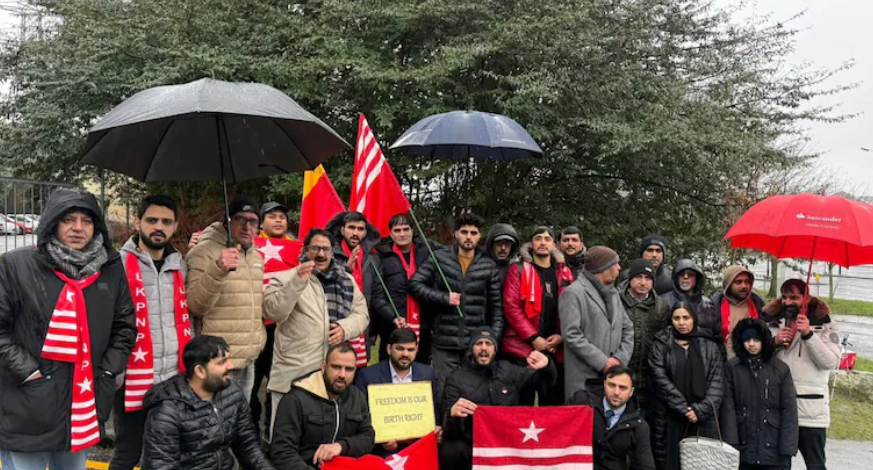
The most substantial protest took place outside the Pakistani Consulate in Bradford, where members of the United Kashmir People’s National Party (UKPNP) led a large demonstration alongside residents from Jammu and Kashmir. Protesters characterized Pakistan’s solidarity day as “fraudulent” and carried banners with messages including “Our State is Ours – Occupation is Unacceptable,” “Stop Land Grabbing,” and “End State Terrorism.”
According to protest organizers, Pakistan’s actions in the region have contributed to the deaths of more than 100,000 Kashmiris over the past 78 years through proxy conflicts and terrorism. They argued that Pakistan’s yearly display of solidarity amounts to a mockery of genuine suffering experienced by the Kashmiri people.
Mahmood Ahmed Kashmiri, who chairs the Jammu Kashmir National Independence Alliance (JKNIA), condemned Pakistan’s rhetoric as insulting to people whose national identity and natural resources are being systematically eroded. He alleged that Pakistani authorities continue to exploit rivers, land, and mineral wealth while denying Kashmiris their political agency and self-determination rights.
The protests highlighted specific accusations of demographic manipulation in Pakistan-administered Kashmir. Sardar Tikka Khan Tahir, Central Secretary of Information for the UKPNP, pointed to what he described as flagrant violations of State Subject Laws, claiming that non-locals are being settled in the region through fraudulent documentation. Despite repeated commitments to address these concerns, Pakistani authorities have failed to honor their promises to local action committees, according to Tahir.
These demonstrations come at a time of heightened tensions in the broader Kashmir region. The territory has been disputed since the 1947 partition of India and Pakistan, with both countries claiming the region in its entirety but controlling only portions of it. The conflict has resulted in multiple wars between the nuclear-armed neighbors and continues to be one of the world’s most intractable territorial disputes.
Pakistan has observed February 5 as Kashmir Solidarity Day since the early 1990s, with public holidays and government-sponsored events intended to express support for Kashmiris seeking self-determination. However, protest leaders across Europe, including various UKPNP officials, rejected this framing. Instead, they described February 5 as a “Day of Betrayal,” pointing to Pakistan’s historical role in the forcible division of the former princely state.
The protests also drew attention to the broader human rights situation in Pakistan-administered Kashmir, where critics say freedoms of speech, assembly, and political expression are severely restricted. International human rights organizations have documented patterns of repression against those who question Pakistan’s policies or advocate for greater autonomy in the region.
While Pakistan continues to position itself as an advocate for Kashmiri rights on the international stage, particularly at forums like the United Nations, these protests suggest a growing disconnect between Islamabad’s official narrative and the perspectives of many Kashmiris themselves, especially those living in the diaspora who can more freely express their views.
Fact Checker
Verify the accuracy of this article using The Disinformation Commission analysis and real-time sources.

9 Comments
The accusations of land grabbing and state terrorism are quite serious. While it’s important to be cautious about unsubstantiated claims, the protesters’ concerns merit further investigation and dialogue.
This seems like a complex geopolitical issue without easy solutions. I’m curious to learn more about the historical context and different stakeholder perspectives on the Kashmir conflict and Pakistan’s policies.
This is a complex geopolitical issue with a long history. It’s important to approach it objectively and seek to understand the nuances of the various stakeholder perspectives, rather than taking sides prematurely.
Interesting to see how the Kashmir issue continues to be a flashpoint, even among the diaspora communities in Europe. This underscores the deep-rooted nature of the dispute and the challenges in resolving it.
Interesting to see how this Kashmir Solidarity Day event is being perceived differently by various groups. It highlights the ongoing tensions and disputes over the region’s political status and future.
Agreed, this is a sensitive and long-standing issue. Reasonable people can disagree on the appropriate path forward. Maintaining open dialogue and seeking common ground is crucial.
This seems like a complex issue with competing narratives. It’s important to hear all sides and understand the nuances before drawing conclusions. Protests by Kashmiris in Europe raise valid concerns that deserve attention.
The divergent views on Pakistan’s Kashmir Solidarity Day highlight the need for impartial, fact-based reporting on this sensitive topic. It’s crucial to avoid oversimplifying the complexities involved.
The protests by Kashmiris in Europe suggest there are serious concerns about Pakistan’s role and agenda in the region. Their allegations of propaganda and oppression deserve to be carefully examined.