


Listen to the article
Iran’s Missile Program: Propaganda vs. Reality
Iranian Revolutionary Guard forces conducted extensive military exercises last week, dubbed “Combined Maneuvers 1404,” amid heightened regional tensions. The drills, which received widespread coverage on state media, showcased what Tehran claimed was a “qualitative shift” in missile capabilities.
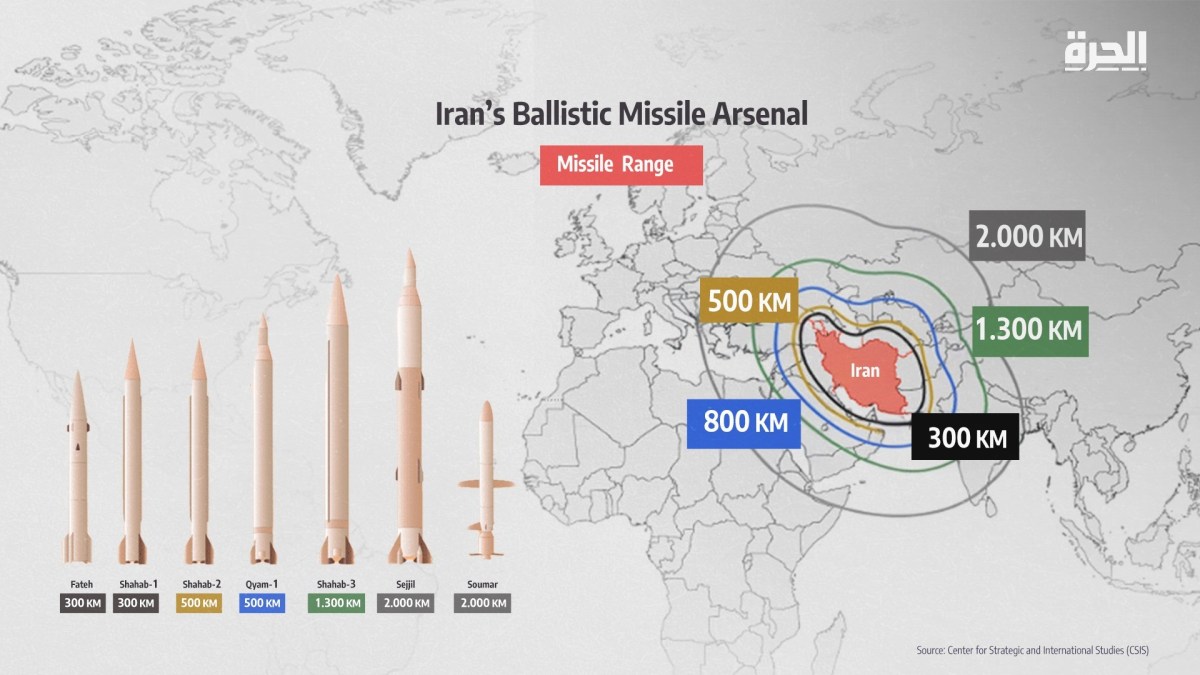
According to Iran’s Fars News Agency, the exercises—named “The Great Prophet 19″—featured the unveiling of the “Fath-450,” a ballistic missile exceeding seven meters in length. The missile reportedly carries a 225-kilogram warhead and reaches speeds of approximately Mach 5. Iranian authorities also highlighted the “Fath-360,” described as a tactical missile with advanced navigation systems and precision-targeting capabilities.
However, a significant gap appears to exist between Iran’s public claims and its actual operational capabilities, according to multiple intelligence sources.
Information obtained by Alhurra from exclusive sources reveals that Iran’s missile forces operate from the Dastvareh Barracks in northwest Tehran, managing a network of bases and covert installations across the country. The force comprises roughly 15 divisions and command centers distributed across nine primary airbases.
A crucial component of this structure is the “Seventh Iron Brigade,” based at the Al-Mahdi Barracks in Bidganeh. This brigade, responsible for the Shahab missile series, represents the historical foundation of Iran’s missile program. Its original members received training in Syria and Libya during the 1980s on Soviet-made Scud missiles, which continue to serve as the technical blueprint for many systems now marketed under new designations.
Iran’s missile infrastructure is built around the concept of “passive defense,” an initiative dating back to 1989. This strategy involves concealing sensitive facilities within mountain ranges and underground tunnel networks. Four major centers form the backbone of this infrastructure.
The Semnan Missile Complex stands as the country’s largest missile facility, housing launch platforms and testing sites. In Fars Province, the Lar Missile Center contains an extensive tunnel network officially described as an “underground missile city,” designed primarily for protection and concealment.
The Khorramabad Center, dedicated to long-range Shahab-3 missiles, gained notoriety in 2010 following major explosions attributed to inadequate safety protocols. The Bidganeh and Karaj areas function as field laboratories for propellant development—a site where Hassan Tehrani Moghaddam, considered the “father of Iran’s missile program,” was killed in 2011 during an explosion involving unstable fuel.
Production oversight falls to the Aerospace Industries Organization (AIO). While formally under the Ministry of Defense, the AIO maintains close operational ties with the Revolutionary Guard. Manufacturing is divided between two primary entities: the Hemat Group, specializing in liquid-fuel missiles that require hours of preparation before launch, and the Bakri Group, which focuses on solid-fuel systems like the recently showcased “Fath” series.
Despite Iran’s claims of technological self-sufficiency, intelligence reports indicate ongoing collaboration between Tehran and Pyongyang, particularly in missile engine development. North Korean experts reportedly operate from compounds east of Tehran, exchanging technical knowledge for oil. The striking similarities between North Korea’s Musudan (Hwasong-10) and Iran’s Khorramshahr missile underscore this partnership.
Several critical vulnerabilities undermine Iran’s claims about its missile capabilities. While Tehran asserts that missiles like the Fath-450 achieve precision within 35 meters of their targets, operational history tells a different story. Strikes against Iraq’s Ain al-Asad base and opposition groups in Iraqi Kurdistan have shown error margins frequently exceeding several hundred meters, with missiles often failing at launch or missing intended targets entirely.
Iran’s access to advanced microchips and high-performance guidance systems remains severely restricted by international sanctions. Consequently, the Revolutionary Guard reportedly relies on smuggled and repurposed civilian-grade electronics, leaving their guidance systems vulnerable to electronic warfare countermeasures deployed by technologically superior adversaries.
Military analysts have noted that many platforms showcased in recent exercises may be wooden mock-ups or legacy systems that have been repainted and rebranded—a practice described as “military cosmetics” designed to project an image of technological diversity while masking limited inventory.
Perhaps most tellingly, Iran’s air defense systems failed to detect or intercept low-altitude drones during recent strikes on military installations in Tehran and Isfahan. This performance gap highlights the disparity between Iran’s declared capabilities and actual combat readiness.
While Iran’s missile arsenal remains a potent threat to civilian centers and unprotected infrastructure, its effectiveness against modern, integrated defense networks appears questionable. The program represents a mixture of legacy technology, incremental domestic improvements, and sophisticated media projection—a reality that falls considerably short of the regime’s ambitious claims.
Fact Checker
Verify the accuracy of this article using The Disinformation Commission analysis and real-time sources.

14 Comments
The discrepancy between Iran’s public claims and their actual operational capabilities is concerning. Reliable intelligence sources need to provide a clearer, more objective assessment of the real state of their missile program.
Agreed, relying solely on state media reports is unwise. We need comprehensive, impartial analysis to understand the true nature and scope of Iran’s missile technologies.
The details about Iran’s missile forces and network of bases provide an interesting glimpse into their military infrastructure. However, more context is needed to fully understand the implications and potential threats.
Absolutely, the operational details are intriguing but the bigger strategic picture is what really matters. Careful, nuanced analysis is required to assess the true nature of Iran’s missile program.
The unveiling of new missile models by Iran is certainly attention-grabbing, but I’m curious to know how these capabilities compare to other countries in the region. A comparative analysis would help put things in context.
That’s a good point. Understanding Iran’s missile program in a regional geopolitical context is important for assessing its true significance and implications.
The details about Iran’s missile force and infrastructure are intriguing, but more context is needed to fully evaluate the significance and implications. Independent analysis, not just state media reports, should be the basis for any assessments.
Absolutely, a balanced, fact-based approach is essential when it comes to sensitive military capabilities like this. Relying on a range of credible sources is crucial to avoid being misled by propaganda.
Missile technology is a complex and often opaque field, making it challenging to separate fact from fiction. A thorough, nuanced examination of Iran’s capabilities from multiple credible sources would be invaluable.
Iran seems keen to project an image of advanced missile technology, but the gap between their claims and actual operational capabilities is concerning. Transparent, verifiable data is needed to assess the reality.
I agree, transparency is key when it comes to sensitive military capabilities. Relying on state media reports alone is risky, we need impartial, expert analysis to get a clear picture.
Iran’s missile program is a complex issue with a lot of conflicting claims. It would be good to get a clear, fact-based assessment of their actual operational capabilities from credible military and intelligence sources.
Agreed, separating propaganda from reality is crucial when evaluating Iran’s missile technology. Independent analysis is needed to cut through the noise.
It’s important to be skeptical of claims made by any state actors, including Iran, when it comes to sensitive military capabilities. Independent verification and fact-checking are essential to cut through propaganda and misinformation.