


Listen to the article
Iranian Women’s Soccer Team Defections Spark Political Controversy in Australia
In a week marked by diplomatic tension and political maneuvering, six members of the Iranian women’s soccer team have defected to Australia during the Asia Cup tournament, raising questions about the motives behind the Australian government’s handling of the situation.
The saga began during the team’s opening match against South Korea on March 2, when several players did not sing the Iranian national anthem. Australian media immediately characterized this as a “silent protest,” suggesting the women would face severe consequences upon returning to Iran. When the team later sang the anthem in subsequent matches, media outlets portrayed this as evidence of coercion, though no substantive evidence was provided.
Against this backdrop, protests emerged outside the team’s Gold Coast hotel. Demonstrators, described by media as “human rights activists,” included supporters of the deposed Shah, who was overthrown in the 1979 Iranian revolution. These protests coincided with Australian federal agents approaching team members after matches, explicitly signaling availability to assist those who wished to defect.
The situation escalated dramatically when U.S. President Donald Trump inserted himself into the controversy, publicly demanding that Prime Minister Anthony Albanese’s government grant asylum to the players. Trump reportedly called Albanese at 2 a.m. Monday Australian time to personally press the issue.
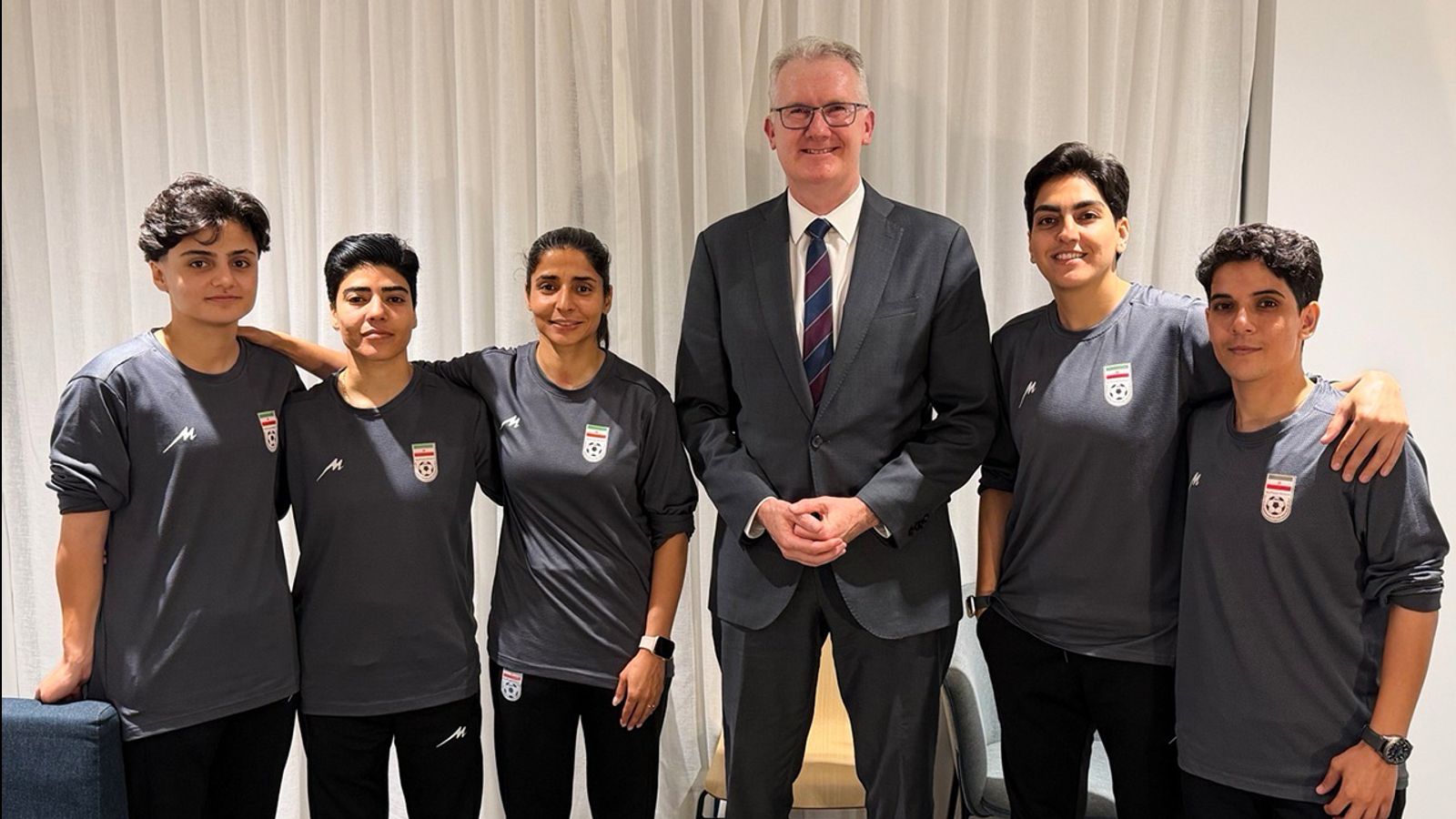
Shortly thereafter, five team members signaled their desire for asylum and were quickly taken into protective custody by the Australian Federal Police. By Monday evening, they were photographed with Home Affairs Minister Tony Burke, who was signing humanitarian visa documents granting them fast-track permanent residency.
In an unprecedented move, Burke and AFP officers then traveled to Sydney, where the remaining team members were preparing to depart. Each player was separated and placed alone in a room with Australian officials who “offered” the possibility of defection. This tactic secured two additional defections, though one player subsequently reversed her decision and chose to return to Iran.
The timing of these events has raised eyebrows. Just as the defection drama unfolded, the Australian government formally joined military action against Iran, announcing the deployment of air-to-air missiles, an advanced command warplane, and 85 troops to the United Arab Emirates. Critics suggest the high-profile handling of the defections provided convenient humanitarian cover for Australia’s military involvement.
Questions about consistency in Australia’s refugee policies have emerged. Government figures from September reveal that 124 Iranian nationals remain in various forms of immigration detention in Australia. Under the same government now celebrating the soccer players’ defections, these detainees face indefinite limbo with limited rights and protections.
Further complicating matters, the Labor government announced new legislation during this same period that would allow authorities to bar visa holders from certain countries from entering Australia. Government ministers explicitly stated these laws target potential refugee applications from people fleeing the very conflict in Iran that Australia has joined.
The government has also faced criticism for blocking the return of 11 Australian women and 23 children from Syria due to alleged connections with ISIS fighters, despite their citizenship status and lack of criminal convictions.
The defection saga has attracted support from unexpected quarters, including Reza Pahlavi, son of Iran’s former Shah, who praised Australia’s actions in a Sydney Morning Herald opinion piece. Pahlavi, who has long advocated for regime change in Iran from his position in the United States, characterized the orchestrated defections as an example for other governments to follow.
As this complex situation continues to unfold, questions remain about the intersection of humanitarian concerns, diplomatic protocols, and the political considerations that appear to have influenced the Australian government’s approach to these high-profile defections.
Fact Checker
Verify the accuracy of this article using The Disinformation Commission analysis and real-time sources.

20 Comments
Interesting geopolitical implications here. While defections can raise awareness, they also risk further polarization. I wonder if there are more nuanced ways to support Iranian athletes without escalating diplomatic tensions.
Agreed. Careful handling of such sensitive situations is crucial to avoid unintended consequences. Diplomacy and respect for sovereignty should guide the approach.
This saga highlights the complexities of navigating sports, politics, and human rights. A thoughtful, measured response that avoids further polarization and prioritizes the athletes’ wellbeing would be the most constructive course of action.
I agree. Maintaining a principled, impartial stance focused on the humanitarian aspects, rather than geopolitical posturing, is crucial in this delicate situation.
This saga underscores the need for a delicate balance between supporting human rights and avoiding further geopolitical tensions. A thoughtful, measured response that prioritizes the athletes’ wellbeing and respects sovereignty should guide the Australian government’s actions.
Well said. Maintaining an impartial, humanitarian focus while navigating the complexities of sports, politics, and international relations is crucial in this sensitive situation.
The defections and political controversy surrounding the Iranian women’s soccer team highlight the intricate interplay of sports, human rights, and geopolitics. A nuanced, diplomatic approach that respects sovereignty and prioritizes the athletes’ safety would be the wisest course of action.
While the defections bring attention to important human rights issues, the Australian government’s actions also warrant scrutiny. A balanced, diplomatic approach that respects sovereignty and prioritizes the athletes’ safety would be the wisest path forward.
This seems like a complex issue with valid concerns on both sides. I hope the athletes’ safety and wellbeing are the top priority, regardless of the political factors at play.
Well said. Navigating the balance between human rights and geopolitical interests requires wisdom and empathy. Simplistic narratives rarely capture the full nuance.
This saga highlights the fine line between supporting human rights and inflaming geopolitical tensions. A thoughtful, measured approach that prioritizes the athletes’ safety and dignity would be the wisest course of action.
This is a sensitive situation that deserves careful consideration. Protecting the athletes’ rights and wellbeing should be the primary focus, not geopolitical posturing.
I agree. Politicizing the athletes’ plight risks overshadowing the human element. A balanced, humanitarian response would be most appropriate here.
The defections and political controversy surrounding the Iranian women’s soccer team raise challenging questions about the intersection of sports, politics, and human rights. A nuanced, humanitarian response is needed to navigate this delicate situation.
Well said. Maintaining a principled, apolitical stance focused on the athletes’ wellbeing should be the guiding priority, not geopolitical maneuvering.
The Iranian women’s soccer team saga highlights the delicate interplay of sports, politics, and human rights. While defections raise awareness, a more measured approach may yield better long-term outcomes.
While the defections raise important human rights questions, the Australian government’s actions also warrant scrutiny. Maintaining a principled, impartial stance is crucial in these delicate matters.
Agreed. Avoiding the temptation to leverage the athletes’ plight for political gain should be the priority. Protecting their wellbeing and respecting sovereignty must guide the response.
The defections of Iranian women’s soccer players raise important human rights questions, but the Australian government’s handling of the situation also deserves close examination. A nuanced, diplomatic approach that respects sovereignty and prioritizes the athletes’ safety would be the wisest path forward.
The Australian government’s handling of this situation seems fraught with potential pitfalls. Navigating the complexities of sports, politics, and human rights requires a nuanced, diplomatic approach.