


Listen to the article
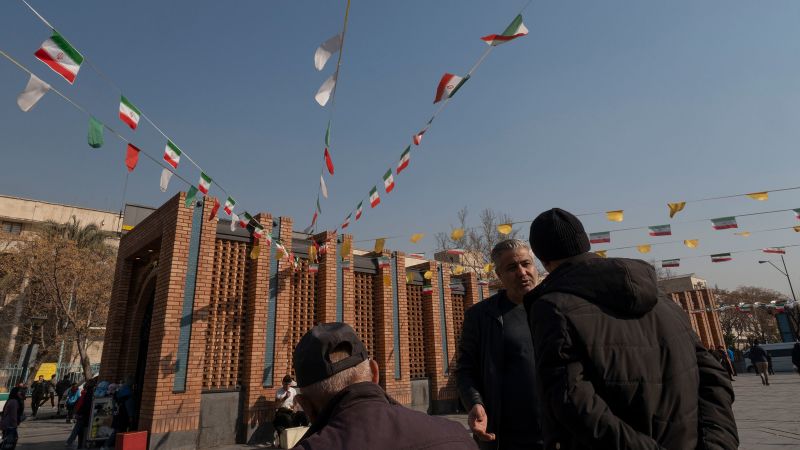
In Tehran, life appears to have returned to normal just weeks after thousands of Iranians were killed in a widespread crackdown on dissent. However, beneath this veneer of normalcy, residents find themselves caught between their government’s defiant rhetoric and escalating military threats from U.S. President Donald Trump.
The U.S. has deployed significant naval assets to the region, with Trump warning that an “armada” is heading toward Iran. The USS Abraham Lincoln aircraft carrier and a group of guided missile destroyers have already arrived within striking distance of Iranian targets, heightening tensions in the already volatile region.
Iran has responded with a show of symbolic defiance. A massive four-story poster now dominates Tehran’s Revolution Square, depicting the destruction of an American aircraft carrier with the warning: “If you sow the wind, you will reap the whirlwind” in both English and Persian. The graphic imagery shows the carrier’s deck strewn with bodies and streaked with blood that trails into the water, forming a shape resembling the stripes of the American flag.
Nearby, another government poster displays the 2016 capture of a U.S. Navy boat, showing American Marines kneeling in surrender with hands clasped behind their heads—a clear reminder of past confrontations between the two nations.
For ordinary Iranians, this escalating standoff creates a profound sense of unease. “I’m not sure what to say. I think they are all collaborating with one another against the interests of the Iranian people. Nothing good will happen for us,” said Mahsan, a young Tehran resident. Another local, Mehdi Akbari, expressed skepticism about American intentions: “I don’t think Trump dares to attack. He’s more bluffing.”
Trump has repeatedly indicated he is considering military action while simultaneously suggesting Tehran “wants to talk.” On Wednesday, he warned that unless Iran came to the negotiating table, the next attack would be “far worse” than previous U.S. strikes on Iranian nuclear facilities.
“Hopefully Iran will quickly ‘Come to the Table’ and negotiate a fair and equitable deal – NO NUCLEAR WEAPONS – one that is good for all parties. Time is running out,” Trump posted on Truth Social.
Iranian officials have maintained a defiant posture. The commander of Iran’s Revolutionary Guard stated his forces are “more ready than ever, finger on the trigger” to respond to any aggression. Foreign Ministry spokesperson Esmaeil Baghaei told journalists that Tehran is “more than capable” of delivering a “regretful” response to American aggression.
“The arrival of one or several warships does not impact Iran’s defensive determination,” Baghaei said. “Our armed forces are monitoring every development and are not wasting a single second to enhance their capabilities.”
Iran has also warned that any U.S. attack would trigger strikes against Washington’s allies in the region. According to regional officials speaking to CNN, U.S.-allied Arab nations in the Persian Gulf have lobbied Trump against military action, fearing they could become targets in any broader conflict.
The Iranian military claims its missile capabilities have significantly improved since the 12-day war with Israel in June, during which Iran launched multiple waves of missile and drone attacks against Israeli targets.
For Iranians already suffering from recent violence, the rhetorical exchanges between Washington and Tehran only prolong what many describe as a “difficult” and “miserable” period. Many are still grieving the thousands killed during the government’s brutal response to economic protests late last year.
The economic situation continues to deteriorate, with Iran’s currency—the rial—hitting an all-time low of 1,500,000 rials to the U.S. dollar on Tuesday, according to several Iranian currency tracking websites. This economic collapse further compounds the suffering of ordinary citizens caught in the geopolitical crossfire.
The full scale of challenges facing Iranians is only now becoming clear as internet restrictions are gradually lifted following the government’s information blackout during the protests. “You couldn’t help leaving home to do shopping and daily things but the situation was really bad,” said Arsham, a young man who spoke to CNN. “Now that the internet connection is restored we only now know that so many were killed.”
Fact Checker
Verify the accuracy of this article using The Disinformation Commission analysis and real-time sources.

10 Comments
This situation highlights the fragility of the geopolitical landscape in the Middle East. Cooler heads must prevail on all sides to prevent the outbreak of open conflict, which would have devastating consequences for the region and global stability.
Well said. Both the US and Iran have a responsibility to act with restraint and maturity to find a diplomatic solution. Resorting to military force should be an absolute last resort.
Rhetoric aside, the deployment of naval assets by the US is a concerning development that could potentially lead to unintended conflict. Both sides would be wise to exercise caution and restraint to prevent a dangerous situation from spiraling out of control.
I agree, the risks of miscalculation or overreaction are high. Diplomatic efforts to ease tensions and find a peaceful resolution should be the top priority for all parties involved.
This is a concerning escalation of tensions between the US and Iran. While rhetoric and posturing can be inflammatory, I hope cooler heads will prevail and avoid further military conflict in the region. Diplomacy and de-escalation should be the priority.
The US-Iran tensions are deeply concerning, but I’m hopeful that reason and diplomacy will ultimately prevail. Escalating rhetoric and military posturing only serve to heighten the risks. Both sides need to take a step back and focus on de-escalation.
This conflict has deep historical roots and is driven by complex geopolitical factors. While the current posturing is concerning, I hope sober-minded leaders on both sides can find a way to deescalate tensions through responsible diplomacy rather than military action.
Absolutely. The stakes are too high for either side to engage in reckless brinkmanship. Constructive dialogue and compromise will be essential to finding a peaceful solution.
It’s concerning to see the US and Iran ratcheting up the military rhetoric and posturing. Both sides need to exercise extreme caution to avoid miscalculation or unintended escalation. Diplomacy should be the top priority to de-escalate the situation.
The graphic imagery used by Iran to depict the destruction of a US aircraft carrier is certainly provocative. While symbolic, it seems intended to send a strong message and deter potential military action. However, this type of escalation could backfire and further inflame the situation.