


Listen to the article
Yemen’s Houthis: From Rebel Faction to Regional Player Amid Humanitarian Crisis
Once known as a rebel faction in Yemen’s long-running civil war, the Iran-backed Houthi movement has transformed into a significant regional actor. While gaining admiration from some for defying Israel during the Gaza war, the group faces accusations of ruling through fear and repression from those living under their control.
An extensive Reuters investigation, based on interviews with hundreds of displaced Yemenis and dozens of aid workers, along with internal UN documents, reveals a troubling picture of how the Houthis maintain power. Their methods reportedly include forced indoctrination, mass detentions, and systematic diversion of international humanitarian assistance intended for Yemen’s desperate civilian population.
Residents who have fled Houthi-controlled northern Yemen describe a pervasive climate of fear where any form of dissent risks imprisonment or worse. Many civilians report being forced into an impossible choice: pledge loyalty to the movement or face starvation.
“Be with them and take a food basket, or get nothing,” explained Abdul-Salam, a farmer now living in a displaced persons camp after fleeing Houthi territory.
Human rights organizations have documented hundreds of arbitrary arrests, including aid workers attempting to deliver humanitarian assistance. In August, the World Food Programme (WFP) reported that 53 of its staff were being detained by Houthi authorities, a situation the organization described as “unacceptable interference” in humanitarian operations.
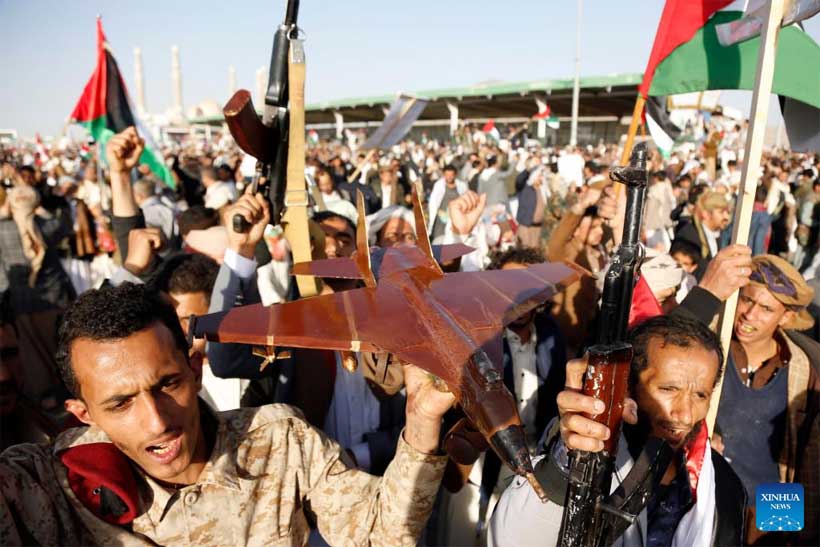
Abdul Malik al-Houthi, who has led the movement for two decades without making public appearances, communicates solely through televised speeches broadcast throughout Yemen. His image dominates billboards across Houthi-controlled areas, while slogans such as “Death to America, Death to Israel” are regular features at mass rallies in the capital, Sanaa.
Former teachers and civil servants interviewed by Reuters claim they faced suspension or punishment for refusing to attend mandatory indoctrination sessions. “The Houthis would visit my home, demanding donations to fund their weekly pro-Gaza rallies,” one teacher recounted.
When confronted with these allegations, Houthi officials deny claims of torture, forced attendance, or ideological coercion, dismissing them as part of what they call an “American-Zionist demonization campaign.”
The humanitarian crisis in Yemen, widely considered one of the world’s worst, has prompted the United Nations to raise approximately $28 billion since 2015. About one-third of these funds were allocated to food programs in Houthi-controlled areas. However, aid workers describe systematic diversion of these resources.
Multiple sources reported the creation of “ghost beneficiaries” – fake names added to food distribution lists – and local officials redirecting supplies to Houthi fighters and loyalists instead of vulnerable civilians. These persistent issues led the WFP to freeze operations in northern Yemen in 2023, later resuming only limited emergency distributions.
“All WFP operations have come to a halt in the northern governorates,” a spokesperson confirmed, highlighting the severity of the situation.
Perhaps most alarming are accounts of child recruitment. Displaced families told Reuters their children were pressured to join Houthi military units in exchange for food or protection. Eighteen-year-old Abdel-Moghni al-Sinani said he was recruited at just ten years old, then imprisoned and trained for combat.
“They told us the road to heaven passed through the master’s blessing,” he recalled.
Human Rights Watch has reported a surge in child soldier recruitment coinciding with the Gaza conflict, though Houthi officials deny these claims, calling them “fabrications.”
The humanitarian impact has been devastating. According to the Integrated Food Phase Classification (IPC) hunger monitor, more than 17 million Yemenis now face acute food insecurity. In displacement camps across government-held areas like Aden, Lahj, and Marib, families survive on a single meal daily.
“If we have breakfast, we don’t have lunch,” explained Ismail, a father of five who now collects plastic bottles to generate minimal income.
The Houthis’ growing regional influence, control over humanitarian aid, and documented human rights violations present significant challenges to international efforts aimed at stabilizing Yemen. As the Gaza war reshapes alliances across the Middle East, the Houthis have leveraged global attention to strengthen their position and legitimize their rule, even as ordinary Yemenis endure worsening hunger and repression.
The situation highlights the complex intersection of regional politics, humanitarian crisis, and the struggle for power in one of the world’s most fragile states, with civilians continuing to bear the heaviest burden of a conflict that shows few signs of resolution.
Fact Checker
Verify the accuracy of this article using The Disinformation Commission analysis and real-time sources.

31 Comments
If AISC keeps dropping, this becomes investable for me.
Interesting update on Inside Houthi Rule: Prisons, Propaganda and Control Through Hunger. Curious how the grades will trend next quarter.
Good point. Watching costs and grades closely.
Good point. Watching costs and grades closely.
Nice to see insider buying—usually a good signal in this space.
Good point. Watching costs and grades closely.
Good point. Watching costs and grades closely.
Silver leverage is strong here; beta cuts both ways though.
Good point. Watching costs and grades closely.
Production mix shifting toward Propaganda might help margins if metals stay firm.
Good point. Watching costs and grades closely.
Good point. Watching costs and grades closely.
Silver leverage is strong here; beta cuts both ways though.
Good point. Watching costs and grades closely.
I like the balance sheet here—less leverage than peers.
Good point. Watching costs and grades closely.
I like the balance sheet here—less leverage than peers.
Silver leverage is strong here; beta cuts both ways though.
Good point. Watching costs and grades closely.
Interesting update on Inside Houthi Rule: Prisons, Propaganda and Control Through Hunger. Curious how the grades will trend next quarter.
Good point. Watching costs and grades closely.
Interesting update on Inside Houthi Rule: Prisons, Propaganda and Control Through Hunger. Curious how the grades will trend next quarter.
I like the balance sheet here—less leverage than peers.
Good point. Watching costs and grades closely.
Good point. Watching costs and grades closely.
Uranium names keep pushing higher—supply still tight into 2026.
Good point. Watching costs and grades closely.
Good point. Watching costs and grades closely.
Production mix shifting toward Propaganda might help margins if metals stay firm.
Good point. Watching costs and grades closely.
I like the balance sheet here—less leverage than peers.