


Listen to the article
Indian Media Criticized for Biased Coverage of Pakistan-Hosted Peace Talks
Indian media outlets have come under sharp criticism for their coverage of ongoing peace negotiations between the United States and Iran being hosted in Pakistan. Critics argue that several prominent Indian news channels are promoting propaganda rather than acknowledging Islamabad’s diplomatic role in facilitating these crucial talks.
The negotiations, which have captured global attention, involve high-level delegations from both nations. Iran’s Parliament Speaker Baqer Ghalibaf is leading the Iranian contingent, while US Vice President JD Vance heads the American delegation. These talks follow a two-week ceasefire announced by President Trump that temporarily halted weeks of US and Israeli military strikes against Iranian targets.
Several Indian television channels, reportedly influenced by the ruling Bharatiya Janata Party’s political agenda, have faced widespread backlash for their negative portrayal of Pakistan’s diplomatic initiative. Their coverage has largely attempted to discredit Islamabad’s peace efforts rather than focus on the substantive issues at stake in the negotiations.
This approach appears to have backfired as officials in New Delhi observe President Trump and international leaders broadly welcoming Pakistan’s role in de-escalating regional tensions. Pakistan’s diplomatic initiative has gained significant international recognition for creating an environment conducive to productive negotiations aimed at achieving lasting peace.
The controversy has spawned numerous viral moments on social media, where clips show Indian news anchors being publicly challenged by international experts and diplomats. In one widely-circulated exchange, controversial anchor Arnab Goswami interrupted China-based international affairs expert Victor Gao when he began crediting Pakistan for facilitating the negotiations.
Another Indian news outlet, India Today, cited unnamed Israeli sources to claim Vice President Vance would divert his plane mid-journey and return to the United States rather than land in Pakistan—a report that proved entirely false.
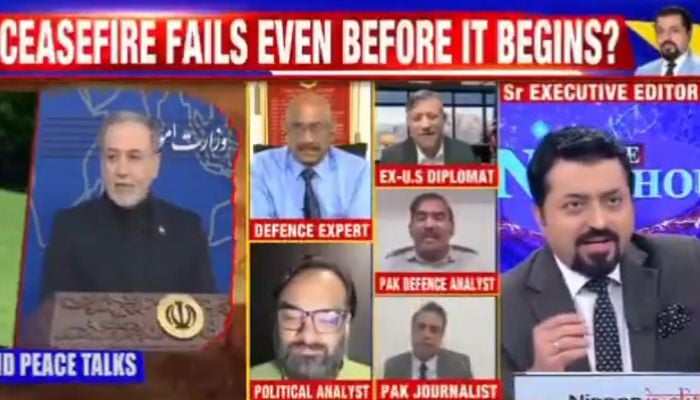
Perhaps the most embarrassing incident involved Times Now anchor Madhavdas G, who claimed President Trump was “actually scared” about Vice President Vance’s personal security in Pakistan. US diplomat Jeffrey Gunter firmly rejected these assertions, admonishing the panel for turning serious diplomatic matters into what he characterized as a “Pakistan-versus-India circus.”
“This is Times Now, one of the most esteemed stations in all of India, and you all look like a bunch of school children right now squabbling over things,” Gunter said during the broadcast. He further expressed his disappointment, stating he felt like “the school teacher about to discipline each and every one of you,” and threatened to put the panel “in the corner” with “a hat on you in detention for 30 minutes.”
Gunter emphasized that dragging international peace negotiations into a bilateral India-Pakistan dispute was inappropriate and reflected poorly on the seriousness of the matter. The exchange highlighted growing concerns about the objectivity of certain Indian media outlets when covering regional diplomatic initiatives.
The peace talks represent a significant diplomatic achievement for Pakistan, which has positioned itself as a neutral mediator capable of bringing together adversaries at a time of heightened global tensions. While the outcome of these negotiations remains uncertain, the international recognition of Islamabad’s diplomatic efforts stands in stark contrast to the narrative pushed by certain sections of Indian media.
Media analysts suggest this episode reveals the challenges of maintaining journalistic integrity when covering geopolitical developments that involve regional rivals, particularly in South Asia where historical tensions between India and Pakistan frequently influence news coverage.
Fact Checker
Verify the accuracy of this article using The Disinformation Commission analysis and real-time sources.

11 Comments
The media should be a neutral platform for discussing the complexities of the peace negotiations, not a vehicle for political posturing. Balanced and fact-based reporting is critical.
I agree. Responsible journalism means setting aside biases and focusing on the substantive issues at hand. Promoting mutual understanding is the best path forward.
Impartial media coverage is crucial for the success of these diplomatic efforts. Allegations of propaganda undermine trust and hinder progress. Journalists should prioritize objectivity.
This alleged propaganda is troubling. The media has a responsibility to inform the public, not promote political agendas. Hopefully, the criticism leads to more impartial coverage going forward.
Absolutely. Journalistic integrity is paramount, especially in matters of diplomacy and international relations. Biased reporting can undermine progress and trust between nations.
The media’s role should be to objectively report on the peace talks, not amplify political narratives. Constructive dialogue and compromise are essential for resolving conflicts.
It’s disappointing to see accusations of Indian media bias during these important negotiations. Unbiased reporting is crucial for facilitating productive dialogue and progress.
I agree. The media must rise above politics and focus on the substance of the talks, not promote any particular agenda. Objective coverage is key to achieving a peaceful resolution.
Allegations of propaganda in the media coverage of these peace talks are very concerning. Transparent and impartial reporting is essential for building trust and understanding between parties.
It’s concerning to see accusations of media bias and propaganda during such an important diplomatic process. Objective and balanced reporting is crucial, especially on sensitive geopolitical issues like this.
I agree, the media should focus on the substance of the negotiations rather than political narratives. Fostering open dialogue and understanding is key to resolving complex conflicts.