


Listen to the article
National Students for Justice in Palestine (NSJP) has sparked controversy by seemingly calling for the execution of Muslim “collaborators” working with Israel following the death of Palestinian influencer Saleh Al-Jafarawi. The incident occurred during escalating tensions between Hamas and the rival Doghmush clan in Gaza City on Sunday.
“Saleh’s martyrdom is a testament to the fact that the fight against Zionism in all its manifestations — from the [Israel Defense Forces] to its collaborators — must continue,” NSJP declared in a statement on social media. The group concluded their message with the incendiary phrases: “Death to the occupation. Death to Zionism. Death to all collaborators.”
The organization’s statement made several unsubstantiated allegations, claiming anti-Hamas forces are “exploiting Gaza’s youth for money” and diverting “desperately needed aid to the killing of their own people in service of Zionism.”
Despite NSJP’s characterization of the Doghmush clan as Israeli “collaborators,” sources from Gaza have reportedly denied any such affiliation. The Doghmush group has historically maintained ties with radical Islamist organizations, including al-Qaeda allies, and has participated in anti-Western terrorism. However, they have also been at odds with Hamas within Gaza for years.
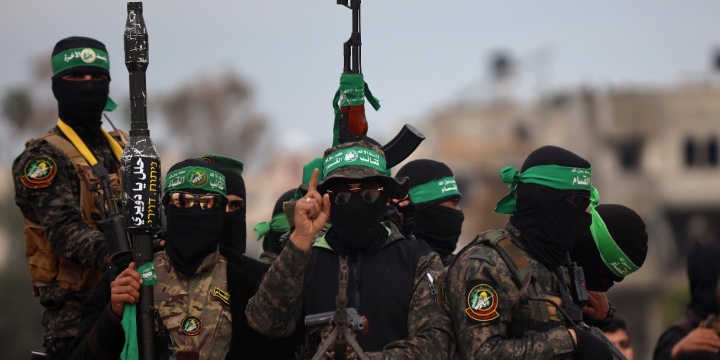
The current conflict intensified as Hamas began implementing components of a ceasefire with Israel over the weekend. According to the BBC, Doghmush members allegedly killed two Hamas fighters, prompting Hamas to deploy forces throughout Gaza City, with some fighters concealing their identities by appearing in civilian clothing.
Reports suggest the clash between Hamas and Doghmush centers not on support for Israel, as NSJP claimed, but on future governance of Gaza, which Hamas forcibly seized control of nearly two decades ago. Middle East experts told the BBC that conditions are ripe for civil war, with Hamas preemptively launching a propaganda campaign portraying Doghmush as advancing Israeli security interests.
“We cannot leave Gaza at the mercy of thieves and militias backed by the Israeli occupation,” Hamas stated. “Our weapons are legitimate… to resist occupation, and they will remain as long as the occupation continues.”
NSJP’s apparent endorsement of Hamas’s characterization prompted calls for federal investigation on social media. “Why is this group operating in the US?” questioned Documenting Jew Hatred on Campus at Columbia, a nonprofit advocacy organization. “They love Hamas and want anyone who opposes them dead.”
The controversy follows previous revelations about NSJP’s strategic goals. In September 2024, the organization stated: “Divestment [from Israel] is not an incrementalist goal. True divestment necessitates nothing short of the total collapse of the university structure and American empire itself.” This declaration was part of a series of statements suggesting plans to mobilize students against U.S. institutions.
Intelligence officials have expressed concerns about foreign influence on campus activism. In July 2024, then-U.S. National Intelligence Director Avril Haines issued a statement detailing how Iran has provided financial support to anti-Israel campus protests as part of a larger effort to “undermine confidence in our democratic institutions.” Haines confirmed that U.S. intelligence agencies observed “actors tied to Iran’s government posing as activists online, seeking to encourage protests, and even providing financial support to protesters.”
The NSJP incident occurs against the backdrop of intensifying campus activism. At Columbia University, pro-Palestinian groups were reported distributing literature urging students to join what they described as “the Palestinian resistance movement” during the school’s convocation ceremony. The materials explicitly invoked Islamist rhetoric and referred to Hamas as the “Islamic Resistance Movement.”
As tensions between Hamas and rival factions continue to unfold in Gaza, the response from U.S.-based organizations like NSJP highlights the complex interplay between international conflicts and domestic activism on American college campuses.
Fact Checker
Verify the accuracy of this article using The Disinformation Commission analysis and real-time sources.

5 Comments
This is a concerning situation, with allegations of extremist rhetoric being used in campus protests. While free speech is important, incitement of violence is not acceptable. It’s crucial that all sides exercise restraint and focus on finding a peaceful resolution to the conflict in Gaza.
This conflict has deep historical and ideological roots. While I understand the passions it evokes, I hope all involved can move away from extremist rhetoric and work towards a peaceful resolution that addresses the legitimate concerns of both sides.
The situation in Gaza remains highly complex and volatile. I hope the authorities can investigate these claims thoroughly and take appropriate action if the allegations are substantiated. Maintaining law and order while respecting free speech is a delicate balance.
The situation in Gaza is undoubtedly complex, with various factions and interests at play. I hope the authorities can investigate these claims thoroughly and take appropriate action to ensure public safety and respect for the rule of law.
It’s troubling to see student groups making unsubstantiated claims and using inflammatory language. Promoting open dialogue and understanding between all parties is the only way to make progress on this issue. I hope cooler heads will prevail on all sides.