


Listen to the article
China Unveils Ambitious Space Aircraft Carrier Concept
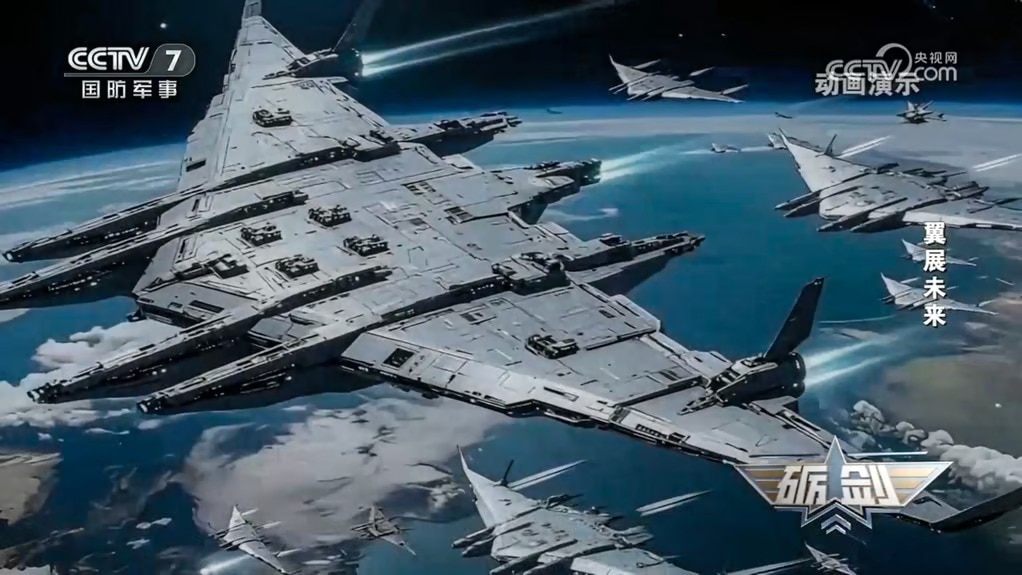
China has unveiled plans for a massive space-based aircraft carrier called the Luanniao, designed to hover at the edge of Earth’s atmosphere. The futuristic triangular warship, recently showcased in a concept video on Chinese state media CCTV, resembles something from science fiction and would be capable of deploying unmanned fighter jets and launching missiles at targets below.
According to Chinese officials, the Luanniao forms part of the country’s broader Nantianmen Project, which translates to “South Heavenly Gate.” This ambitious defense initiative aims to create an integrated system spanning air and space domains, potentially giving China a significant edge in future conflicts.
The project first gained attention in 2017 when the Aviation Industry Corporation of China introduced early concepts. Since then, models of the carrier and its accompanying aircraft have appeared at several exhibitions, including the 2018 Zhuhai Air Show. The latest surge of interest follows the release of a detailed concept video broadcast on China Central Television in late January.
If realized, the Luanniao would dwarf any existing naval vessel. With proposed dimensions of 242 meters in length and 684 meters in width, the triangular craft would be approximately twice as long and three times wider than the USS Gerald R. Ford, currently the world’s largest aircraft carrier. Its wingspan would extend over 2,000 feet, with an estimated weight of up to 120,000 tonnes.
The carrier would reportedly be designed to accommodate 88 unmanned stealth fighter jets, referred to as Xuan Nu or “Mysterious Woman.” These aircraft would be capable of deploying hypersonic missiles against targets anywhere on Earth, operating from the carrier’s position at the edge of space.
Chinese state media suggests the Luanniao could become operational within 20 to 30 years, possibly by 2045 or 2055. However, the timeline appears optimistic considering the revolutionary technological advances required to make such a vessel functional.
Military experts have pointed out significant technical hurdles that would need to be overcome. Launching and maintaining a vehicle of this size and weight at the edge of space would require breakthroughs in propulsion systems, energy generation, and materials science that currently don’t exist.
The closest historical parallel to the Luanniao concept is the Soviet-era KM Ekranoplan, nicknamed the “Caspian Sea Monster.” This massive ground-effect vehicle was designed to skim just above water surfaces at high speeds while carrying heavy military payloads. However, even the Ekranoplan operated only meters above sea level and never left the atmosphere before being abandoned after the Cold War due to prohibitive costs and safety concerns.
The Nantianmen Project reportedly encompasses other advanced technologies beyond the Luanniao. These include the Baidi fighter jet featuring adaptive wings for enhanced performance, directed energy weapons utilizing lasers or microwaves, and experimental particle beam weapons. The entire system would reportedly rely on artificial intelligence for decision-making processes.
Song Zhongping, a prominent Chinese military commentator, has stated that these concepts align well with future air and space combat scenarios. However, international observers remain skeptical about the feasibility of such technology, with many dismissing it as science fiction rather than a practical near-term military development.
Some Western defense analysts view the announcement as primarily aimed at domestic audiences, serving to boost national pride and project strength to international rivals, particularly the United States. This comes amid ongoing tensions regarding Taiwan and territorial disputes in the South China Sea.
“This appears to be more about signaling China’s technological ambitions than presenting an imminent military capability,” said one defense expert who requested anonymity. “The physics and engineering challenges are enormous, and the timeline seems extremely optimistic given current technological limitations.”
For now, the Luanniao remains confined to conceptual videos, scale models, and computer-generated imagery. Whether China can overcome the formidable technological barriers to transform this sci-fi vision into reality will be closely watched by military planners and aerospace experts worldwide over the coming decades.
Fact Checker
Verify the accuracy of this article using The Disinformation Commission analysis and real-time sources.

9 Comments
Fascinating concept, though it’s hard to say how feasible this space aircraft carrier really is. China’s aerospace ambitions seem increasingly grandiose – I wonder if this is more propaganda than practical reality at this stage.
This sounds like the stuff of science fiction! I’m curious to see if China can actually pull off something this technologically advanced. It would be a game-changer if they succeed, but there are a lot of technical hurdles to overcome.
China is certainly aiming high with this Luanniao concept. But I can’t help but be skeptical – it feels more like propaganda than a realistic near-term capability. I’ll believe it when I see a functioning space carrier in orbit.
A space-based aircraft carrier is an eye-catching idea, but I have to wonder about the practicality and cost-effectiveness. Wouldn’t it be simpler and more efficient to focus on advances in traditional aerospace and naval platforms? This seems like an overly ambitious distraction.
That’s a fair point. China may be biting off more than it can chew with this Luanniao concept. Grounded, incremental progress in core military capabilities could be a wiser investment of resources.
The Luanniao space carrier is an audacious idea, but I have my doubts about its near-term viability. China tends to over-promise on these kinds of futuristic military projects. Still, it’s an interesting development to keep an eye on.
Wow, a space-based aircraft carrier? That’s a bold ambition. I wonder how China plans to overcome the challenges of operating such a massive platform in the harsh environment of space. Seems like it would require major breakthroughs in propulsion, power, and materials science.
Agreed, the technical hurdles are immense. I’ll be curious to see if they can demonstrate any meaningful progress on a prototype in the coming years.
While the Luanniao space carrier is an impressive technical concept, I can’t help but feel it’s more about political posturing than practical defense needs. China seems to be in a space race with the US, but this kind of grandiose project feels like overkill.