


Listen to the article
In the waning days of the Fall 2025 semester, as students across Canadian universities focus on final exams, campus journalism continues to grapple with its coverage of the Israeli-Palestinian conflict. A review of recent student newspaper articles reveals what some observers describe as a consistently one-sided narrative that often lacks balanced perspective.
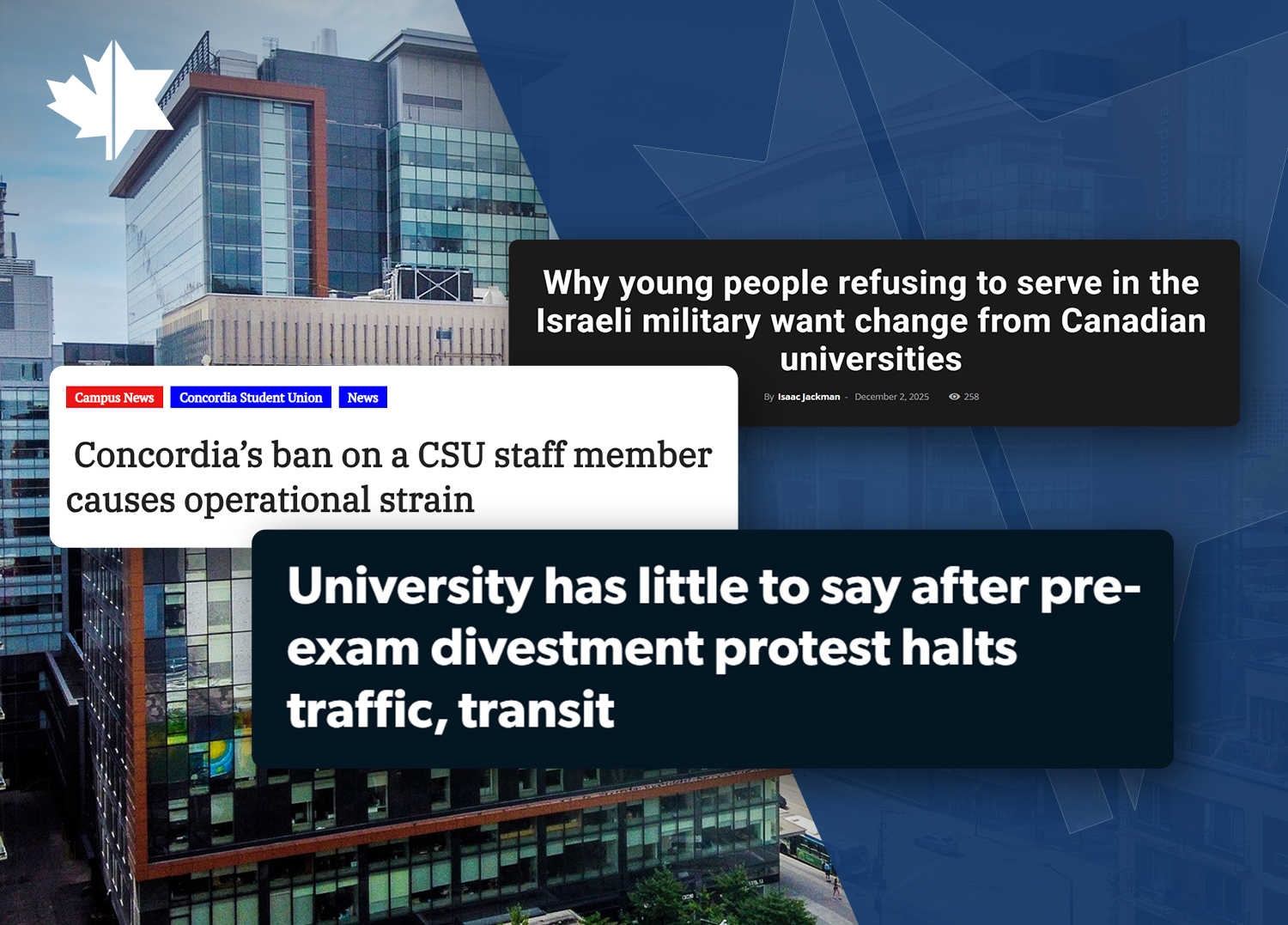
At Carleton University, The Charlatan published a piece by Isaac Jackman on December 2 highlighting Israeli citizens who have refused military service. The article positioned these individuals as representing a moral stance against what was characterized as Israel’s “genocide” in Gaza, despite acknowledging they constitute a small minority within Israeli society. Critics note the article juxtaposed these refusers with calls for Boycott, Divestment and Sanctions (BDS) implementation at Carleton, potentially framing them as the only “acceptable” Israelis while implicitly condemning the broader Israeli population.
Concordia University’s student paper, The Concordian, covered the case of Julianna Smith, the Concordia Student Union’s Campaigns Coordinator, who was banned from campus for her role in organizing an October anti-Israel demonstration. Reporter Jia Marguerite Schofer’s piece extensively quoted Smith and those concerned about the impact on student union operations but notably omitted perspectives from students who may have been harassed during the protests that Smith helped coordinate.
At the University of British Columbia, The Ubyssey reported on a pre-exam divestment protest that disrupted campus traffic. Reporters Spencer Izen and Aisha Chaudhry described participants as part of a “Palestine solidarity movement” condemning “Israeli human rights abuses and genocide.” While the article included quotes from university officials and bystanders, it lacked voices from students who might have felt targeted by chants such as “all the Zionists are racist.”
This pattern extends to French-language campus media. Montréal Campus published an article by Aurelie Lachapelle examining BDS efforts at the Free University of Brussels, suggesting similar actions should be taken at Université du Québec à Montréal. The piece quoted an Israeli-Jewish researcher who deemed Israeli universities “complicit” in “colonization” and a Palestinian student calling for “the total decolonization of Palestine…from the river to the sea.”
Simon Fraser University’s The Peak covered an October strike organized by SFU350 and Independent Jewish Voices SFU. Reporter Lucaiah Smith-Miodownik presented claims such as “climate justice is Palestinian liberation” without critical analysis or alternative viewpoints.
At the University of Alberta, The Gateway’s Leah Hennig reported on Gaza students facing Canadian visa delays. While noting Hamas’s October 7, 2023 attack that “killed about 1,200 people and took 250 hostages,” the article characterized Israel’s response as a “military campaign” that many experts have called “a genocide.” Critics point out that this framing minimizes Hamas’s ongoing role in the conflict while emphasizing Israeli military actions.
Media analysts suggest this pattern of reporting reflects a broader trend in campus journalism that often prioritizes activist framing over balanced coverage. Some observers express concern that such reporting may contribute to an environment where Jewish and Israeli students who hold different perspectives feel marginalized in campus discussions.
As Canadian universities prepare for winter break, questions remain about how student media can provide comprehensive coverage that includes diverse viewpoints on complex geopolitical issues. While press freedom remains essential on university campuses, the challenge of ensuring balanced reporting on contentious international conflicts continues to test the boundaries of student journalism.
Fact Checker
Verify the accuracy of this article using The Disinformation Commission analysis and real-time sources.

10 Comments
While I understand the desire to highlight alternative voices, framing them as the ‘only acceptable’ Israelis seems overly reductive. This conflict has deep historical roots and nuanced perspectives on both sides. Dismissing the broader Israeli population is concerning.
Agreed. Oversimplifying complex issues into binary narratives often leads to more polarization rather than constructive dialogue. Journalism should strive for greater complexity and empathy.
It’s troubling to see campus media adopt such a one-sided stance on the Israeli-Palestinian conflict. This is a highly contentious issue that deserves careful, impartial reporting – not the promotion of specific ideological agendas. I hope to see more balanced coverage in the future.
Absolutely. Objective, fact-based journalism is crucial, especially on divisive geopolitical topics. Campus papers should be a forum for diverse perspectives, not a platform for propagandizing.
This is certainly a concerning trend on campus. I’m curious to hear more about the perspectives and motivations behind this surge of anti-Israel content. What do you think is driving this, and how can we encourage more balanced and nuanced coverage of this complex issue?
I agree, the lack of balanced coverage is worrying. It’s important that student journalism upholds principles of objectivity and fairness, even on sensitive geopolitical topics.
This is a concerning trend that warrants further investigation. I’m curious to know more about the editorial processes and potential biases at play within these campus newspapers. Ensuring balanced coverage of such a contentious geopolitical issue should be a top priority.
Absolutely. Transparency around the editorial policies and decision-making processes of student media is crucial. Readers deserve to understand the frameworks guiding coverage of complex, politically-charged topics.
The characterization of Israel’s actions as ‘genocide’ seems highly inflammatory and not supported by the facts. While the situation is certainly complex and deserving of scrutiny, such charged rhetoric risks further entrenching existing divides. Nuance and restraint are needed here.
I agree, inflammatory language is counterproductive. Journalists should strive for careful, impartial analysis, not inflammatory rhetoric that exacerbates tensions. This is a delicate issue that requires a measured approach.