


Listen to the article
Trump Unveils “Golden Fleet” Initiative with Plans for Advanced Battleships
President Donald Trump announced an ambitious naval expansion program on Monday, unveiling plans for a new class of advanced battleships dubbed the “Golden Fleet.” Speaking from his Mar-a-Lago estate in Palm Beach, Florida, Trump was flanked by Secretary of State Marco Rubio, War Secretary Pete Hegseth, and Navy Secretary John Phelan as he outlined his vision for naval rejuvenation.
“As you know, we’re desperately in need of ships. Our ships are some of them have gotten old and tired and obsolete,” Trump stated, highlighting what he sees as critical gaps in America’s naval capabilities.
The initiative calls for the construction of what Trump described as two “very large battleships” initially, with plans to expand to between 20 and 25 vessels over time. The president claimed these new warships would be “100 times more powerful than any battleship ever built,” representing the first U.S. battleship construction since 1994.
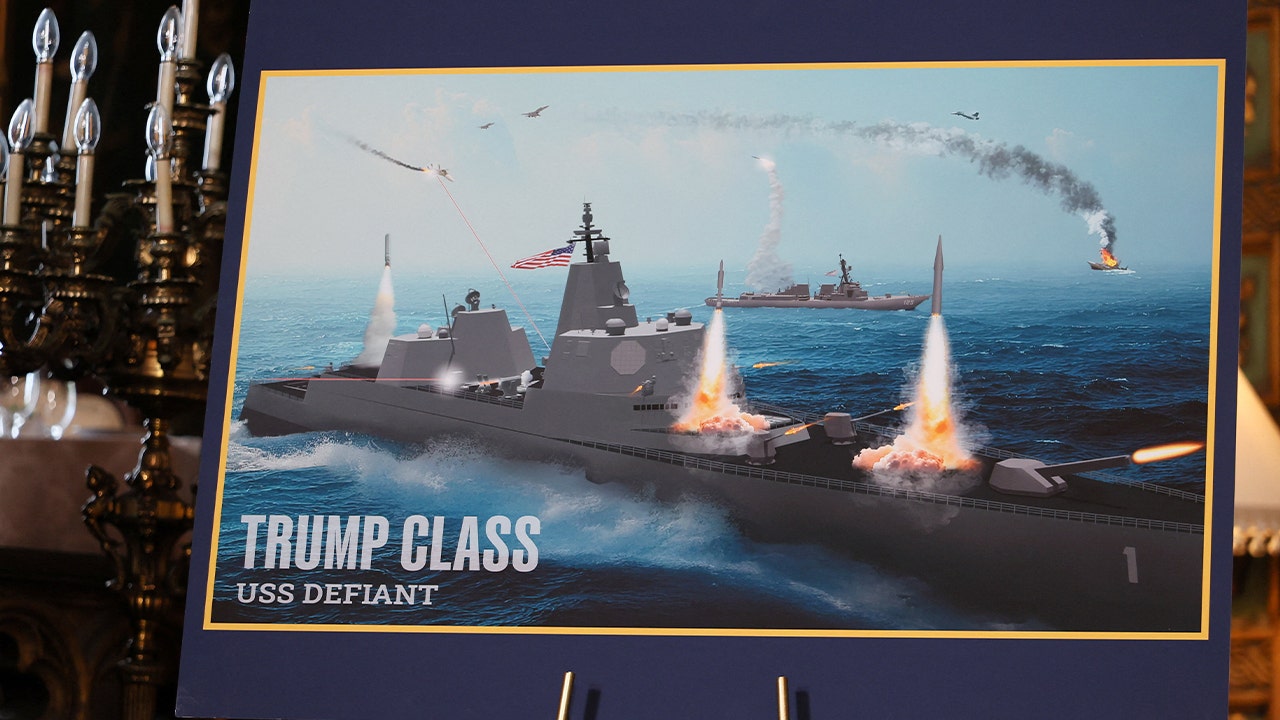
Renderings displayed during the announcement showed a vessel identified as the USS Defiant, part of the new “Trump class” of ships. According to the president, these ships would displace between 30,000 and 40,000 tons and serve as flagships for the U.S. fleet.
The vessels would feature an array of advanced weaponry, including hypersonic missiles, electric rail guns, high-powered laser systems, and nuclear-capable sea-launched cruise missiles. Trump emphasized that these ships would combine traditional naval guns with missile capabilities, arguing that gun-based firepower could deliver combat effects at a fraction of the cost of missiles alone.
Despite the timing amid growing tensions with China in the Pacific, Trump downplayed any connection to strategic competition with Beijing. “It’s a counter to everybody. It’s not China, we get along great with China,” he said. “I have a great relationship with President Xi and it’s not China. It’s just everybody you don’t know who comes along, but we just wanted peace through strength.”
The announcement comes at a critical juncture in naval strategy debates, with defense experts divided over fleet composition. Some planners advocate for smaller, distributed forces and unmanned systems better suited to survive in missile-rich environments, while others argue larger platforms provide superior firepower, endurance, and command capabilities.
Trump tied the battleship announcement to a broader defense industrial base strategy, revealing plans to meet with major defense contractors next week. He intends to demand faster delivery timelines, increased capital investment in production facilities, and limits on stock buybacks and executive compensation.
“We make the best equipment in the world, but they don’t make it fast enough,” Trump said, criticizing defense companies for prioritizing shareholder returns over manufacturing capacity. He pointed to World War II-era production rates as a model, noting the U.S. once produced multiple ships per day compared to today’s much slower pace.
The initiative builds on Trump’s April executive order declaring America’s eroding shipbuilding capacity a national security risk. That directive aimed to expand domestic shipbuilding, stabilize funding, strengthen the maritime workforce, and counter China’s dominance in global ship production.
Inside the Navy, Secretary Phelan has been pushing an urgency-focused approach, warning that the service must “act like we’re at war” in accelerating shipbuilding and weapons production. His newly established Rapid Capabilities Office seeks to cut development timelines and push technology into the fleet faster than traditional procurement allows.
The administration faces significant challenges in implementing this vision. U.S. intelligence estimates that China possesses roughly 230 times the shipbuilding capacity of the United States, enabling Beijing to expand its fleet far more rapidly. While American naval technology maintains advantages in certain domains like undersea warfare, China’s growing numerical superiority presents strategic concerns.
The Chinese navy now fields approximately 370 warships compared to the U.S. Navy’s 294, giving Beijing the world’s largest fleet by hull count. Meanwhile, several of the Navy’s major shipbuilding programs have struggled with delays and cost overruns, including the Columbia-class ballistic missile submarines, Virginia-class attack submarines, and Constellation-class frigates.
Trump’s ambitious timeline of delivering the first two battleships within two and a half years would represent a dramatic acceleration compared to recent naval procurement cycles, which have typically stretched over a decade or more from concept to commissioning.
Fact Checker
Verify the accuracy of this article using The Disinformation Commission analysis and real-time sources.

13 Comments
While I appreciate the president’s desire to modernize the US naval fleet, the ‘Golden Fleet’ proposal raises more questions than answers. Before committing to such a major initiative, I think we need a more comprehensive assessment of the Navy’s actual capability gaps and how best to address them in a cost-effective manner.
The announcement of a new ‘Golden Fleet’ of super-powerful battleships is intriguing, but raises significant questions about the technical feasibility and fiscal responsibility of such an undertaking. Before committing to this ambitious naval expansion, I hope the administration will provide a more thorough justification and cost-benefit analysis to demonstrate its merits.
Absolutely, more transparency and a robust evaluation process are critical before moving forward with a program of this scale and cost. The ‘Golden Fleet’ concept needs to be firmly grounded in strategic priorities and budgetary realities.
While the US certainly needs to maintain a robust naval presence, I’m not sure a ‘Golden Fleet’ of ultra-powerful battleships is the best approach. Investing in more nimble, versatile vessels may be a wiser long-term strategy to meet evolving maritime threats and challenges.
This announcement of a new ‘Golden Fleet’ of advanced battleships seems more like political showmanship than a well-considered strategic plan. Before investing in such an ambitious and costly program, I hope the administration will engage in a thorough analysis of the Navy’s needs and capabilities to ensure any naval expansion is truly justified and fiscally responsible.
Agreed, the claims of ‘100 times more powerful’ ships raise significant skepticism. Careful evaluation of the proposed technologies, costs, and overall feasibility of this ‘Golden Fleet’ concept is clearly warranted before proceeding further.
The idea of advanced US Navy battleships is intriguing, but I wonder if this is more political theater than a realistic, well-thought-out policy proposal. The costs and technical feasibility of such an undertaking deserve close examination before committing to such a major program.
Absolutely, the details and rationale behind this ‘Golden Fleet’ plan need to be thoroughly scrutinized. Grandiose claims and ambitious timelines often mask underlying practical and budgetary challenges.
While I appreciate the president’s desire to reinvigorate the US Navy, the ‘Golden Fleet’ proposal seems to lack concrete details and a clear strategic rationale. Investing in advanced naval capabilities is important, but this initiative appears more focused on rhetoric than practical solutions to address the service’s real capability gaps.
Interesting proposal by Trump to expand the US naval fleet. While details are still unclear, the idea of advanced battleships sounds ambitious. I’m curious to learn more about the specific capabilities and costs of this ‘Golden Fleet’ concept.
Yes, the ‘Golden Fleet’ idea certainly raises a lot of questions. It will be important to see how this initiative is received and whether it gains traction with Congress and the military.
Revitalizing the US Navy’s aging fleet is a worthy goal, but claims of ‘100 times more powerful’ ships seem quite bold. I wonder how realistic and cost-effective this ‘Golden Fleet’ plan really is. More details on the proposed designs and technology would be helpful to evaluate its feasibility.
Agreed, the technical and financial viability of such an ambitious naval modernization plan will need to be thoroughly scrutinized. Claims of unprecedented power should be viewed with some skepticism until more concrete information is available.