


Listen to the article
Illinois Faces Unprecedented Wave of Open Congressional Seats in Primary Election
Political printing presses are working overtime, debate organizers are struggling to accommodate the multitude of candidates, and voters are being bombarded with campaign advertisements as Illinois heads into one of its most crowded primary elections in decades.
The reliably Democratic state is experiencing an extraordinary level of political turnover this year, with six House and Senate seats left open by retiring lawmakers. This has created a rare opportunity for a new generation of Democratic candidates to emerge, with nearly 60 hopefuls vying for these six positions. The situation has also left voters with the daunting task of sifting through numerous candidates before the March 17 primary.
“Having all these names and faces thrown at you and trying to remember which one is which, it’s disorientating,” said James Beatley, a 21-year-old voter who has been represented his entire life by retiring Congressman Danny Davis. Now Beatley must choose from among 13 Democrats seeking to replace the longtime representative.
The wave of retirements in Illinois represents a significant portion of the national congressional turnover. The state accounts for approximately one-quarter of all House Democratic retirements and 10 percent of all House retirements across the country, according to an Associated Press analysis. Political scientist Brian Gaines from the University of Illinois notes that this is Illinois’ largest number of open House seats in at least 70 years.
Currently, five of Illinois’ 17 congressional seats—approximately 29 percent—are open. According to Gaines, the percentage was similarly high only twice before, during the 1940s, when seven of the state’s then-26 seats were open.
Retiring incumbents view this transition as an opportunity for renewal within the party, despite the loss of experienced lawmakers. “Illinois is undergoing tremendous change, and you can kind of feel it,” said 84-year-old Danny Davis, who was first elected in 1996. “It opens up opportunities for a new generation of leadership.”
The dozens of candidates in the five open Chicago-area House races represent diverse backgrounds, including twenty-something political newcomers, attorneys, and two former members of Congress attempting comebacks. They have engaged in spirited debates over issues such as funding tied to Israel and criticism of aggressive immigration enforcement policies that have affected Chicago and other cities.
The most crowded field is in retiring Rep. Jan Schakowsky’s district, where she’s stepping down after 14 terms. Fifteen Democrats are competing there, including Evanston Mayor Daniel Biss, digital content creator Kat Abughazaleh, and several state lawmakers.
Maria Lordots, a 20-year-old education student at the University of Illinois Chicago who will vote in Schakowsky’s district, has found the process of researching candidates challenging. “You see a few clips, and that sort of influences you to or away from a candidate,” she said, explaining her support for Abughazaleh due to dissatisfaction with establishment Democrats.
Roberto Gomez-Valadez, a 21-year-old UIC business student, shares that frustration. He’s from a suburb south of Chicago in Rep. Robin Kelly’s district, where she is leaving her seat to run for retiring Sen. Dick Durbin’s position. Ten Democratic candidates are competing in Kelly’s district, including state legislators and former Rep. Jesse Jackson Jr., son of the late civil rights leader.
“It’s overwhelming,” said Gomez-Valadez, who plans to vote for state Sen. Robert Peters after a positive personal interaction. “When there’s so many candidates, overlapping opinions, it’s so much harder to stand out.”
Other notable races include the contest for Rep. Raja Krishnamoorthi’s seat, which has drawn eight Democrats including former Rep. Melissa Bean. Meanwhile, Rep. Jesus “Chuy” Garcia’s departure has left another open seat, though political maneuvering has resulted in an uncontested Democratic primary with his chief of staff as the candidate.
The unprecedented number of candidates has created logistical challenges for debate organizers. The League of Women Voters, which has sponsored candidate forums for about a century, reports that Illinois has more than double the usual number of debates this year. “It’s usually our schtick, and it’s a thing this time around,” said Roberta Borrino from the League of Women Voters of Illinois.
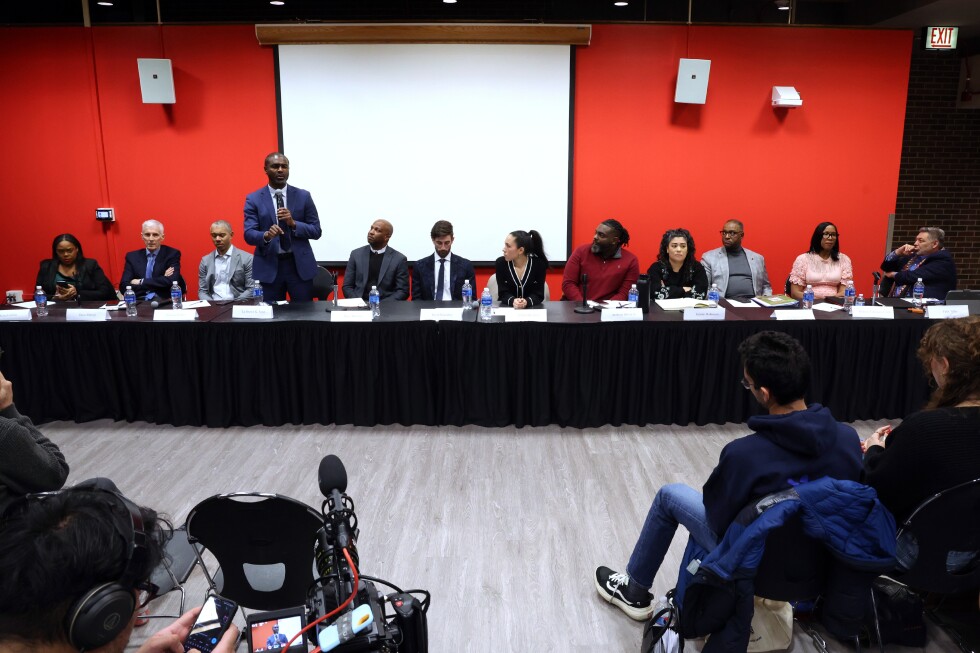
Space and time constraints have forced creative solutions. Some forums span multiple days, while others have candidates speak in shifts, with one group waiting in a separate room while others debate. At a recent UIC debate for Davis’ district, candidates shared microphones and were limited to 45-second answers during a two-hour session.
“You have to get really good at answering questions in barely no time,” said Anabel Mendoza, a 28-year-old immigrant rights organizer running for office. “You get really good at getting to the point.”
The unprecedented electoral activity has also created a windfall for political printing businesses. Richard Lewandowski, who operates a family-owned printing press in Chicago that has been in business for 50 years, has his employees working seven days a week for up to 12 hours daily to meet the demand for campaign mailers. “You only see a midterm like this once every 20 years,” Lewandowski observed.
Adding to the electoral intensity are contested races for the state legislature and constitutional offices. Billionaire Governor JB Pritzker, who is seeking a third term, has endorsed his Lieutenant Governor Juliana Stratton for the Senate seat.
With most Democratic primary winners expected to prevail in November’s general election in this heavily Democratic state, the stakes of the primary are particularly high. Election officials see encouraging signs of improved voter engagement after 2022 saw the lowest turnout in more than 50 years, when statewide primary participation was just 19 percent.
In Chicago, more than 43,000 early ballots have already been cast by mail and in person with two weeks remaining until the primary. This figure is double the approximately 20,000 ballots cast during the same period in the 2022 midterm primary and roughly quadruple the 10,000 from 2018.
“When districts are competitive it does bring additional people to the polls,” said Max Bever, spokesman for the Chicago Board of Elections, suggesting that this unusual election might reverse recent trends of declining voter participation.
Fact Checker
Verify the accuracy of this article using The Disinformation Commission analysis and real-time sources.

29 Comments
Exploration results look promising, but permitting will be the key risk.
Good point. Watching costs and grades closely.
Good point. Watching costs and grades closely.
Interesting update on Congress is on track for record retirements. In Illinois, that’s created a candidate frenzy. Curious how the grades will trend next quarter.
Good point. Watching costs and grades closely.
Good point. Watching costs and grades closely.
Uranium names keep pushing higher—supply still tight into 2026.
Good point. Watching costs and grades closely.
Good point. Watching costs and grades closely.
I like the balance sheet here—less leverage than peers.
Good point. Watching costs and grades closely.
Good point. Watching costs and grades closely.
I like the balance sheet here—less leverage than peers.
Good point. Watching costs and grades closely.
Good point. Watching costs and grades closely.
Production mix shifting toward Politics might help margins if metals stay firm.
Good point. Watching costs and grades closely.
Good point. Watching costs and grades closely.
Nice to see insider buying—usually a good signal in this space.
Good point. Watching costs and grades closely.
Good point. Watching costs and grades closely.
Interesting update on Congress is on track for record retirements. In Illinois, that’s created a candidate frenzy. Curious how the grades will trend next quarter.
Good point. Watching costs and grades closely.
Good point. Watching costs and grades closely.
Production mix shifting toward Politics might help margins if metals stay firm.
Good point. Watching costs and grades closely.
Good point. Watching costs and grades closely.
Exploration results look promising, but permitting will be the key risk.
Good point. Watching costs and grades closely.