


Listen to the article
Nigeria’s Technology Agency Endorses National Hub to Combat Digital Misinformation
The National Information Technology Development Agency (NITDA) has thrown its weight behind the establishment of a centralized National Crisis Communication Hub (NCCH) aimed at combating the proliferation of fake news, hate speech, and AI-driven misinformation in Nigeria.
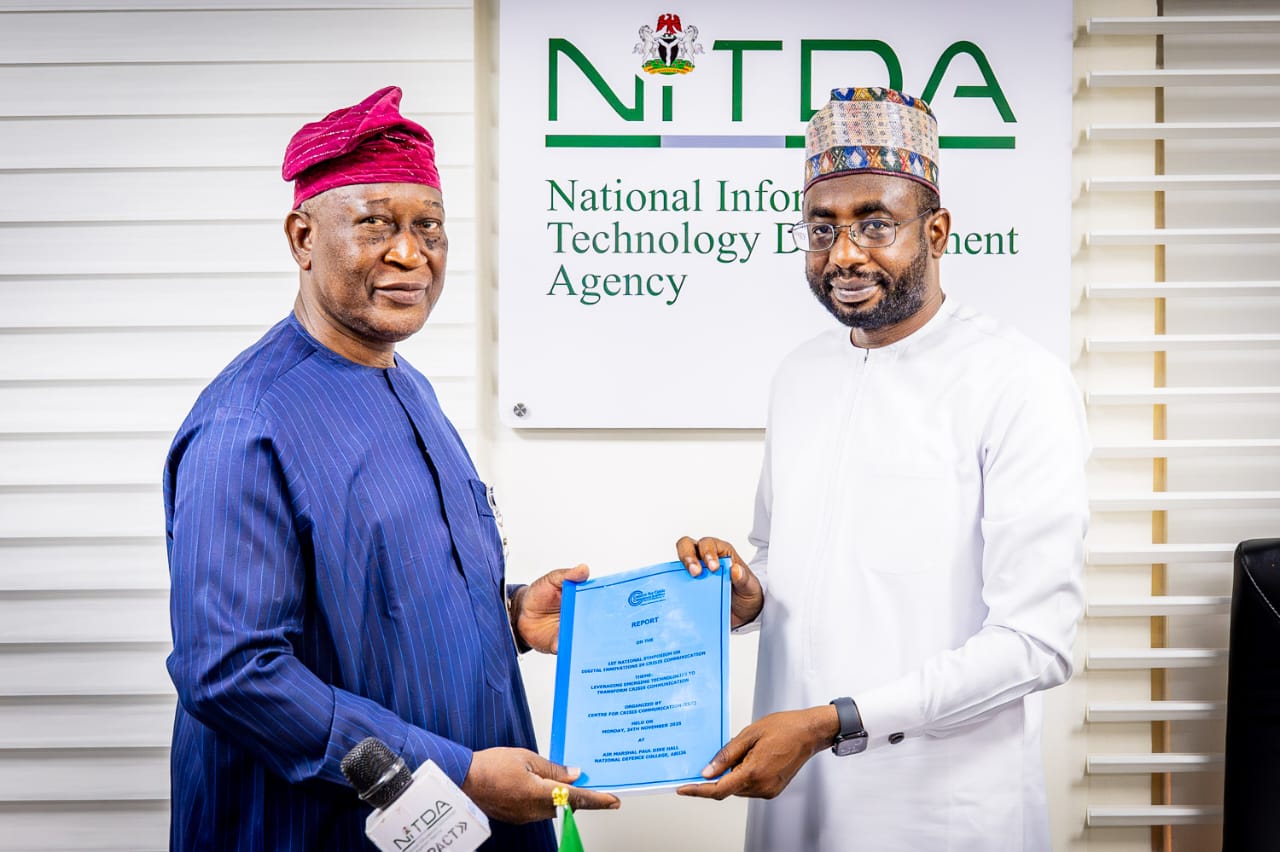
During a high-level meeting at NITDA headquarters, Director-General Kashifu Inuwa received a delegation from the Centre for Crisis Communication (CCC), led by its Chairman, Major-General Chris Olukolade (rtd.), following the successful conclusion of the maiden National Symposium on Digital Innovations in Crisis Communication.
Inuwa highlighted the alarming speed at which false information spreads compared to verified facts, attributing this phenomenon to what he termed the “novelty factor.” He explained that the disruption of traditional media by social platforms has created an environment where individuals and groups can easily disseminate harmful content with significant economic and social ramifications.
“There is a direct correlation between novelty and virality,” Inuwa stated. “Misinformation is often packaged as something new or shocking, which allows it to outpace accurate information. The way forward is to build public trust through credible government action and strong, strategic partnerships.”
The NITDA chief expressed particular concern about the upcoming 2027 political season, noting that rapid advancements in artificial intelligence technologies will likely intensify the creation and spread of deepfakes and automated propaganda. These emerging threats, he emphasized, make the establishment of a coordinated national response mechanism increasingly urgent.
In response to a 12-point resolution presented by the CCC, NITDA outlined several key initiatives to accelerate the implementation of the proposed hub. These include strengthening digital literacy through professional training programs that leverage platforms such as Cisco NetAcad to equip journalists, media professionals, and security spokespersons with critical skills in AI-content detection and ethical reporting.
The agency also proposed organizing regional symposiums across Nigeria’s six geopolitical zones to deepen grassroots participation and awareness. Additionally, NITDA plans to establish structured engagement with global technology companies to facilitate faster identification and removal of content that poses risks to national security.
Cybersecurity collaboration featured prominently in the discussions, with Inuwa revealing plans to work closely with relevant cyber units of critical institutions to establish a multi-layered defense system against digital threats.
During his presentation, Major-General Olukolade emphasized that the call for a National Crisis Communication Hub emerged as the central resolution from the recently concluded symposium held at the National Defence College. He stressed that Nigeria must adopt proactive, predictive, and digitally powered tools to effectively manage emerging security and information threats.
According to Olukolade, the proposed center would function as an independent, multi-stakeholder platform designed to monitor and counter harmful content during sensitive periods such as elections, while simultaneously safeguarding democratic principles and freedom of expression.
The retired general also advocated for the development of specialized mobile applications that would enable citizens to report crimes and emergencies in real time, effectively transforming social media and digital platforms into tools for public safety and early warning systems.
Both organizations emphasized the importance of inclusivity in their digital initiatives, agreeing that innovation must amplify the voices of persons with disabilities and other marginalized groups. This approach would ensure that emergency alerts and crisis information remain accessible to all segments of Nigerian society.
To translate these resolutions into concrete action, NITDA and the CCC have agreed to establish a joint working team tasked with documenting specific agreements and driving implementation throughout 2026. This collaborative effort positions the proposed hub as a cornerstone of Nigeria’s digital resilience strategy against misinformation and emerging information threats in an increasingly complex media landscape.
Fact Checker
Verify the accuracy of this article using The Disinformation Commission analysis and real-time sources.

14 Comments
Curious to see how the hub plans to combat AI-generated misinformation specifically. Will they use AI/ML tools to detect and counter synthetic media, or focus more on public education?
Good question. A multi-pronged approach leveraging both technological solutions and public awareness campaigns will likely be needed. Staying ahead of evolving AI-driven threats will be an ongoing challenge.
Kudos to NITDA for supporting this crisis communication hub. Tackling AI-driven misinformation is a complex challenge, but centralized coordination and information-sharing can make a real difference.
Well said. A unified, national-level approach is likely more effective than fragmented, localized efforts. I hope this hub can serve as a model for other countries grappling with similar issues.
This is an important initiative, but success will hinge on strong partnerships and coordination between government, industry, and civil society groups. Bringing diverse perspectives to the table will be key.
Absolutely. Effective crisis communication requires buy-in and participation from all stakeholders. Building trust and legitimacy across sectors will be critical for this hub’s long-term impact.
It’s concerning to hear that false information can spread so rapidly online compared to verified facts. Addressing the ‘novelty factor’ that drives virality will be key for this hub’s success.
Absolutely. Identifying the techniques used to make misinformation seem novel and cutting-edge will be crucial. A proactive, coordinated approach is needed to stay ahead of bad actors.
While the goals of this hub are laudable, I have some skepticism about its ability to meaningfully curb the spread of AI-generated misinformation. Regulating synthetic media is notoriously difficult.
That’s a fair point. The technological arms race between disinformation and detection is an ongoing challenge. Sustained, creative thinking will be needed to stay ahead of bad actors deploying ever-more sophisticated AI tools.
Combating AI-generated misinformation is an important issue, especially in the mining and energy sectors where accurate information is critical. The proposed crisis communication hub sounds like a promising initiative to tackle this challenge.
I agree, having a centralized hub to coordinate efforts against fake news and disinformation could be very effective. Transparency and credibility are essential in these industries.
The mining, metals, and energy sectors are ripe targets for misinformation campaigns. This crisis hub could provide an important safeguard for maintaining public trust and market stability in these critical industries.
Well said. Reliable information flow is vital, especially for capital-intensive, long-term investments in extractive and energy projects. This initiative seems timely and necessary.