


Listen to the article
Geopolitical Turmoil Dominates 2026’s Early Data Journalism Highlights
In a turbulent start to 2026, global newsrooms have been overwhelmed with major geopolitical events, providing rich material for data journalists worldwide. The shocking capture of Venezuelan President Nicolas Maduro by U.S. forces has dominated headlines, raising questions about international norms and the future of American foreign policy.
This period of upheaval has sparked numerous data-driven investigations, with news organizations deploying sophisticated analysis techniques to make sense of rapidly unfolding events. From oil markets to internet blackouts, wildfires to health misinformation, data teams are contextualizing complex global developments through innovative visualizations and analytical approaches.
In Iran, nationwide protests over economic hardship and political repression prompted authorities to implement one of the most comprehensive internet blackouts in recent history. The Financial Times documented this digital crackdown with charts visualizing connectivity collapse using NetBlocks data. Their analysis revealed how Tehran’s decades-long investment in a walled-off National Information Network has repeatedly failed to contain dissent, while activists maintain limited information flow using Starlink satellite connections.
Following the U.S. capture of President Maduro, President Donald Trump declared American oil companies would invest billions in rebuilding Venezuela’s energy sector. Spanish newspaper El País used data visualizations to explain the paradox of Venezuela’s oil industry – despite holding the world’s largest crude reserves, production has collapsed to less than one million barrels daily. Their analysis traced how Venezuela now primarily exports to China, often via “ghost tankers” that disable tracking systems to avoid sanctions.
Health misinformation has emerged as another data journalism focus. Portuguese outlet Público analyzed over 7,000 health-related claims across 1,860 TikTok videos, employing AI models to identify misleading content. Their investigation revealed how TikTok’s preference for natural remedies coupled with confirmation bias creates self-reinforcing cycles of false health information, with misleading content often outpacing accurate information on the platform.
Environmental issues remain prominent in data reporting. The Guardian mapped increasing global wildfire activity, showing that every day in 2024, fires consumed an area larger than Malta. Using University of Maryland data on forest loss, their analysis highlighted how climate change is driving larger, longer, and more destructive blazes across previously unaffected regions like the Amazon. These forests, typically carbon sinks, captured only a quarter of their usual annual intake in 2023-2024, with concerning implications for climate stability.
Urban environmental concerns also received attention. The Straits Times examined traffic noise in Singapore, where dense transport networks create persistent sound pollution. Their team measured noise levels inside 25 homes near major infrastructure, recording over 100 hours of audio to determine how many residents live with sound levels exceeding World Health Organization safety thresholds of 53 decibels.
Space industry safety became a focal point following a SpaceX Starship test explosion over the Caribbean. ProPublica’s investigation reconstructed how commercial flights were endangered by falling debris, forcing one Delta flight into an emergency diversion. Using flight tracking data, they mapped aircraft paths against the Federal Aviation Administration’s debris zone, showing how experimental launches push risk into civilian airspace.
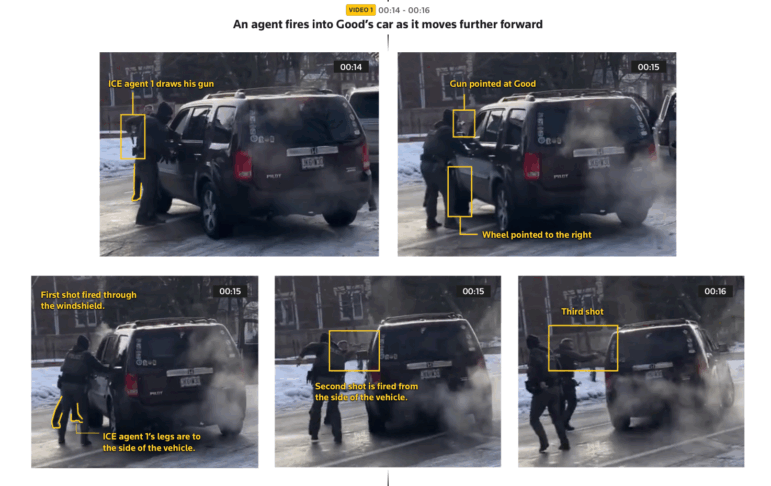
Other notable data journalism included Reuters’ analysis of body camera footage showing an ICE officer fatally shooting 37-year-old Renee Good in Minneapolis, an incident that sparked nationwide protests. Their frame-by-frame breakdown raised questions about use of force protocols and proportionality in law enforcement encounters.
The Washington Post examined AI capabilities by testing leading platforms against real freelance assignments, finding even the best AI systems completed just 2.5% of tasks correctly. Meanwhile, cultural analysis thrived with Kontinentalist’s examination of Bollywood’s shifting genres over three decades, tracing the decline of romance films in favor of action, thriller, and nationalist productions reflecting India’s changing political landscape.
These diverse investigations demonstrate how data journalism continues to evolve, employing increasingly sophisticated methods to analyze complex global events and provide context during periods of significant geopolitical upheaval.
Fact Checker
Verify the accuracy of this article using The Disinformation Commission analysis and real-time sources.

12 Comments
With the surge of health misinformation on platforms like TikTok, I’m glad to see scrutiny being applied. Robust data analysis can help identify the scale and nature of the problem, informing efforts to combat the spread of false claims.
Agreed. Quantifying the reach and impact of health misinformation is a vital first step. Fact-based, data-driven reporting on this issue can inform effective policy responses and platform moderation strategies.
Concerning to see Iran resorting to internet blackouts amid protests. Access to information is crucial during times of unrest. I hope the people of Iran can find ways to stay connected and voice their concerns despite the crackdown.
Agreed. Restricting internet access only heightens the tensions and obscures the situation from the outside world. A worrying sign of the government’s efforts to control the narrative.
The data journalism work documenting these events is invaluable. Detailed analysis of the internet blackout and its impacts provides crucial context. I’m curious to learn more about the long-term implications for Iran’s digital infrastructure and information access.
Excellent point. Understanding the technical details and scale of the blackout is key to assessing its broader sociopolitical ramifications. Data-driven reporting can really shine a light on these complex geopolitical dynamics.
The situation in Venezuela remains deeply concerning. I’m interested to see the data-driven reporting examining the state of the oil industry and the impact of the regime change. Rigorous analysis will be crucial for understanding the country’s economic and political future.
Absolutely. Venezuela’s oil sector is so pivotal to its economy, so closely examining production, exports, and related metrics is vital. Navigating the aftermath of this political upheaval will be enormously challenging.
The fatal ICE shooting is a tragic and troubling development. I hope the data journalism investigations can shed light on the circumstances and broader context around this incident. Transparency and accountability will be essential.
Yes, rigorous reporting is crucial in these sensitive cases. Data analysis can potentially uncover patterns or systemic issues that might otherwise be obscured. A thorough, impartial examination of the facts is needed.
Overall, it’s encouraging to see data journalism playing such a central role in covering these complex, fast-moving global events. Rigorous analysis and visualization can provide invaluable insights and context. I look forward to seeing more of this high-quality reporting.
Well said. Data-driven journalism is proving instrumental in making sense of these turbulent times. The ability to unpack the nuances and discover hidden patterns is a real asset for news consumers seeking a deeper understanding.