


Listen to the article
Google’s AI Summaries Show 9% Error Rate, Raising Misinformation Concerns
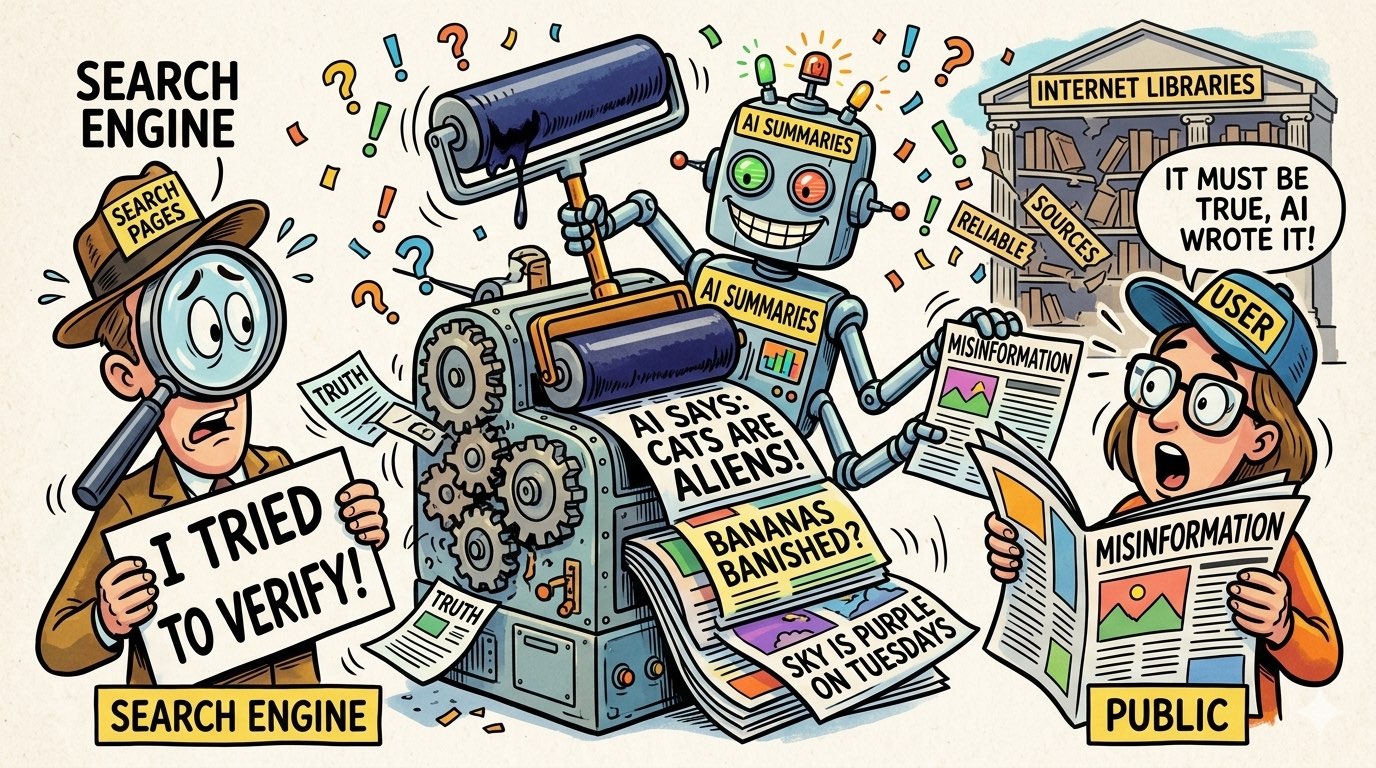
A new survey commissioned by The New York Times has revealed that Google’s AI-generated search summaries are inaccurate approximately 9% of the time. While a 91% accuracy rate might seem impressive at first glance, the implications become staggering when considering that Google processes 5 trillion search queries annually—potentially delivering incorrect information in tens of millions of cases every hour.
The research, conducted by AI startup Oumi, followed concerns expressed by The New York Times regarding the accuracy of Google’s AI-generated summaries. The study highlights a troubling scenario where Google may be inadvertently creating an unprecedented misinformation crisis through its AI Overviews feature.
This issue is particularly concerning when coupled with user behavior. According to a study cited by Inc.com last July, only about 8% of users actually verify AI-provided answers. Even more alarming, research from the University of Pennsylvania found that over 80% of users accept ChatGPT’s outputs at face value, even when incorrect—a phenomenon researchers dubbed “cognitive surrender.”
The Oumi study utilized an industry benchmark called SimpleQA to test the accuracy of Google’s AI summaries. Researchers conducted initial tests in October on AI Overviews powered by Google’s Gemini 2, followed by a second round three months later after Google upgraded to Gemini 3. Each test involved over 4,300 Google searches, with results showing Gemini 3 to be the more accurate model. While this demonstrates improvement, concerns persist about search engines providing answers prone to AI hallucinations.
Google has contested the study’s methodology, with spokesman Ned Adriance telling the Times that “It doesn’t reflect what people are actually searching on Google.” However, Google itself has previously acknowledged that its latest AI model occasionally produces incorrect information, despite claiming advantages from its two decades of search indexing experience.
One illustrative example involved searches for “Dhurandhar Bhatawdekar,” a character from the 1983 Bollywood film “Rang Birangi.” Initially, Google’s AI produced nonsensical results despite the film having a Wikipedia page. The system later corrected itself following media coverage and viral social media posts clarifying the reference, demonstrating both the system’s fallibility and its ability to improve over time.
For publishers, these accuracy issues represent a glimmer of hope amid significant disruption. The introduction of AI summaries has correlated with declining publisher revenues and traffic. People Inc. (formerly Dotdash Meredith) reported that Google Search traffic to their sites dropped from 54% to just 24% over two years. The company’s CEO, Neil Vogel, has been vocal about blocking AI crawlers that train models without compensating publishers, revealing that this stance has led to new licensing deals with Microsoft and OpenAI.
However, smaller publishers face a difficult dilemma. As one industry expert noted in a column for CXO Today, “Blocking AI bots feels empowering, but in India’s ad-dependent media economy, it may accelerate collapse.” For many publishers, especially those in markets like India, blocking AI crawlers presents an existential threat—blocking them risks invisibility, while allowing them risks obsolescence.
As AI summaries continue to evolve, the balance between technological advancement and accuracy remains precarious, with significant implications for both information integrity and the publishing industry’s economic future.
Fact Checker
Verify the accuracy of this article using The Disinformation Commission analysis and real-time sources.

20 Comments
Exploration results look promising, but permitting will be the key risk.
Good point. Watching costs and grades closely.
Nice to see insider buying—usually a good signal in this space.
Good point. Watching costs and grades closely.
Exploration results look promising, but permitting will be the key risk.
Good point. Watching costs and grades closely.
I like the balance sheet here—less leverage than peers.
Good point. Watching costs and grades closely.
If AISC keeps dropping, this becomes investable for me.
Good point. Watching costs and grades closely.
The cost guidance is better than expected. If they deliver, the stock could rerate.
Good point. Watching costs and grades closely.
Good point. Watching costs and grades closely.
Exploration results look promising, but permitting will be the key risk.
Good point. Watching costs and grades closely.
If AISC keeps dropping, this becomes investable for me.
Good point. Watching costs and grades closely.
Silver leverage is strong here; beta cuts both ways though.
If AISC keeps dropping, this becomes investable for me.
Good point. Watching costs and grades closely.