


Listen to the article
Misinformation Flood Follows Bondi Beach Terror Attack
In the wake of the tragic Bondi Beach attack that claimed 15 lives during a Hanukkah celebration, a tsunami of misinformation has swept across social media platforms, raising new alarms about the spread of artificial intelligence-generated content and fake news.
The Australian Associated Press’ FactCheck service has identified at least a dozen examples of false narratives and conspiracy theories circulating online since the December 14 attack carried out by father and son Sajid and Naveed Akram.
Among the most prominent falsehoods was a fabricated report claiming a fictional 43-year-old IT professional named Edward Crabtree was the man who wrestled a gun from one of the attackers. The real hero was later correctly identified as Ahmed Al Ahmed. The false story appeared on a website called “The Daily” under the byline of a nonexistent journalist named Rebecca Chen.
Investigation revealed the website domain was registered on the same day as the attack from an address in Iceland, clearly indicating a coordinated attempt to spread disinformation during a national tragedy.
Digital manipulation has been particularly prevalent, with AI-generated videos showing political leaders making statements they never actually made. One doctored clip portrayed Prime Minister Anthony Albanese announcing the cancellation of all Pakistani nationals’ visas following the attack. Another fabricated video showed NSW Premier Chris Minns providing unconfirmed details about one of the shooters being an Indian national.
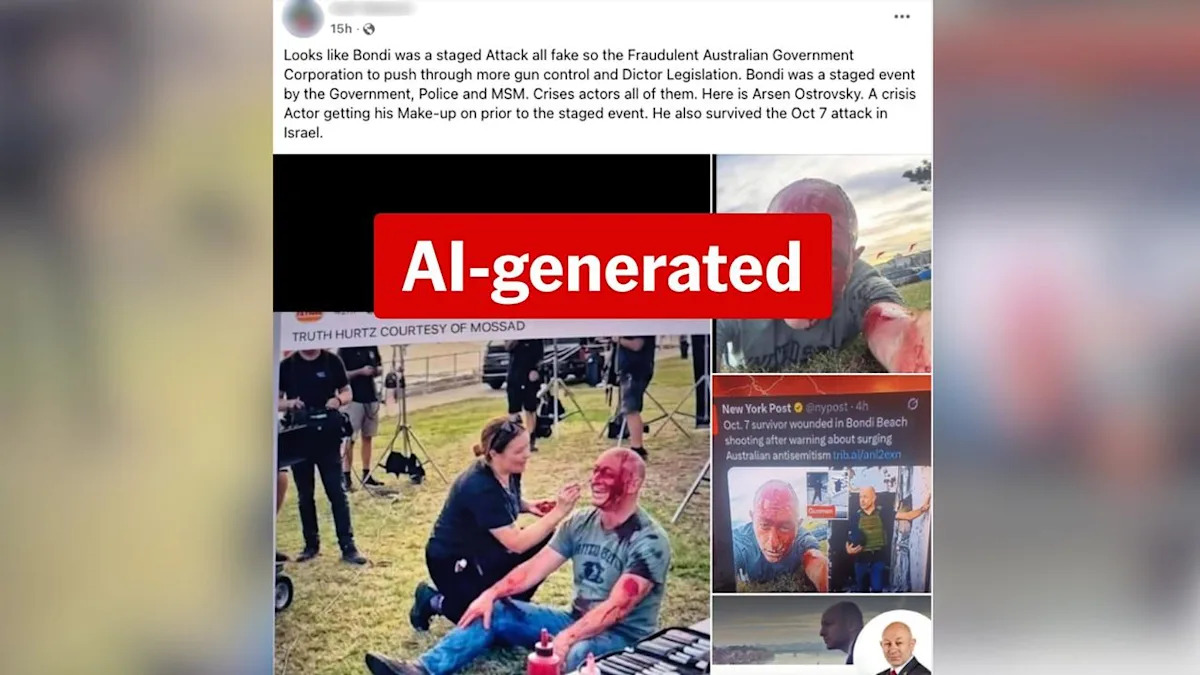
Perhaps most disturbing has been the targeted harassment of survivor Arsen Ostrovsky, who appeared in legitimate news interviews after the attack. AI-generated images circulated showing Ostrovsky supposedly having makeup applied by a film crew, falsely suggesting he was a “crisis actor” and that the entire massacre was staged. A second manipulated image targeting Ostrovsky claimed his injuries were fake.
Other AI-generated content included doctored photographs purportedly showing Naveed Akram meeting with Captain Chandra Kant Kothari, the Defence Attache of India to the Philippines – a meeting that never occurred.
“After a tragedy, people look for answers, and that creates the perfect space for AI-generated images and false stories to spread,” Swinburne AI expert Atie Kia told AAP. She noted that the combination of social media platforms and increasingly accessible AI tools has created an environment where deepfakes and false narratives can proliferate rapidly.
The sophistication of AI-generated content has reached concerning levels, making detection increasingly difficult for the average social media user. “People think it takes a professional to create fake videos but it just takes some clicks,” Dr. Kia explained. “It is easy to place a real person’s face into a violent image and even when proven fake, the reputational damage can last.”
Even a week after the deadly attack, misinformation continued to spread, including debates about the nationalities of the gunmen despite official confirmation from authorities. The Australian government has stated that one gunman was born in Australia, while Indian police confirmed the other originated from Hyderabad.
The Bondi Beach incident highlights a growing challenge facing societies worldwide: the weaponization of artificial intelligence to spread confusion and division following traumatic events. Experts suggest that improved digital literacy and stronger verification practices are essential to combat this trend.
For communities still mourning the loss of 15 lives, the spread of misinformation adds another layer of pain to an already devastating situation. As AI technology becomes more accessible and sophisticated, the ability to distinguish fact from fiction becomes increasingly crucial during times of crisis.
The proliferation of false narratives surrounding the Bondi Beach attack serves as a stark reminder of how quickly misinformation can influence public perception during national tragedies, potentially fueling division when unity is most needed.
Lifeline 13 11 14
beyondblue 1300 22 4636
Fact Checker
Verify the accuracy of this article using The Disinformation Commission analysis and real-time sources.

11 Comments
Fabricated stories and AI-generated content have no place in the aftermath of a tragedy. We owe it to the victims and their loved ones to seek out the truth and avoid amplifying falsehoods. Kudos to the FactCheck service for their efforts to set the record straight.
Kudos to the FactCheck service for working to debunk the false narratives. In times of crisis, it’s crucial that the public has access to reliable, verified information. Fact-checking efforts help counter the flood of misinformation and restore some clarity.
Absolutely. Reputable fact-checking organizations play a vital role in separating truth from fiction, especially when emotions are running high. Their work helps maintain public trust and prevent further harm.
It’s disturbing to see how AI-generated content and coordinated disinformation campaigns can exploit tragedies like this. We have to be extremely cautious about what we share online, especially in emotionally charged situations. Fact-checking should be the first step before engaging with any claims.
Couldn’t agree more. Spreading misinformation, even inadvertently, can have real and serious consequences. We all have a responsibility to be discerning consumers of information.
It’s disheartening to see how quickly false narratives can take hold online, even in the wake of a tragedy. We must remain vigilant and rely on authoritative, fact-based sources to understand what really happened. Spreading unverified claims only compounds the harm.
The use of AI to generate false content and spread disinformation is a concerning trend. We need robust media literacy efforts to help people identify and avoid falling for these kinds of manipulative tactics, especially around sensitive events.
Agreed. Building public awareness and critical thinking skills is key to countering the spread of misinformation. Fact-checking should be second nature, not an afterthought, when consuming news and social media content.
The proliferation of misinformation around events like this is a troubling trend. We must be discerning consumers of information and always verify claims, no matter how compelling they may seem. Relying on authoritative sources is the only way to cut through the noise.
Tragic that misinformation spreads so quickly in the wake of such a horrific attack. We need to be vigilant in verifying claims, especially when they seem too dramatic or unbelievable. Fact-checking services play a crucial role in cutting through the noise and identifying the truth.
Absolutely. Amplifying false narratives only compounds the damage. It’s vital that we rely on reputable, authoritative sources to get the facts straight.